Clear Sky Science · en
Co-utilizing global big science facilities: a novel type collaboration and the impacts on scientific disruption
Why sharing giant labs matters
Many of today’s biggest scientific questions, from new materials to medical advances, depend on huge, expensive laboratories that no single university can build alone. This study explores a new way scientists are teaming up by sharing several of these global “big science” facilities for the same project, and asks how this affects the kind of discoveries they make.

What big science facilities are
Big science facilities are giant research machines such as powerful X ray sources, neutron sources, or observatories. They are usually funded by governments or international organizations, but scientists from around the world can apply for time to run experiments there. Each facility has in house experts who keep the machines running and help visiting researchers make sense of the data. Because no single facility can do everything, and demand for access is high, many scientists now look beyond their nearest lab and combine what several facilities can offer.
A new way to collaborate
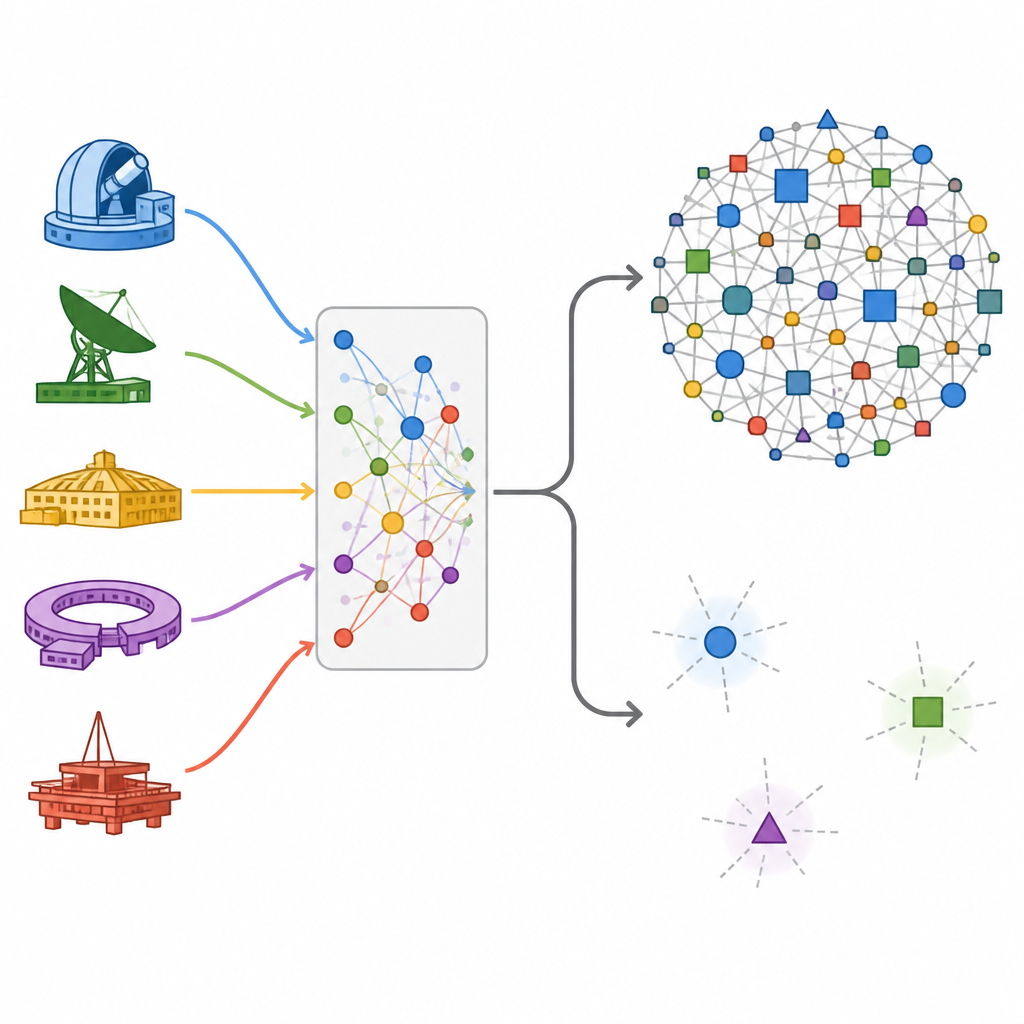
The authors call this pattern “co utilization,” meaning that one research team uses more than one large facility for the same line of work. Sometimes they tap different technologies, such as different X ray energies, to look at a material in several ways. Other times they simply need more capacity of the same kind. By collecting and matching publication records from 40 synchrotron light sources worldwide, the team assembled a dataset of about 213,000 research articles, of which more than 20,000 clearly drew on multiple facilities. Co utilization has grown over the past decades, though it still represents only a modest share of all facility based papers.
Impact versus disruption
To judge what this means for science, the study looked at two outcomes. One is scientific impact, captured by how often a paper is cited. The other is “disruption,” a measure of whether later work leans on a paper instead of its predecessors, suggesting it opened a new direction rather than extending an existing one. Across several tests, papers that used multiple facilities tended to be cited more, but were slightly less likely to count as disruptive. In other words, co utilization appears to support influential, widely used science that builds on known lines of work more than it triggers sharp breaks with the past.
What shapes bold ideas
The researchers then asked which features of co utilization are linked with more disruptive outcomes. They found that drawing on knowledge from different scientific communities and countries helps. When facilities in different nations are combined, and when their past work covers different topics, the chances of disruptive findings rise. By contrast, combining facilities with very different energy ranges and instrument types shows a small negative link with disruption, suggesting that juggling too many technological differences can make radical advances harder. Experience also matters: repeatedly using the same pair of facilities tends to align their work and slightly lowers disruption, but keeping the partnership going over many years has a positive effect, hinting that stable long term networks can eventually support bold moves.
Why this matters for science policy
These patterns offer practical lessons for how big science can be organized. Facility managers and funders who want to foster breakthrough ideas may wish to support international projects that link distant laboratories and mix knowledge while keeping experimental methods reasonably focused. Encouraging new links between facilities, and then sustaining those links over time, can help balance fresh perspectives with trusted working relationships. For scientists, the message is that using several big labs can boost the visibility and usefulness of their work, and that carefully chosen, knowledge rich partnerships are more likely to push the boundaries of what is known, even if the most radical disruptions remain rare.
Citation: ZHANG, M., WANG, L., ZHANG, L. et al. Co-utilizing global big science facilities: a novel type collaboration and the impacts on scientific disruption. Humanit Soc Sci Commun 13, 636 (2026). https://doi.org/10.1057/s41599-026-06992-9
Keywords: big science facilities, research collaboration, scientific impact, scientific disruption, synchrotron co-utilization