Clear Sky Science · en
Towards social relationships: a Bayesian Model averaging approach to identify determinants of children’s character skills
Why relationships matter for kids’ futures
When people talk about giving children a good start in life, they often point to money, class size, or fancy school facilities. This study asks a different question: what if the most powerful "investment" in a child’s future is not cash or equipment, but warm, everyday relationships with parents, teachers, and friends? Using data from thousands of primary school students in China, the researchers show that the quality of these relationships is strongly linked to children’s character skills—traits like perseverance, self-control, empathy, and confidence—that shape success throughout life.

From test scores to whole-person development
For decades, education research has focused mainly on cognitive skills: how well children do on tests of math, reading, or problem-solving. Money spent on schools or tutoring is usually judged by how much it raises scores. Yet a growing body of evidence shows that character skills—sometimes called social and emotional skills—are just as important. They influence school performance, later earnings, health, and even longevity. At the same time, rapid advances in technology mean that many routine tasks can be automated, raising the value of skills like teamwork, resilience, and communication that machines cannot easily replace.
Looking closely at children’s daily worlds
To understand what really shapes these character skills, the authors surveyed 2,616 fifth-grade students in 48 primary schools across six Chinese cities, covering both richer eastern regions and less developed central and western areas, as well as urban and rural communities. They measured broad personality traits such as openness, conscientiousness, and emotional stability, along with more specific traits like grit, self-esteem, and engagement in school and society. At the same time, they collected detailed information on nearly 50 possible influences: family income and parents’ education, how much time children spent on homework, sleep, and exercise, the quality of school equipment, class size, and—crucially—how children related to their parents, teachers, and peers.
Letting the data weigh all possibilities
Rather than testing just one preferred model, the researchers used a statistical approach called Bayesian Model Averaging. In simple terms, this method considers many different combinations of possible influences at once and then averages across them, weighting models according to how well they fit the data. This helps avoid cherry-picking results and gives a more reliable picture of which factors truly stand out. The team grouped influences into three broad types: unchangeable endowments (such as gender and family background), resource inputs (like income, school reputation, and extracurricular classes), and social-relationship inputs (including parenting style, teacher–student interaction, peer relationships, and bullying).
Warm ties beat wallets and facilities
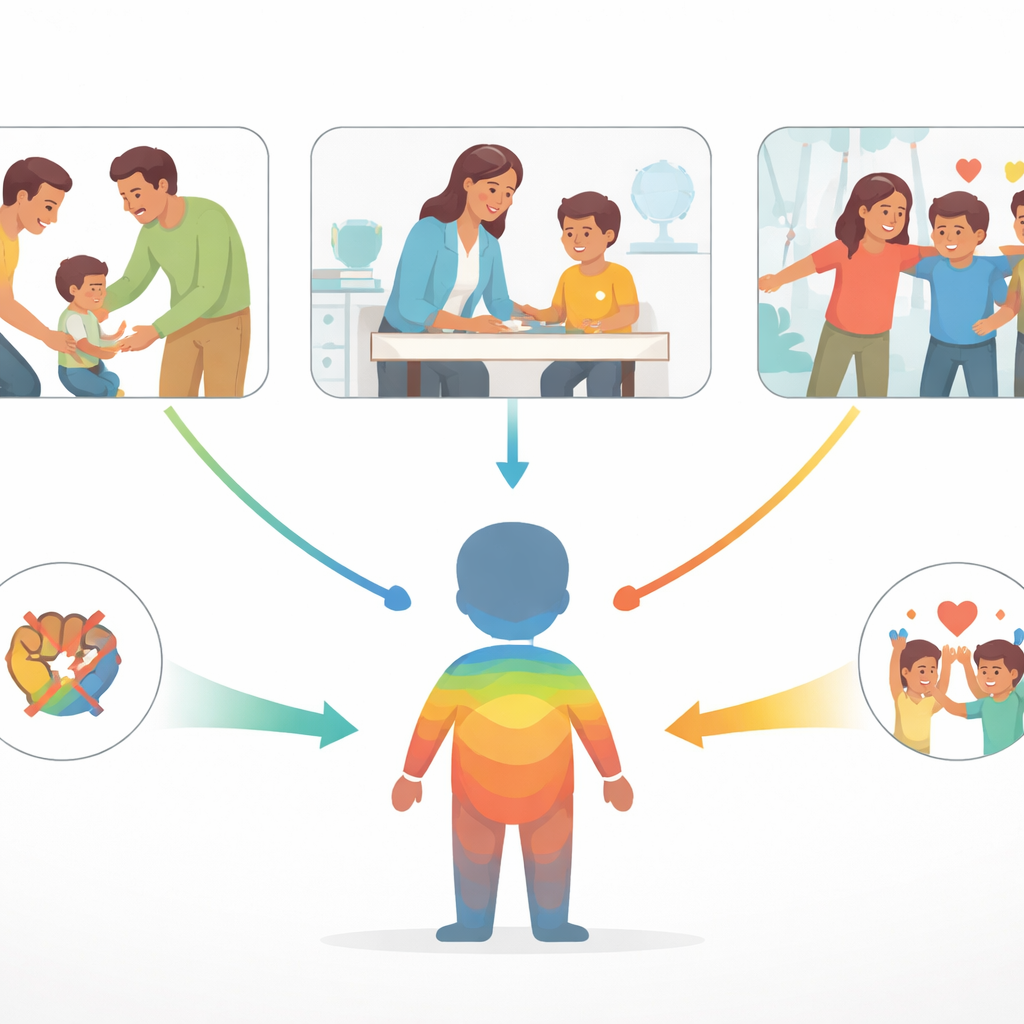
The clearest finding is that social-relationship factors consistently matter more for children’s character skills than either family income or school resources. Warm, supportive parenting from both mothers and fathers is strongly linked to higher levels of openness, emotional stability, conscientiousness, grit, self-esteem, and engagement in school and community. Harsh or rejecting parenting and overprotective behavior, in contrast, are tied to poorer emotional balance and lower perseverance. At school, friendly, respectful interactions between teachers and students—and positive peer networks—go hand in hand with more cooperative, confident, and engaged children. Experiences of bullying show the opposite pattern, undermining self-esteem, emotional stability, and school engagement. By comparison, factors that dominate policy debates—such as school equipment, club offerings, or even family income—have much weaker and less consistent links to these character outcomes.
Rethinking how we invest in children
These results suggest that if societies want children who are resilient, caring, and motivated, the most effective investments may not be bigger budgets alone but better relationships. Because relationships are easier to change than a family’s income or a child’s birthplace, they offer a promising way to narrow gaps between advantaged and disadvantaged children. Parent education programs that encourage warmth and respect, teacher training that emphasizes supportive classroom climates, efforts to build healthy peer networks, and strong anti-bullying policies may all deliver large returns in children’s character development. In plain terms, this study concludes that how adults and peers treat children each day may matter more for their inner strengths than how much money is spent on buildings or test preparation.
Citation: Zhou, J., Zhu, X. & Tian, X. Towards social relationships: a Bayesian Model averaging approach to identify determinants of children’s character skills. Humanit Soc Sci Commun 13, 575 (2026). https://doi.org/10.1057/s41599-026-06939-0
Keywords: character skills, parenting and education, teacher–student relationships, peer influence, child development