Clear Sky Science · en
Scaled memories in the linguistic landscape: a case study of Ping’an Cemetery, Beijing, China
Why the Words on Gravestones Matter
Cemeteries may seem like quiet resting places, but they also tell powerful stories about who is remembered and how. This article looks at a large, state-run commercial cemetery in Beijing and asks a deceptively simple question: why are some people commemorated as ordinary family members, while others become public figures even after death? By examining the language and design of gravestones and signs, the study shows how a single burial ground can double as both a private space of mourning and a public stage where fame, status and even profit are crafted and displayed.
Family Goodbyes in Stone
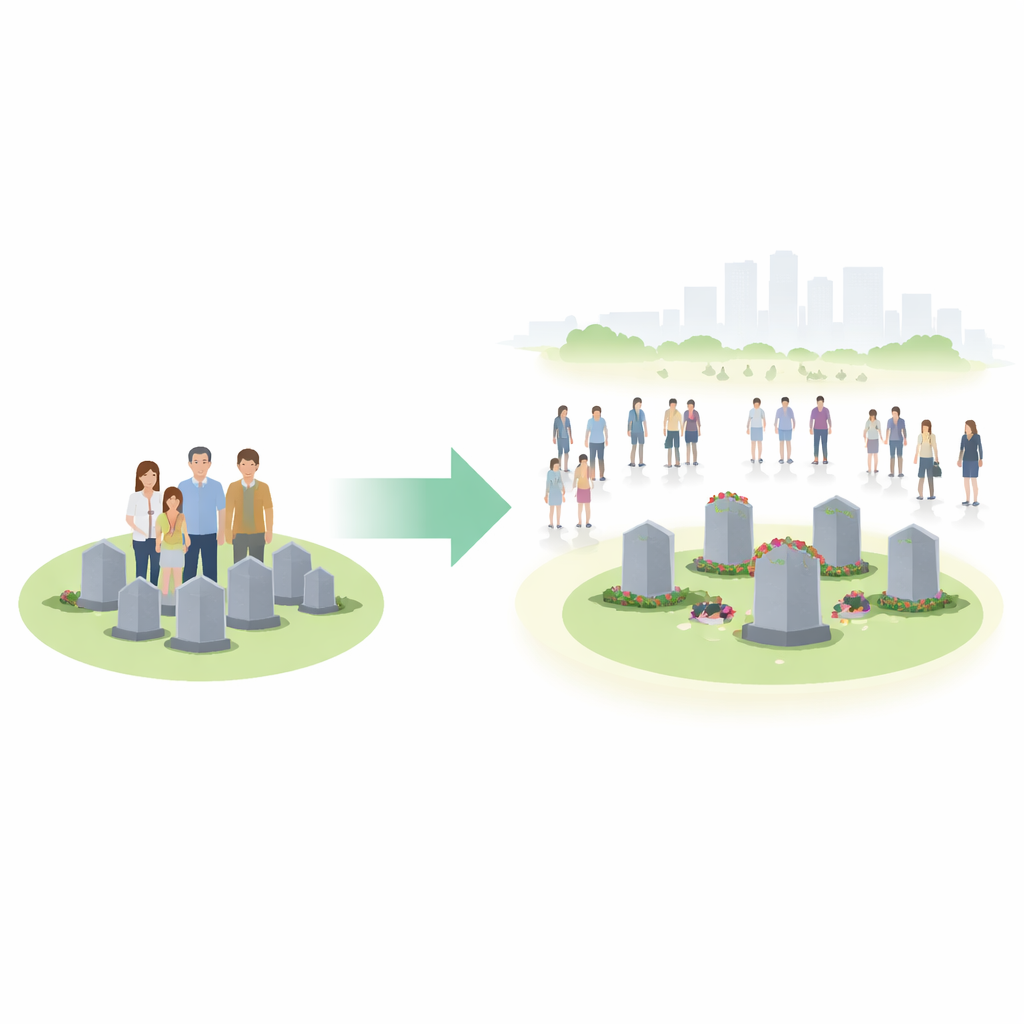
Most graves in Ping’an Cemetery look similar in size and shape, but the way they are inscribed reveals an intimate world of family ties. For the majority of the deceased, gravestones highlight roles such as father, mother or elder, often using affectionate phrases and simple personal praise. These stones are designed mainly for close relatives, who already know the person’s life story. The language focuses on love, virtue and everyday character rather than specific achievements. In this way, the grave functions as a family memorial: its meaning is rich for insiders, but largely opaque to strangers passing by.
When a Grave Becomes a Public Landmark
In the same cemetery, however, a smaller group of graves quietly plays a very different role. These belong to people described as famous—revolutionaries, professors, athletes, artists and other public figures. Their stones tend to replace or downplay kinship terms and instead foreground occupational titles or honorifics that signal social standing. Life stories carved into the stone detail concrete achievements: major works, positions held, national contributions. These stones are often commissioned or endorsed by institutions as well as families, inviting not only relatives but also strangers, fans and visitors to take part in remembering. The same physical space that holds private grief thus also hosts public admiration.
Layers of Memory and Hidden Hierarchies
The study uses the idea of “scales” to describe how wide and how highly valued each kind of remembrance is. At the lower scale, memory is local and emotionally charged: it belongs mainly to the family circle, built on shared experiences and personal affection. At the higher scale, memory becomes more public, general and long-lasting, supported by official titles, national narratives and media visibility. Gravestones that focus on family roles keep remembrance at the intimate end of this spectrum. Gravestones that stress careers and honors push the deceased upward, transforming them into figures of broader social importance. These two ways of writing the dead into stone create a quiet hierarchy: ordinary people’s stories rarely move beyond the private sphere, while famous people’s lives are framed as part of the nation’s or city’s heritage.
From Memory to Market
Because Ping’an is a commercial cemetery, these hierarchies do not remain purely symbolic. Graves of well-known figures attract tourists, inspire brochures and displays, and help the cemetery market itself as a place where modern Chinese history is embedded in the landscape. Selling plots near celebrity graves offers buyers a sense of proximity to prestige, and a memorial hall showcasing famous residents reinforces the site’s cultural value. In this way, the distinction between ordinary and famous dead becomes a resource: it is used to build the cemetery’s brand and to turn symbolic status into economic gain. Meanwhile, the countless graves marked only by family love risk being overlooked beyond their immediate circle.

What This Means for How We Remember
The article concludes that the language and layout of gravestones in Ping’an Cemetery do more than honor individuals; they help decide whose lives will echo more loudly in public memory. By separating “ordinary” from “famous” and giving each group different kinds of inscriptions, the cemetery participates in a broader politics of remembrance in contemporary China. Public recognition is closely tied to institutional power and market interests, so that some lives are scaled up into lasting collective memory while others remain confined to private grief. The study suggests that even in the most solemn spaces, the way we write about the dead reflects—and reinforces—social inequalities that persist beyond the grave.
Citation: Yin, C. Scaled memories in the linguistic landscape: a case study of Ping’an Cemetery, Beijing, China. Humanit Soc Sci Commun 13, 537 (2026). https://doi.org/10.1057/s41599-026-06885-x
Keywords: cemeteries, memory, linguistic landscape, China, commemoration