Clear Sky Science · en
Associations between the recovery process and caregiver burden in severe mental disorders: An exploratory cross-sectional study
Why this study matters for families
Caring for a loved one with a long lasting mental health problem can be both meaningful and exhausting. This study from Catalonia, Spain, looks at how the ups and downs of a person’s recovery affect the daily load carried by their main family caregiver. Understanding when and why this burden is heaviest can help families, clinicians, and policy makers design support that fits real life rather than an idealised treatment plan.
Different paths of getting life back
The researchers use a recovery model that goes beyond symptom control and focuses on how people rebuild their lives. They describe five stages. In the moratorium stage, people feel lost and hopeless. In awareness, they begin to sense that change is possible. Preparation involves planning how to move forward, rebuilding means actively working on goals, and growth reflects living a fuller life with better self management and resilience. Recovery also has inner parts such as hope, identity, meaning, and responsibility. These ideas guided how the team measured where each person was along the path.

Who took part in the project
The study drew on 223 pairs of adults with severe mental disorders and their main family caregivers enrolled in the Activa’t programme across 12 regions of Catalonia. Most service users were middle aged men diagnosed with psychotic disorders, bipolar disorder, or severe recurrent depression, and most caregivers were older women, often mothers, who lived in the same home. Trained psychologists and social workers interviewed both members of each pair, rating the service user’s recovery stage and the caregiver’s burden using well established questionnaires.
What caregiver burden looks like day to day
Caregiver burden in this study included both visible work and inner strain. Objective burden covered how many tasks the caregiver helped with, how often they stepped in, and how many hours per week this took. Tasks ranged from supporting daily living activities such as cooking, washing, and managing medication to dealing with disturbed behaviours. Subjective burden captured how uncomfortable or stressed the caregiver felt, how often their routines were interrupted, how much the situation worried them, and whether it changed family relationships, health, and finances. Many caregivers reported frequent concerns, changes in their lifestyle, and tension in relationships within the household.
How recovery stages shape the caregiver’s load
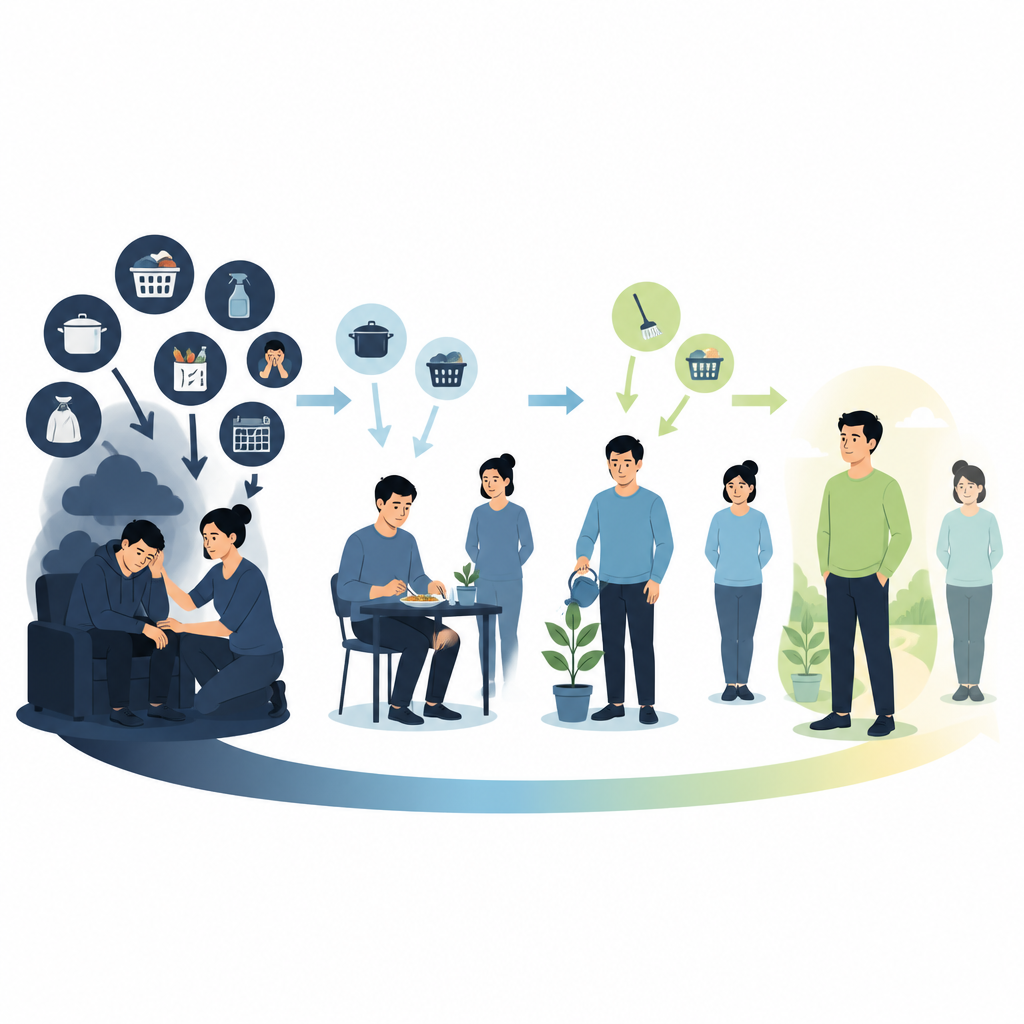
The central finding is that the weight on caregivers changes with the service user’s stage of recovery. Burden was highest in the moratorium stage, when daily functioning was most affected and hope was lowest. In this phase caregivers spent more hours helping with basic tasks, felt more discomfort, reported more disruptions to their routines, and worried more about their relative. Burden eased in the awareness stage, where assistance needs and emotional strain tended to drop. In later stages such as rebuilding and growth, help with daily tasks and emotional stress remained lower than in moratorium, although financial costs could increase as people engaged more in life. Interestingly, the detailed inner aspects of recovery like hope or meaning showed only weak links with burden, suggesting that the broad stage of recovery mattered more for families than subtle shifts in inner experience.
What this means for care and support
For a lay reader, the take home message is that recovery from severe mental disorders is not only about the person in treatment, it is also about their family. When a person is at their lowest, their relatives carry the heaviest load, especially around everyday chores and emotional worry. As the person gains awareness and autonomy, family life becomes more manageable, though new demands can appear. The authors argue that mental health services should assess where people are in their recovery and offer stage sensitive support that includes practical help for families, especially early on. Providing external assistance with household tasks, psychoeducation, and respite can make it easier for caregivers to stay well while their loved one works toward a fuller, more independent life.
Citation: Rojo, E., Eiroa-Orosa, F.J., San Pío, M.J. et al. Associations between the recovery process and caregiver burden in severe mental disorders: An exploratory cross-sectional study. Humanit Soc Sci Commun 13, 732 (2026). https://doi.org/10.1057/s41599-026-06841-9
Keywords: caregiver burden, mental health recovery, family caregiving, severe mental illness, daily living support