Clear Sky Science · en
Strategic differences and corporate environmental disclosure quality: empirical evidence from heavily polluting industries in China
Why this study matters for everyday life
China’s rapid industrial growth has come with serious air and water pollution, especially from heavy industries like steel, cement, and power generation. At the same time, investors and the public increasingly want to know how responsibly companies treat the environment. This study asks a deceptively simple question: when companies choose business strategies that differ from their industry peers, does that make them more honest and detailed about their pollution—or less? The answer turns out to be nuanced, with important lessons for governments, investors, and communities concerned about corporate transparency.
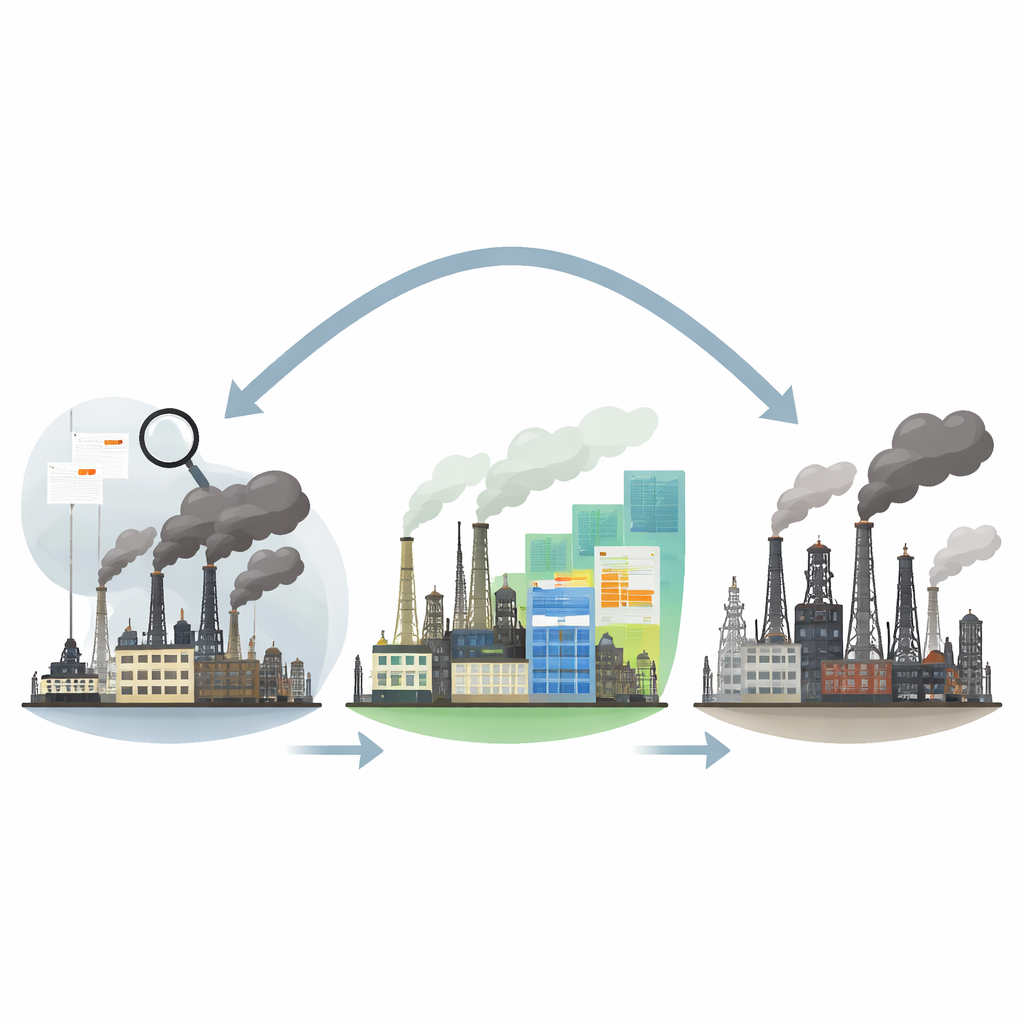
Different paths companies can take
Companies even within the same line of business rarely look identical. Some follow the industry’s beaten path with conservative investments and familiar products. Others pursue “different” strategies—investing more in new technologies, changing their cost structure, or reshaping how they operate. These strategic differences can help a company stand out and earn higher profits, but they also bring greater uncertainty and risk. For firms in highly polluting industries, such choices interact directly with how they report their environmental performance, from the completeness of emissions data to how candidly they describe problems.
How the researchers studied the problem
The author assembled a large dataset of more than 4300 firm–year observations from heavily polluting companies listed on China’s A‑share stock market between 2013 and 2020. The quality of environmental disclosure was scored by systematically reading annual reports, social responsibility reports, and environmental reports, using established checklists that rate how detailed, quantifiable, and balanced the information is. Strategic difference was measured by comparing each firm’s spending structure, capital intensity, and financial risk to the average of its industry peers. The farther a firm’s pattern deviated from the industry norm, the higher its “strategic difference” score. Statistical models then examined how this score relates to environmental disclosure quality, while also considering government regulation, the abilities of top managers, and firm characteristics.
The surprising curve in the results
The key finding is that the link between strategic difference and environmental disclosure quality forms an inverted U shape. Firms with moderate strategic differences tend to disclose environmental information more fully and clearly. Because they take on more business risk to stand out from rivals, these companies seem motivated to reduce overall uncertainty by being more transparent about pollution and environmental practices, thereby reassuring investors and regulators. However, when a company’s strategy drifts too far from the industry mainstream, the pattern reverses. Extreme strategic choices consume managerial attention and financial resources, leaving less capacity for environmental protection. In such cases, companies may resort to thinner, selectively positive reporting to protect their reputation, even as their actual environmental performance lags.

When rules and leadership change the picture
The study also shows that external rules and internal leadership can sharpen this inverted U pattern. In regions with stronger environmental regulation—where pollution control investments are higher and penalties more severe—the difference in disclosure quality between moderately and excessively unconventional firms becomes more pronounced. Similarly, companies led by more capable managers, with broad experience and higher education, show a clearer pattern: they use better disclosure when strategic differences are moderate, but once risk and complexity become too high, even strong managers struggle to maintain high-quality reporting. The effect is especially visible in non-state-owned firms and in companies with weaker internal control systems, where oversight is less rigid and strategic choices have more room to sway reporting behavior.
What it means for policy and investing
For a layperson, the main takeaway is that “being different” is not automatically good or bad for corporate openness about pollution. A moderate degree of strategic originality can go hand in hand with clearer environmental reporting, while extreme departures from industry norms are a warning sign that environmental information may become patchy or cosmetic. Stronger environmental regulations and capable leadership help push firms toward better disclosure, but they cannot fully offset the risks of overly adventurous strategies. For policymakers, this suggests pairing strict, well-enforced rules with incentives that reward honest, detailed reporting. For investors and the public, it highlights the value of looking not only at what a company says about the environment, but also at how its overall business strategy and governance might shape what it chooses to reveal—or hide.
Citation: Zhong, Q. Strategic differences and corporate environmental disclosure quality: empirical evidence from heavily polluting industries in China. Humanit Soc Sci Commun 13, 444 (2026). https://doi.org/10.1057/s41599-026-06814-y
Keywords: environmental disclosure, corporate strategy, polluting industries, China regulation, managerial ability