Clear Sky Science · en
What motivates the formation and evolution of emergency collaboration networks for extreme weather events: a research based on exponential random graph model
Why working together in storms matters
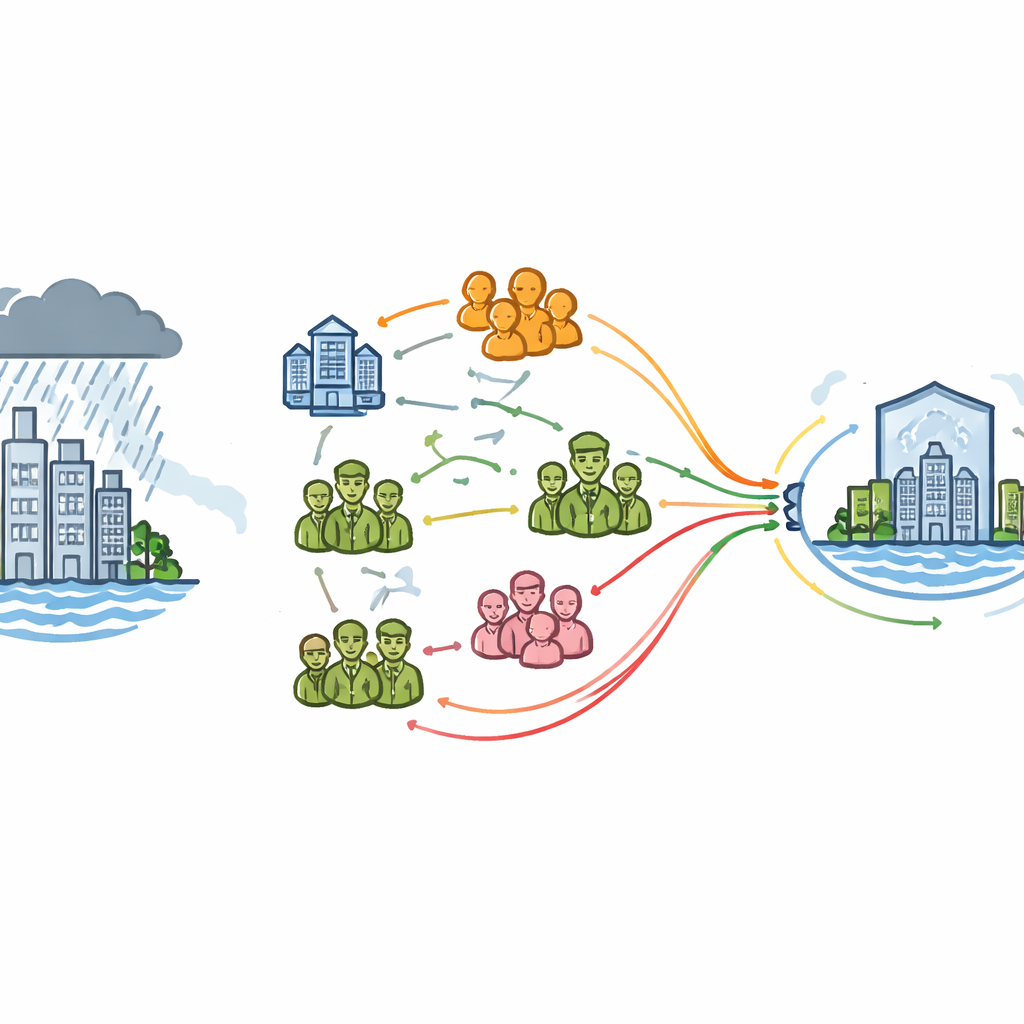
When a city is hit by record-breaking rain, no single agency can handle the crisis alone. Firefighters, meteorologists, transport officials, neighborhood volunteers, and many others must coordinate under intense time pressure. This paper looks at what really drives that cooperation in the chaos of extreme weather, using the 2021 twin rainstorms in Zhengzhou, China, as a natural experiment. By comparing a first, poorly coordinated response in July with a far more effective effort to a similar storm in August, the authors show how emergency collaboration networks form, why they sometimes fail, and how they can quickly improve.
Two big storms, two very different responses
In July 2021, a once-in-a-century rainstorm flooded Zhengzhou, triggering severe losses and public criticism of the local response. Just one month later, another major downpour hit much of the same area, but this time the city’s emergency network worked more smoothly: fewer organizations were involved, yet coordination was tighter and faster. This unusual back-to-back disaster offered a rare chance to observe how collaboration patterns change in a short time under almost identical conditions. The authors reconstructed who worked with whom in each episode from hundreds of official news reports and government documents, then turned those links into two citywide maps of collaboration: the “July network” and the “August network.”
How the researchers read the hidden web
To move beyond simple counts of who talked to whom, the team used a statistical tool called an Exponential Random Graph Model. Instead of treating each partnership as an isolated event, this method asks how the whole pattern of ties arises. It can test, for example, whether organizations tend to favor government partners, prefer similar types of agencies, build on previous joint drills, or cluster into tightly knit groups. It also captures self-organizing tendencies: star-like patterns around powerful hubs, closed triangles where “a friend’s friend becomes a partner,” and open paths where a broker links otherwise separate groups. By comparing many simulated networks to the real ones, the authors could see which tendencies best explained the observed patterns in July and August.
What shapes who teams up in a crisis
The study finds that both outside conditions and internal structure matter, but internal network patterns often dominate. In July, organizations showed clear preferences: they were more likely to work with nonprofit groups and with bodies that had command or coordination roles, as well as those controlling people or money. Agencies at the same level of government and with similar tasks also tended to connect, forming familiar, comfortable clusters. Yet these attribute-based preferences could not fully account for how the network looked or performed. The strongest force was transitivity: organizations were especially likely to collaborate with partners that already shared a collaborator with them, creating many tightly interlinked triangles. This “friend-of-a-friend” effect supported trust, quick information sharing, and reliable resource flows, while long chain-like bridges played a smaller role than often assumed.
Learning from drills and from doing
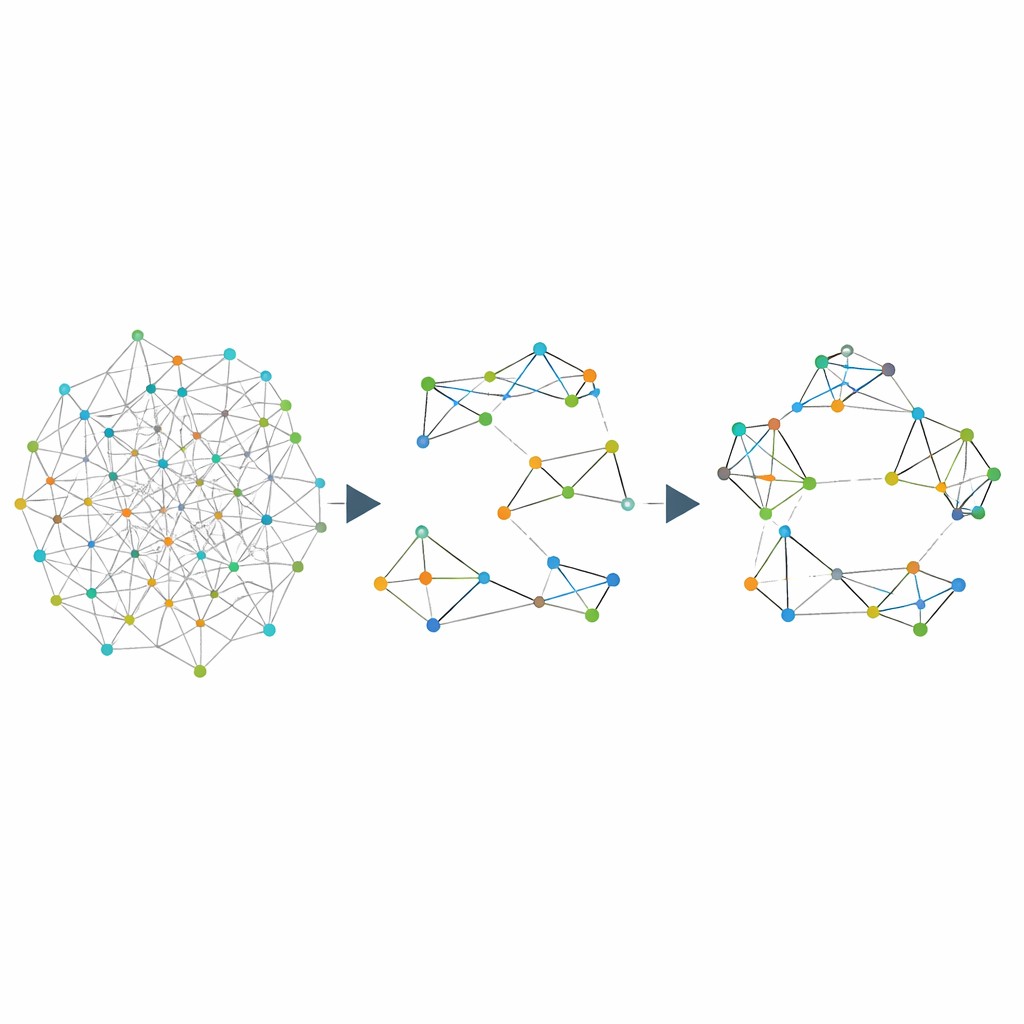
Pre-disaster collaboration left deep fingerprints on the networks. Joint emergency exercises conducted before the storms made it easier for organizations to work together when the first rainstorm hit. Even more powerful was fresh practical experience: the July response network itself became a strong predictor of who would collaborate in August. When the second storm arrived, agencies no longer needed to rely as much on matching roles, sector types, or formal plans. Instead, they reused and streamlined the partnerships that had just been tested in real life, dropping less useful links and reinforcing effective small groups. The August network was smaller but denser, with shorter paths between actors and more clustering—evidence of a leaner, more efficient web built on very recent lessons.
What this means for safer cities
For non-specialists, the key message is that the success of a storm response hinges less on fixed organizational charts and more on living networks of trust and familiarity. Stable, cross-sector micro-groups that train together, share information well, and already trust one another can be activated quickly when disaster strikes, making “who knows whom” just as important as “who is in charge.” Emergency plans and drills still matter, but only if they are updated continuously and tied to real operations so that learning from crises is not lost. By deliberately nurturing these collaborative webs before the next extreme weather event, city governments can respond faster, coordinate better, and protect more lives when the skies open again.
Citation: Qie, Z., Bai, N. & Sun, Y. What motivates the formation and evolution of emergency collaboration networks for extreme weather events: a research based on exponential random graph model. Humanit Soc Sci Commun 13, 461 (2026). https://doi.org/10.1057/s41599-026-06800-4
Keywords: emergency collaboration networks, extreme weather response, disaster coordination, social network analysis, urban resilience