Clear Sky Science · en
Factors affecting the intent to adopt Islamic pension system in Pakistan
Why retirement choices matter
Across the world, people are living longer and worrying more about how they will support themselves after they stop working. In Pakistan, most private and informal workers have no formal pension at all, and many are also uncomfortable with retirement products that involve interest, which clashes with their religious values. This study looks at a newer option—Islamic pension schemes—and asks a simple but important question: what really makes an employee decide to sign up for one of these plans?
A different kind of retirement plan
Islamic pension schemes aim to offer long-term savings in a way that follows Islamic principles. That means avoiding interest, excessive uncertainty, and gambling-like speculation, while emphasizing shared risk, fairness, and ethical investment. Although Islamic banking and insurance have grown quickly in Pakistan, Islamic pensions remain rare and only a small slice of workers participate. The authors argue that to understand this slow uptake, we must look beyond product design and rules, and instead examine how ordinary employees think and feel about these pensions in their daily lives and workplaces.

What shapes people’s intentions
The researchers surveyed 255 employees from different age groups, income levels, and job types in Pakistan. They focused on four main influences: how much people know about Islamic pensions, how they feel about them (their attitude), how important religion is in their lives (religiosity), and how much pressure or encouragement they sense from family, friends, and community (subjective norms). They then used statistical modeling to see how each of these factors contributes to a person’s intention to adopt an Islamic pension scheme. All four turned out to matter, but not equally. Attitude was the strongest driver, followed by religiosity, then knowledge, and finally social pressure.
The quiet power of inner drive
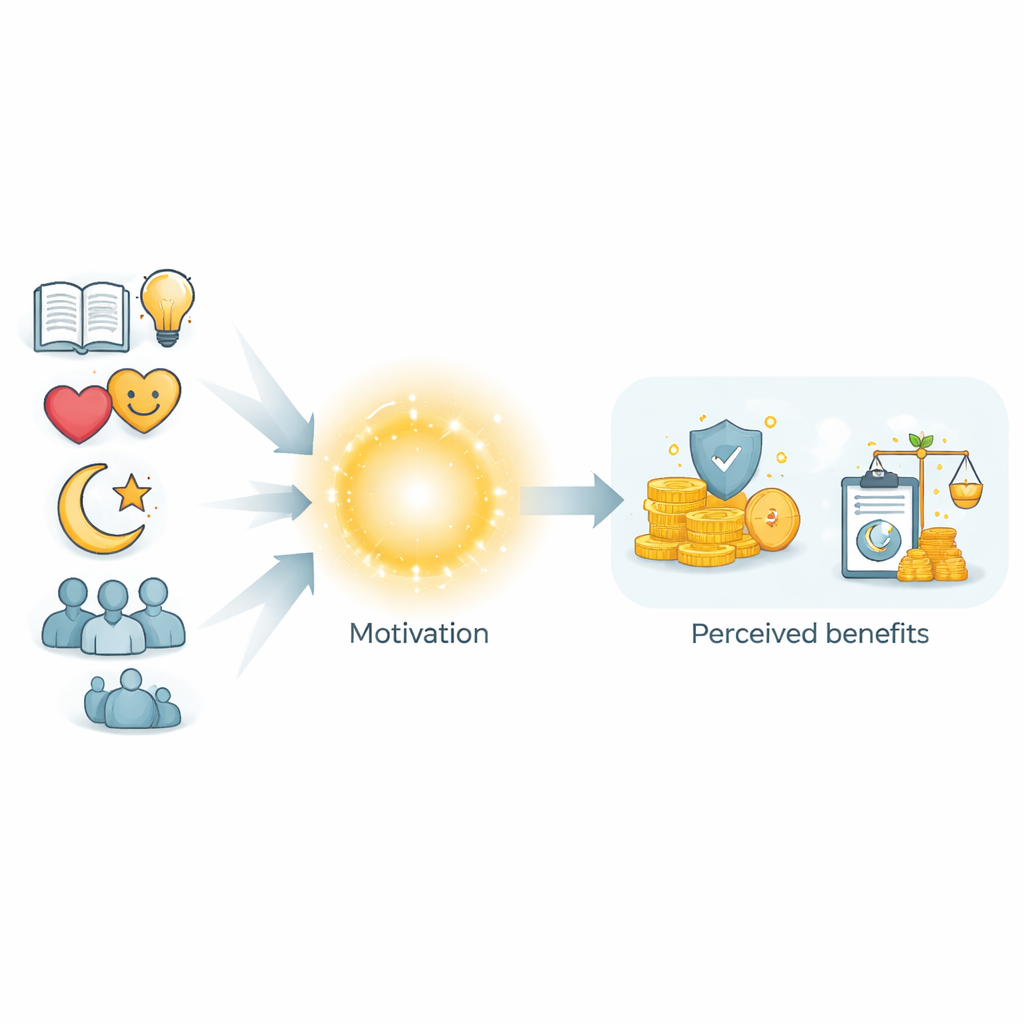
The study did not stop at listing influences; it also examined how they work together inside a person. Here, motivation plays a central role. Motivation captures someone’s inner willingness to act—shaped by ethical comfort, desire for financial security, and a sense of personal satisfaction. The analysis showed that knowledge, attitude, religiosity, and social pressure all boost motivation, and that motivation in turn strengthens the intention to sign up for an Islamic pension. This means that even if someone is knowledgeable and religious, what really translates these elements into action is whether they feel personally driven and ready to commit.
Why perceived benefits tip the balance
The authors also investigated how people’s view of the practical payoffs—what they stand to gain—changes the picture. Perceived benefits include ideas such as better long-term security, fair treatment, and emotional comfort in knowing one’s savings follow religious and ethical standards. The study finds that when people see these benefits as high, their existing motivation translates much more strongly into a clear intention to adopt an Islamic pension. When they see the benefits as weak or uncertain, even motivated individuals may hesitate. In other words, motivation opens the door, but a convincing promise of value is what gets people to step through it.
What this means for everyday savers
For a lay reader, the message of the study is that choosing an Islamic pension is not only about religious rules or technical financial features. It is about how people understand the product, whether it fits their values, how their social circle views it, how strongly they feel driven to act, and whether they believe the plan will genuinely protect and benefit them in old age. The authors conclude that to expand the use of Islamic pensions in Pakistan and similar countries, policymakers and financial institutions must build positive attitudes, improve financial understanding, strengthen visible religious and ethical credibility, and clearly communicate concrete benefits. When these pieces come together, workers are far more likely to see Islamic pension schemes as a trustworthy and worthwhile path to a dignified retirement.
Citation: Waqas, H., Saif, S. & Ganiev, O. Factors affecting the intent to adopt Islamic pension system in Pakistan. Humanit Soc Sci Commun 13, 400 (2026). https://doi.org/10.1057/s41599-026-06758-3
Keywords: Islamic pension schemes, retirement planning, behavioral finance, religiosity and finance, Pakistan workers