Clear Sky Science · en
Unveiling college students’ adoption of AIGC in design learning: an integrated model
Why this matters for future designers
College design students today are learning in studios where artificial intelligence can sketch, write, and generate images in seconds. This study looks at how those students decide whether to actually use AI-generated content (AIGC) tools in their everyday design learning. Understanding their reactions—what excites them, what scares them, and what pushes them to share these tools with friends—helps educators shape courses that protect creativity while making the most of powerful new technologies.
New tools in the design studio
The authors focus on Chinese college students majoring in design, a group for whom visual creativity, iteration, and experimentation are central to their studies. AIGC systems can quickly produce alternative layouts, product ideas, or visual concepts, potentially speeding up the early stages of design and giving students more room to refine their ideas. At the same time, these systems raise worries about originality, authorship, bias, and over-reliance on machines. Earlier research often examined AIGC in general education or from a purely technical angle; this paper zooms in on how design students themselves think, feel, and act when such tools are built into their learning.

Three stages of student response
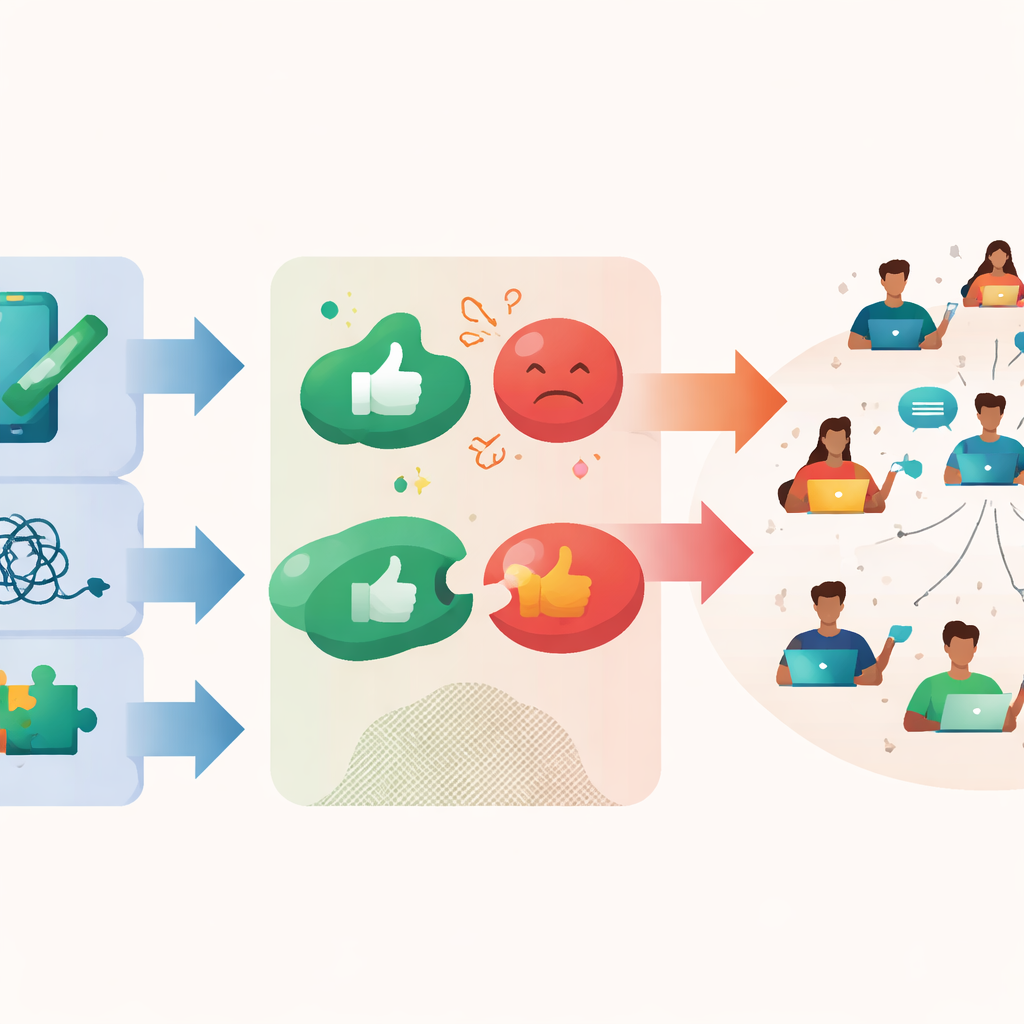
To unpack these reactions, the researchers combine two established ideas from technology studies. One describes how new tools spread through a community, and the other explains how people weigh effort, benefits, and emotions when they first encounter a device. Together, these theories are used to build a three-stage pathway. In the first stage, called technology concern, students judge whether AIGC seems better than older methods, fits with their current way of working, or feels confusing and hard to use. In the second stage, emotional acceptance, they form expectations about how much AIGC will actually improve their performance and how much effort it will take to get comfortable with it. In the final stage, behavioral transformation, social forces and personal willingness to try new things shape whether students keep using these tools and recommend them to others.
What the survey revealed
The team surveyed 385 design students across different specializations, asking detailed questions about these three stages. They then used structural equation modeling, a statistical technique that tests how well different factors are linked. They found that when students see clear advantages in AIGC—such as faster idea generation or richer visual options—and feel that these tools fit smoothly into their usual software and workflows, they expect better results and believe the tools will not be too demanding to learn. In contrast, when AIGC seems complicated or constantly changing, students lower their expectations about both performance and ease of use. In other words, perceived benefit and fit pull students toward adoption, while perceived complexity pushes them away.
Feelings, friends, and early adopters
One of the most striking results is that simply expecting better performance from AIGC did not strongly predict whether students actually went on to use and spread the tools. Instead, the belief that AIGC would not require excessive effort—feeling that it was manageable and worth the learning curve—was a much stronger driver. Social surroundings also played a powerful role: when teachers and classmates were using or encouraging AIGC, students were more likely to keep using it and to introduce it to others. Students with a naturally innovative mindset, who enjoy trying out new methods early, were especially likely to become active users and informal ambassadors of AIGC tools in their peer networks.
What this means for teaching design with AI
The study concludes that successful use of AIGC in design education depends less on flashy promises of improved performance and more on everyday experience: tools must be simple to learn, compatible with existing studio practices, and supported by a positive social environment. Complexity can trigger frustration and anxiety, dampening the potential benefits. For educators and policymakers, this suggests focusing on clear guidance, staged introductions, technical support, and classroom cultures that encourage thoughtful experimentation. When AIGC is made approachable and integrated carefully, it can become a partner in design learning rather than a threat to students’ creativity or integrity.
Citation: Zeng, L., Wang, A., Huang, Y. et al. Unveiling college students’ adoption of AIGC in design learning: an integrated model. Humanit Soc Sci Commun 13, 357 (2026). https://doi.org/10.1057/s41599-026-06713-2
Keywords: AI in design education, student technology adoption, AI-generated content, innovation diffusion, design learning