Clear Sky Science · en
Art and design teachers’ acceptance of AI-generated content for assisted tutoring: an extended TAM-TPACK framework
Why this matters for today’s classrooms
Artificial intelligence tools that can generate images, text, and designs are rapidly entering art and design studios. For teachers, these tools promise faster feedback, new ways to spark creativity, and help with heavy grading loads—but they also raise questions. Will teachers actually choose to use AI as a teaching assistant? What gives them the confidence to try it, and what kind of support do they need? This study looks closely at university art and design teachers in mainland China to understand what encourages—or discourages—them from bringing AI-generated content into their daily teaching.
How AI fits into art and design teaching
The authors focus on “assisted tutoring,” where AI tools support, rather than replace, teachers. They describe three key moments in a typical course. Before class, teachers may ask tools like ChatGPT to generate case studies or explanations of tough concepts. During class, image generators such as Midjourney or DALL·E can help students explore styles, test visual ideas, or rapidly sketch options. After class, AI can help give individualized comments on drafts, suggest refinements, or prepare preliminary critique notes. In studio-based and project-based courses—where students and teachers work together over time on real design problems—these tools could change how ideas are developed and how feedback flows.
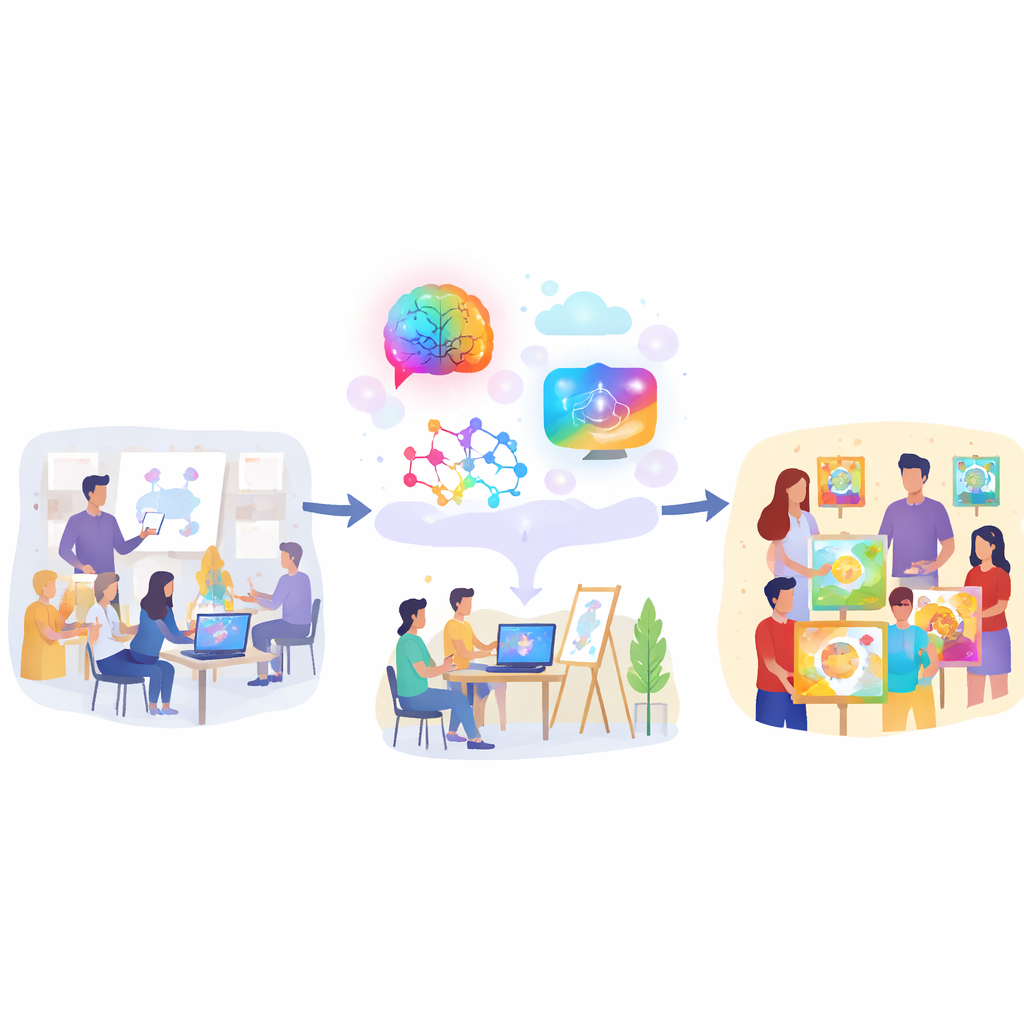
What the researchers set out to test
To unpack teachers’ choices, the study combines two well-known ideas from education and technology research. One is the Technology Acceptance Model, which says that people are more likely to use a tool if they believe it is useful and easy to use, and if that belief shapes their intention to act. The other is the TPACK framework, which says good teaching with technology rests on three kinds of teacher knowledge: of their subject, of teaching methods, and of the technologies themselves. The authors extend these ideas with two more influences: teachers’ own confidence with AI, and the surrounding conditions—such as available hardware, software, and the attitudes of colleagues and leaders. They then survey 387 university art and design teachers from across mainland China and analyze how these pieces fit together statistically.
What the data revealed about teachers
The teachers in the study generally viewed AI tools positively: on average they rated their experience, the tools’ ease of use, and their potential value in the mid-to-high range. The analysis showed clear patterns. Teachers who felt more confident about their ability to understand and explain AI were more likely to see AI tools as easy to use and worthwhile, and they also tended to have stronger combined knowledge of technology, pedagogy, and content. This blend of knowledge, in turn, made AI feel more helpful and less intimidating. External conditions also mattered. When schools provided solid technical resources, training, and problem-solving support, teachers found AI easier to use and were more willing to adopt it. Likewise, when colleagues and leaders looked favorably on AI, teachers were more likely to see it as beneficial and to plan to use it in their own teaching.
How the pieces work together
Looking at all of these factors together, the study paints a layered picture of decision-making. Individual confidence and professional knowledge shape how teachers judge AI’s usefulness and simplicity. At the same time, studio spaces, computing power, software access, and a culture of sharing and critique in art and design all amplify or weaken that judgment. If AI tools feel straightforward and clearly help with teaching quality, preparation time, or feedback, teachers are more inclined to weave them into studio projects, critiques, and assessments. But if tools are hard to access, poorly supported, or distrusted by peers, even confident teachers may hold back. The authors argue that successful adoption requires more than just installing new software; it depends on an ecosystem of training, resources, and peer communities.
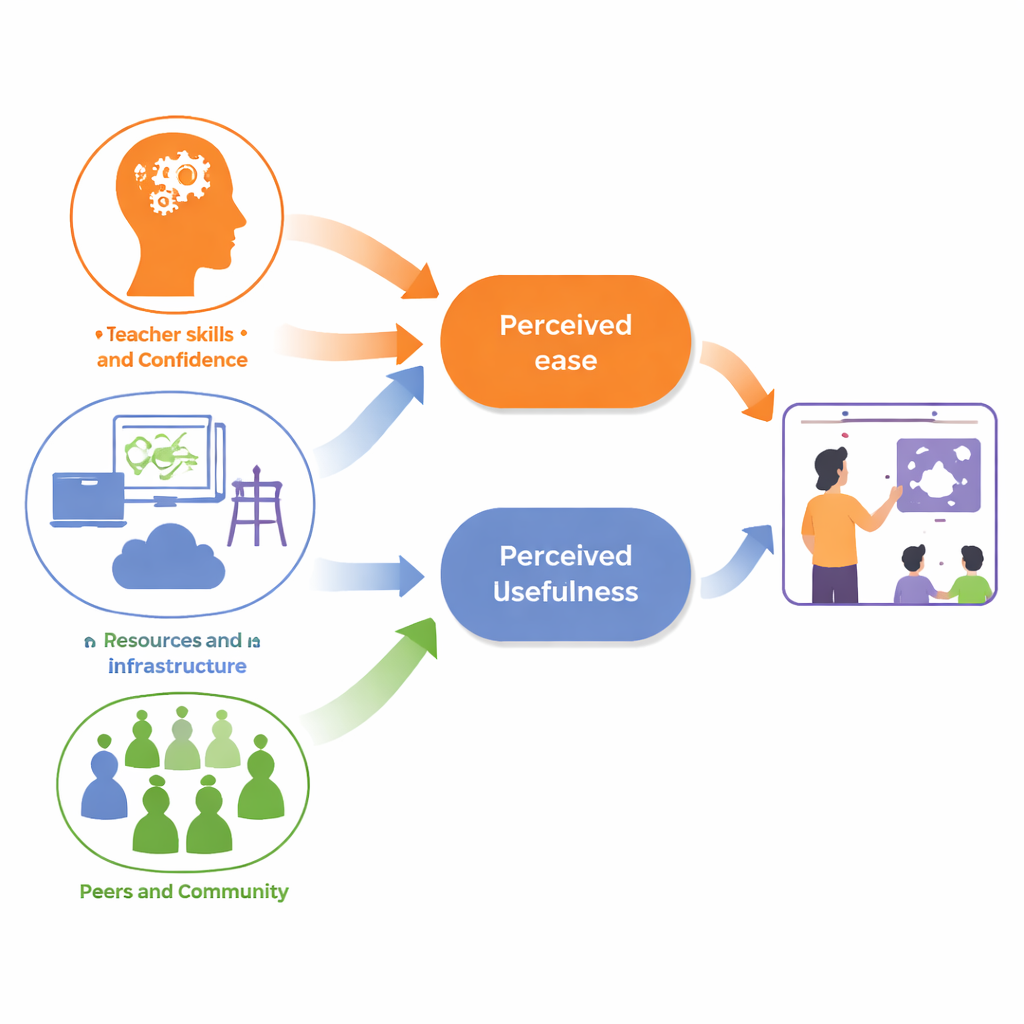
What this means for the future of creative teaching
In everyday terms, the study’s conclusion is simple: art and design teachers are ready to collaborate with AI when three things line up—confidence, competence, and support. When teachers understand both their subject and the tools, feel capable of guiding students through human–AI collaboration, and can rely on strong institutional backing, they are much more likely to experiment with AI-generated content in thoughtful ways. The authors suggest that schools, companies, and policymakers should work together to create long-term support systems that include training, infrastructure, and positive professional communities. Done well, this could shift studios toward a model where people and machines work side by side, freeing teachers to focus more on mentoring, critical judgment, and nurturing students’ creative growth.
Citation: Zhu, Z., Gan, Q. & Duan, P. Art and design teachers’ acceptance of AI-generated content for assisted tutoring: an extended TAM-TPACK framework. Humanit Soc Sci Commun 13, 362 (2026). https://doi.org/10.1057/s41599-026-06692-4
Keywords: AI-generated content in education, art and design teaching, teacher technology adoption, TPACK and AI, human–AI collaboration in classrooms