Clear Sky Science · en
Spatiotemporal impacts and nonlinear moderating effects of the digital economy on county-level public services in western China
Why Digital Change Matters for Everyday Services
Across western China, many counties struggle to provide good schools, clinics, pensions, and cultural spaces for their residents. At the same time, smartphones, broadband, and online platforms are spreading into even remote areas. This article asks a simple but important question: can the digital economy—things like online payments, government portals, and data networks—actually help ordinary people get better public services, and under what local conditions does it work best?
Uneven Ground Beneath Local Services
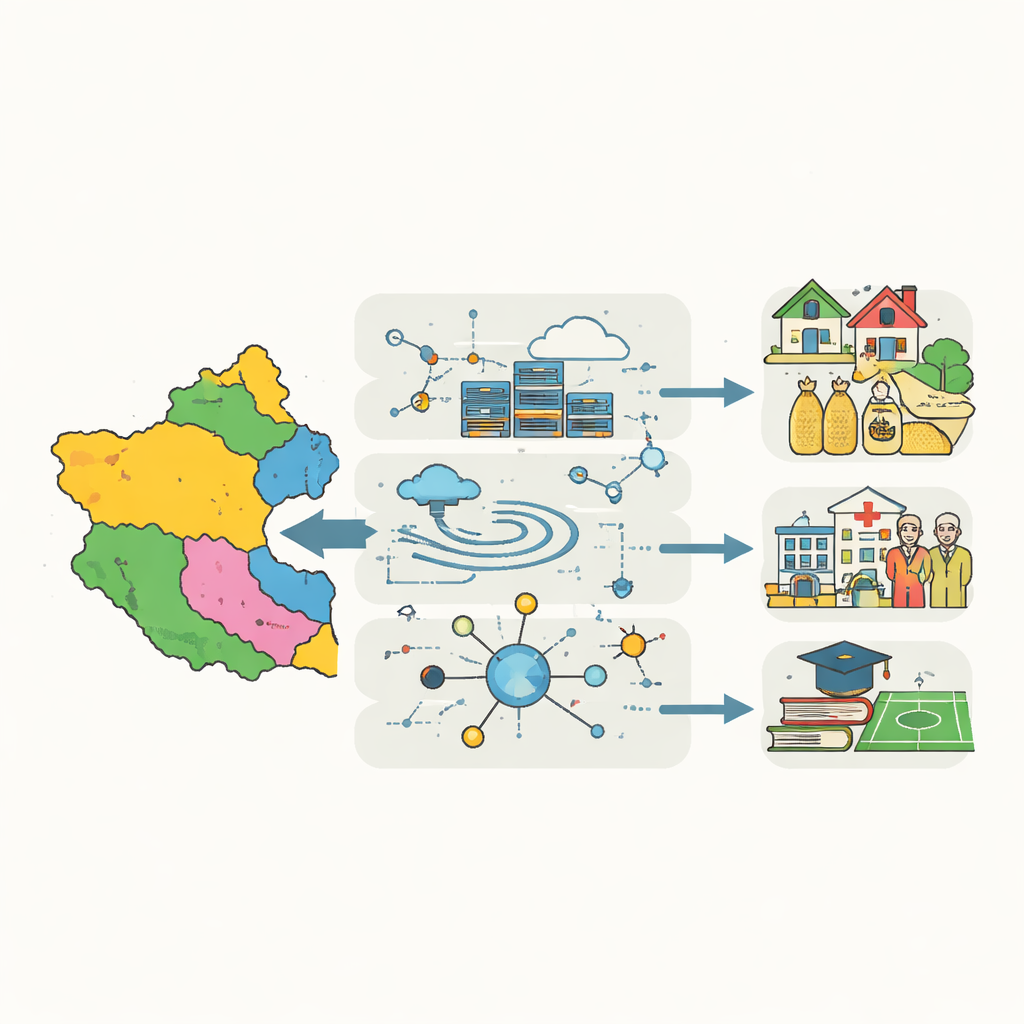
The study looks at 752 counties in 12 western provinces from 2014 to 2022, treating counties as the frontline units that actually run schools, hospitals, housing programs, and social security. It measures three broad groups of services—basic livelihood (income, healthcare, housing), social welfare (support for children, the elderly, and vulnerable groups), and education, culture, and sports—using detailed per‑person indicators. Overall, service quality improved by almost 80 percent in this period, with the fastest gains in education and cultural activities and the slowest in core livelihood support, which still lags behind. Maps and spatial statistics reveal strong geographic clustering: high‑service counties often sit next to each other, while weaker counties form their own "low‑low" clusters, especially in more remote or fiscally constrained areas such as parts of Yunnan and Guangxi.
What the Digital Economy Brings
The author builds a composite index of the digital economy with three pieces: informatization (telecom infrastructure and data systems), internet development (users, broadband, government sites), and digital transactions (online payments and inclusive finance). Sophisticated spatial models show that, within a county, higher digital development is clearly linked to better public services in all three categories, with the strongest effects in education, culture, and sports, and the weakest in basic livelihood. Online education platforms, digital libraries, and cultural content travel easily over networks, while transforming income support, hospitals, and housing systems takes more time and physical investment. However, the same models reveal a darker side: counties that race ahead digitally can draw people, talent, and resources away from their neighbors, creating negative spillovers that leave surrounding areas further behind.
When Context Helps or Hinders
A key finding is that the digital economy does not work in a straight, one‑size‑fits‑all way. Its impact depends heavily on four local conditions: how crowded a county is, how rich it is, how advanced its industrial structure is, and how tight its budget is. In sparsely populated counties, digital tools dramatically cut distance costs and open access to services; as density rises, these gains shrink, and beyond roughly 298 people per square kilometer the positive effect largely disappears or even turns negative as systems become overloaded and competition for resources intensifies. By contrast, higher income levels amplify digital benefits: once per‑person GDP passes about 26,500 yuan, the boost to education, culture, and social welfare becomes much stronger, and climbs again at higher income thresholds. Counties that have shifted toward a service‑oriented economy also see bigger digital gains in education and cultural services, but may leave some social welfare needs behind if support for vulnerable groups does not keep up.

Budgets, Bottlenecks, and Digital Dividends
Public finances emerge as a quiet but powerful moderator. Where local governments can barely cover their spending—measured by a low ratio of revenue to expenditure—even a noticeable jump in informatization yields only tiny improvements in services. As this ratio rises mainly through spending cuts rather than genuine revenue growth, the digital push is starved of funds: investments in broadband, data platforms, and online service portals are delayed or scaled back, and the positive effects of digitalization fade. In such situations, the study argues that central and provincial authorities should step in with targeted transfers to pay for basic digital infrastructure, local digital literacy, and shared online platforms, especially in poorer, high‑density counties that are otherwise at risk of being left further behind.
What This Means for Residents and Policymakers
Put in everyday terms, the article shows that digital tools can indeed help bring better schools, clinics, welfare programs, and cultural opportunities to people in western China—but only when they rest on solid economic and fiscal foundations and when population pressures are manageable. In rich or steadily upgrading counties, digital platforms help services spread faster and more fairly. In crowded or cash‑strapped counties, they can instead deepen gaps, as better‑connected neighbors pull away. The author concludes that closing these divides will require not just more fiber‑optic cables and apps, but careful coordination of digital investment with regional planning, industrial policy, and fiscal support so that the promise of the digital economy translates into tangible improvements in everyday public services for all.
Citation: Huang, X. Spatiotemporal impacts and nonlinear moderating effects of the digital economy on county-level public services in western China. Humanit Soc Sci Commun 13, 480 (2026). https://doi.org/10.1057/s41599-026-06625-1
Keywords: digital economy, public services, western China, spatial inequality, local governance