Clear Sky Science · en
Demographic decline and resurgence in the aging century - grid-level population tendency grasped by artificial intelligence
Why Japan’s Population Future Matters to Everyone
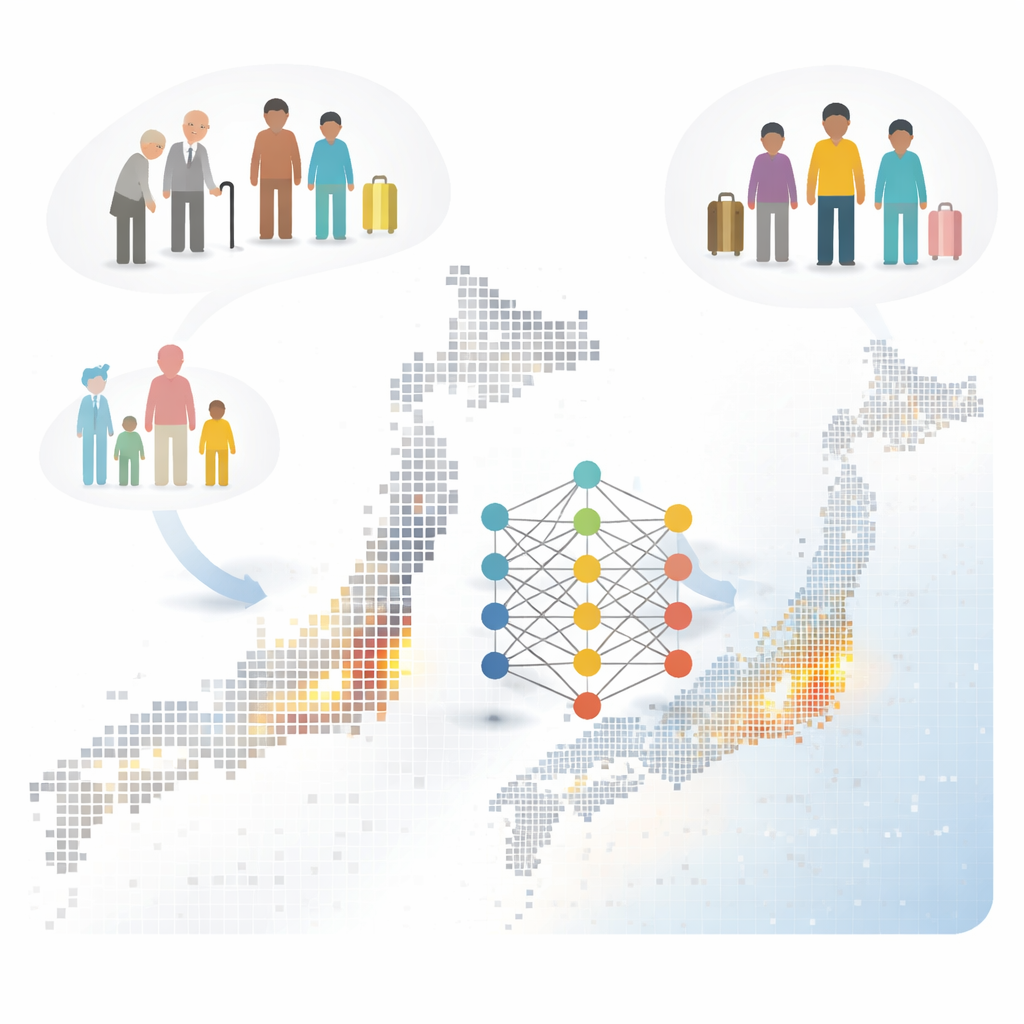
Japan is entering a new demographic era: fewer babies, more older people, and whole neighborhoods slowly emptying out. This study asks what that future will actually look like on the ground, not just for the country as a whole but for each tiny patch of land. Using powerful computer models, the authors forecast how many people will live in every 500-meter square across Japan through the year 2100. Their results reveal not only decline, but also surprising patterns of concentration, rising immigration, and new risks of living alone—offering lessons for any country facing aging and shrinking communities.
Looking at a Country One Small Square at a Time
Instead of treating Japan as a single number on a chart, the researchers break the country into more than 1.5 million small grid cells, each about a quarter of a square kilometer. For every grid, they collect past census counts of people, men and women, different age groups, and households, along with clues about local activity such as nighttime lights seen from satellites. They also add information from city-level forecasts: births, deaths, people moving in and out, and how many residents are young, working-age, or older. This fine-grained view lets them capture sharp contrasts between dense city centers, fading suburbs, and rural villages that are losing people.
Teaching Computers to See Demographic Patterns
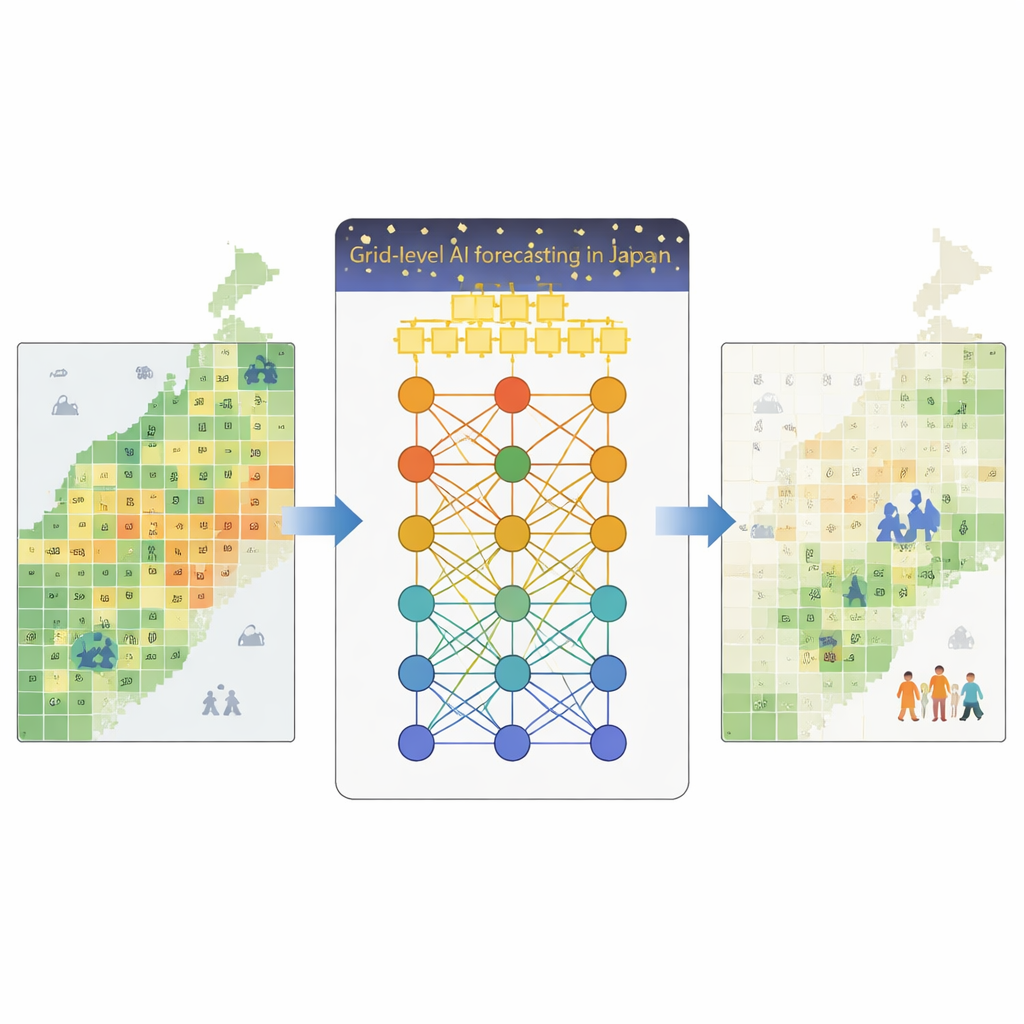
To turn these data into long-range forecasts, the team builds a deep learning model called Fureco-152, with more than three million adjustable parameters. The model looks at each grid together with its neighbors, its city, its nighttime brightness, and its location, then learns how those features have shaped population changes in the past. It is trained and tested repeatedly on earlier decades to ensure that it can correctly “rediscover” known census results. Once trained, the model steps forward in five-year intervals from 2020 to 2100, updating itself as new predicted data become available. A companion model does the same for nighttime lights, so the system can keep using that signal even beyond the years where satellite measurements already exist.
Decline, Concentration, and New Kinds of Communities
The national picture that emerges is stark: Japan’s population is projected to slip below 100 million around 2055, fall to about 90 million by 2070, and then level off with a modest rebound toward the end of the century. Yet this overall decline hides dramatic local changes. By 2100, more than half of all grid cells are expected to be uninhabited. Remote areas and smaller cities lose people fastest, while Tokyo and its surrounding cities continue to draw residents. In many big-city neighborhoods, the number of households grows even as the total population shrinks, meaning more people live alone or in very small families. The share of children drops almost everywhere, while older adults climb to roughly 30 percent of the population for decades before easing slightly. At the same time, foreign residents steadily increase and form stable clusters, with thousands of grids becoming places where immigrants make up the majority.
What These Patterns Mean for Everyday Life
These grid-level forecasts point to very practical challenges. Shrinking, scattered populations will make it harder to pay for and maintain roads, schools, hospitals, and public transport in many regions, while booming city cores must adapt to aging residents, smaller families, and more diverse communities. Emptying grids suggest that some land may be best returned to nature, while others may need new kinds of housing and care systems to combat loneliness. The authors stress that their results are not destiny: major shifts in policy, culture, or the economy could change these paths. Still, by showing where decline, aging, and immigration are likely to hit hardest, their maps give planners and communities a powerful tool to design flexible, place-based responses—helping Japan, and by example other countries, move toward a sustainable and humane “aging century.”
Citation: Li, C., Keeley, A. & Managi, S. Demographic decline and resurgence in the aging century - grid-level population tendency grasped by artificial intelligence. Humanit Soc Sci Commun 13, 601 (2026). https://doi.org/10.1057/s41599-026-06605-5
Keywords: Japan aging population, population forecasting, urban rural decline, deep learning demography, immigration and cities