Clear Sky Science · en
A quantum algorithm for localization using limited cellular information
Finding You with Just One Signal
Modern phones are constantly asked, “Where are you?”—for maps, ride-hailing, emergency calls, and more. Yet many devices can listen to only one cell tower at a time, throwing away a wealth of nearby information that would make pinpointing your position easier. This paper explores how ideas from quantum computing can squeeze far more location accuracy out of that single, modest signal, potentially reshaping how future phones and networks figure out where we are.

Why One Tower Is Not Enough
Today’s location technologies each come with trade-offs. GPS is powerful but drains battery and often fails indoors. WiFi-based methods can be accurate but require dense wireless coverage. Motion sensors in phones drift over time. Cellular positioning—using which towers your phone can hear—is attractive because it works almost everywhere and uses little power. However, the mobile standards and operating systems on most phones, including all iPhones and most Android devices, only expose the single tower your phone is currently connected to. Older research assumed access to several neighboring towers at once, and when that rich view is reduced to just one tower, accuracy can degrade by more than a factor of two. New ideas are needed that work with this harsher information diet.
Turning a City into a Sequence
The authors’ first step is to rethink how a city or neighborhood is represented for location purposes. Instead of storing a huge, separate “fingerprint” for every point, they build a graph of possible user positions—discrete spots such as corners and sidewalk points—connected by edges that reflect where people can actually walk. By letting a computer perform a long random walk on this graph, they generate one long reference sequence describing which cell towers are typically heard along plausible paths. Each position in this master sequence is then converted into several simple yes-or-no tracks: one track per tower, marking whether that tower is heard at that step. This compact representation makes later matching much easier to scale.
Letting Quantum Physics Search for Matches
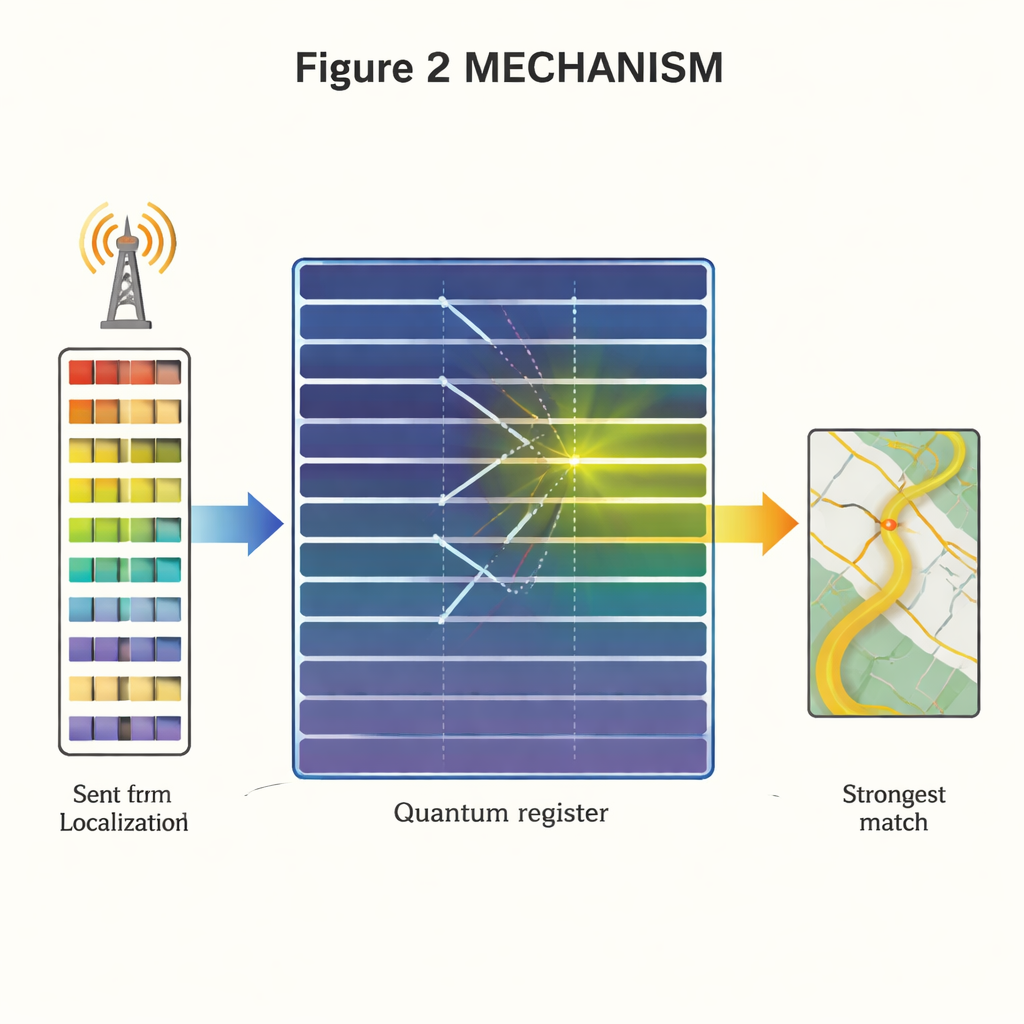
When a user is moving, their phone quietly records the identity of the serving tower over a short history window—perhaps a few recent seconds. This produces another sequence: the online trace. The core challenge is to find where this short trace best fits inside the long reference sequence. Classically, one would slide the window along every possible position and compare, a process that becomes painfully slow and memory-hungry as cities and datasets grow. The proposed quantum algorithm tackles this matching in a radically different way. It encodes all candidate positions in a quantum register at once, along with the bits describing which tower is heard at each step. Quantum operations then compute, in parallel, how different each candidate segment is from the phone’s recent history, and a special search procedure known as Grover’s algorithm boosts the likelihood of reading out the best-matching position when the quantum state is measured.
From One Tower to a Map Pin
In practice, the user may have heard a few different towers over their short history. The algorithm handles each tower’s binary track separately, getting a candidate location estimate from each, then blends these into a single map pin using a weighted average that favors more confident matches. The authors analyze how many quantum bits the method needs and how long it runs, showing that it offers a quadratic speedup in time and an exponential saving in memory compared with the best classical methods that perform a similar kind of sequence matching. They implement the algorithm on IBM’s quantum simulator and test it using real outdoor measurements from a 0.2 square kilometer urban area covered by 21 cell towers. The quantum method matches the accuracy of its classical rival while maintaining its theoretical efficiency advantages.
What This Means for Future Phones
The study demonstrates that a carefully designed quantum algorithm can turn limited, single-tower cellular data into highly accurate location estimates—achieving median errors around 10 meters, well within regulatory requirements for emergency calls. While today’s quantum hardware cannot yet run this approach at city-wide scale, the work lays out a clear blueprint: if future quantum machines provide more stable and numerous qubits, they could power large-scale, low-latency positioning systems that respect current privacy and platform constraints while still delivering precise, energy-efficient localization.
Citation: Shokry, A., Youssef, M. A quantum algorithm for localization using limited cellular information. npj Wirel. Technol. 2, 20 (2026). https://doi.org/10.1038/s44459-026-00033-2
Keywords: cellular localization, quantum computing, mobile positioning, location-based services, Grover search