Clear Sky Science · en
Direct air capture has substantial health and climate opportunity costs
Why This Debate Matters for Our Future
As the world scrambles to slow climate change, a big question looms: should scarce climate dollars go into gleaming machines that pull carbon dioxide from the air, or into wind turbines and solar farms that prevent pollution in the first place? This study weighs those options for the United States, counting not only their impact on the climate but also on people’s health. It shows that where we put our money today can mean the difference between cleaner air and hidden health harms tomorrow.
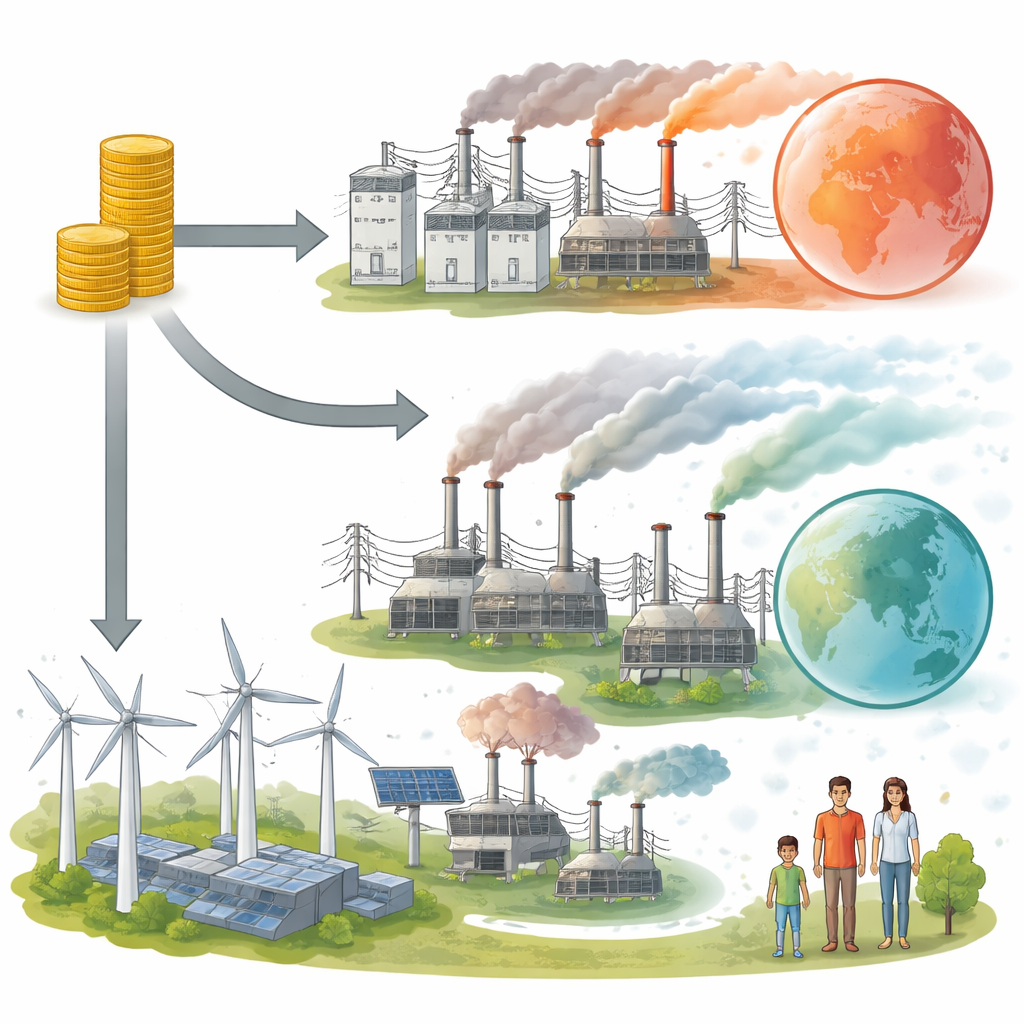
Two Different Paths to Cleaner Air
The paper compares two very different strategies. Direct air capture uses chemical equipment to strip carbon dioxide from ambient air, then stores it underground. It does not directly cut smokestack emissions and must be powered by large amounts of electricity, which often still comes from fossil fuels. By contrast, wind and solar power prevent emissions by replacing coal- and gas-fired power plants on the grid. That swap not only lowers greenhouse gases but also cuts soot- and smog‑forming pollution that harms lungs and hearts. Because governments and companies have limited budgets for climate action, the authors frame the issue as an “opportunity cost”: every dollar spent on one solution is a dollar not spent on the other.
Putting Numbers on Climate and Health
The researchers modeled what would happen if the same annual investment—equivalent to 100 million U.S. dollars—were spent on direct air capture, utility‑scale solar, or onshore wind in 22 power‑grid regions across the contiguous United States from 2020 to 2050. They tested four possible futures for direct air capture, ranging from a pessimistic “stagnation” case similar to today’s technology to an optimistic “breakthrough” with much lower costs and energy use. Using existing grid and health models, they estimated how each choice would change carbon dioxide and key air pollutants, then translated those changes into climate damages avoided and premature deaths prevented, expressed in dollars.
What the Comparison Reveals
Across nearly all regions, years, and technology assumptions, building more wind and solar delivered far greater combined climate and health benefits per dollar than building direct air capture. In the stagnation case, grid‑connected direct air capture actually made things worse overall through 2050: the extra fossil‑fueled electricity needed to run the machines created more greenhouse gases and local air pollution than the captured carbon could offset. Even under more efficient and somewhat cheaper designs, direct air capture barely broke even and still lagged far behind renewables. Only under the most optimistic breakthrough scenario—very cheap and energy‑lean machines—did grid‑connected direct air capture slightly outperform renewables on average, and even then wind or solar remained the better choice in many parts of the Midwest and other regions.
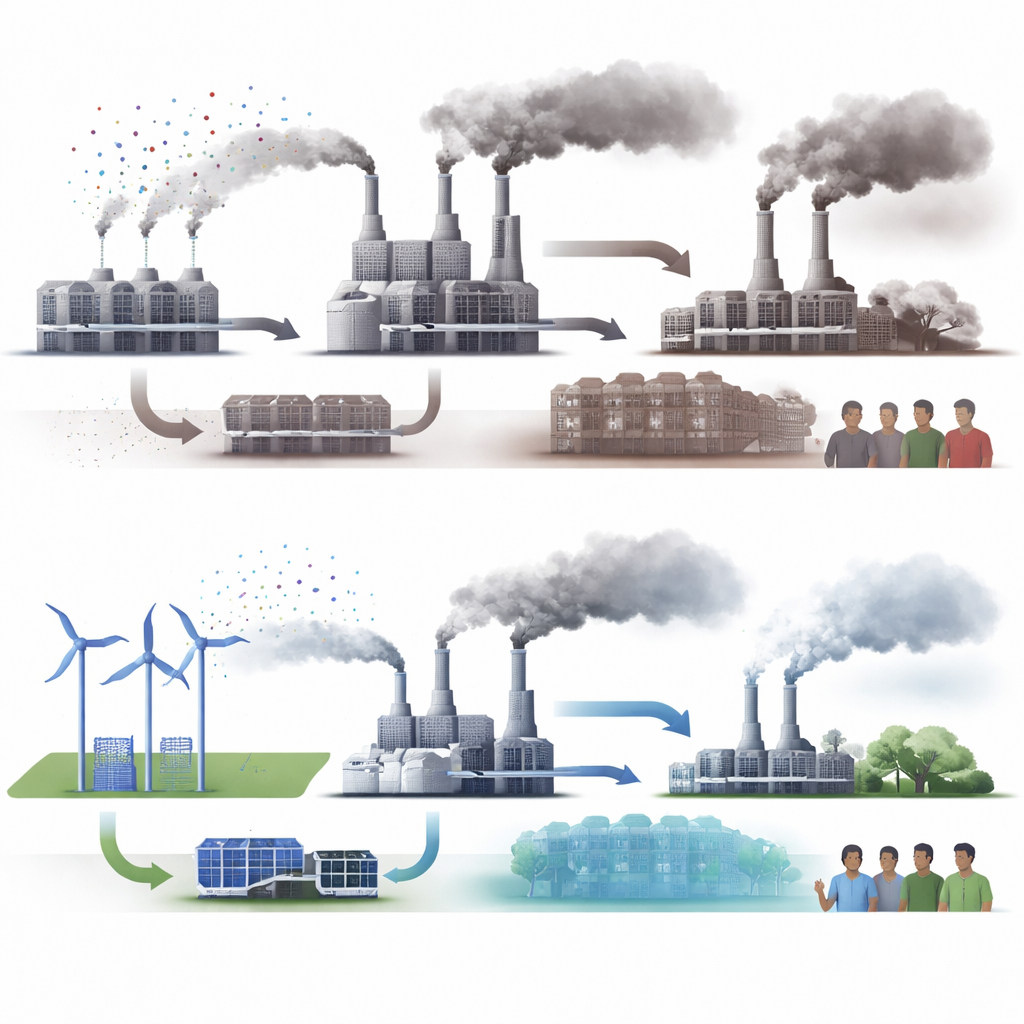
Uneven Impacts Across the Map
The balance between these options depends strongly on the local power mix. In states and regions already rich in renewable electricity, such as California or the Pacific Northwest, the added pollution from running direct air capture plants is smaller, so a breakthrough version can sometimes be the top performer by 2050. In coal‑ and gas‑heavy grids, however, using clean electricity to push more renewables onto the system consistently delivers much larger health and climate gains. Another key finding is that almost all of the dollar‑valued benefit in these calculations—about 93 percent—comes from avoided climate damages, but the remaining share, which reflects cleaner local air, is highly concentrated in space and time. People living near fossil power plants bear the health burden of extra electricity generation for direct air capture, while the climate benefits of any carbon removal are spread worldwide and far into the future.
Rethinking When to Use Big Machines
The authors argue that simply achieving net carbon removal is not enough to justify large‑scale deployment of direct air capture while the grid is still dirty. For this technology to be a smart investment, the electricity system must already be so low‑carbon that additional dollars buy more benefit by pulling carbon out of the air than by adding new renewables. Their framework suggests a sensible sequence: first use clean energy to shut down as much fossil generation as possible, reaping immediate health rewards and lower climate risk, and only then bring direct air capture to scale as a tool for cleaning up the remaining “carbon debt.” In plain terms, it makes more sense to turn off the tap before mopping up the spill.
Citation: Kashtan, Y., Pendleton, J., Sousa, B. et al. Direct air capture has substantial health and climate opportunity costs. Commun. Sustain. 1, 67 (2026). https://doi.org/10.1038/s44458-026-00068-0
Keywords: direct air capture, renewable energy, climate policy, air pollution health, energy transition