Clear Sky Science · en
Large language model reveals an increase in climate contrarian speech in the United States Congress
Why this matters for everyday voters
When members of the U.S. Congress talk about climate change, they are not just debating science—they are shaping what the public believes and what policies ever see the light of day. This study uses a powerful new language-based AI tool to sift through three decades of Congressional speeches, revealing how arguments that cast doubt on climate action have changed over time, which politicians use them most, and how closely they track big climate policy fights. Understanding these patterns helps citizens recognize talking points that slow or block solutions, even when they sound reasonable at first glance.

Mapping the new language of pushback
The researchers began by updating a detailed catalog, or “taxonomy,” of common arguments used to question climate science or delay climate action. Earlier work had already grouped these into familiar themes, such as claims that global warming is not happening, that humans are not responsible, or that the impacts will be mild. The new study sharpened the categories dealing with solutions, teasing apart arguments that attack proposed climate policies from those that praise fossil fuels as essential. It also separated criticism of climate science itself from attacks on scientists and advocates. This finer-grained map makes it easier to tell the difference between honest doubts and talking points crafted to undermine trust or stall change.
An AI model trained to listen for patterns
To apply this framework to the enormous archive of Congressional speeches, the team built a custom large language model—a type of AI trained to understand and label text. They first used existing climate-focused tools to pull out paragraphs that mention climate change from more than 2.5 million floor-speech passages between 1994 and 2024. Human experts then hand-labeled a sample of these paragraphs using the revised taxonomy, providing examples of dozens of specific claim types. The AI was fine-tuned on these examples using a method that teaches it to “think aloud,” stepping through its reasoning before choosing labels. This allowed a relatively small, cost-effective model to perform nearly as well as far larger, more expensive systems, while being practical to run on huge collections of speeches.
From outright denial to arguments of delay
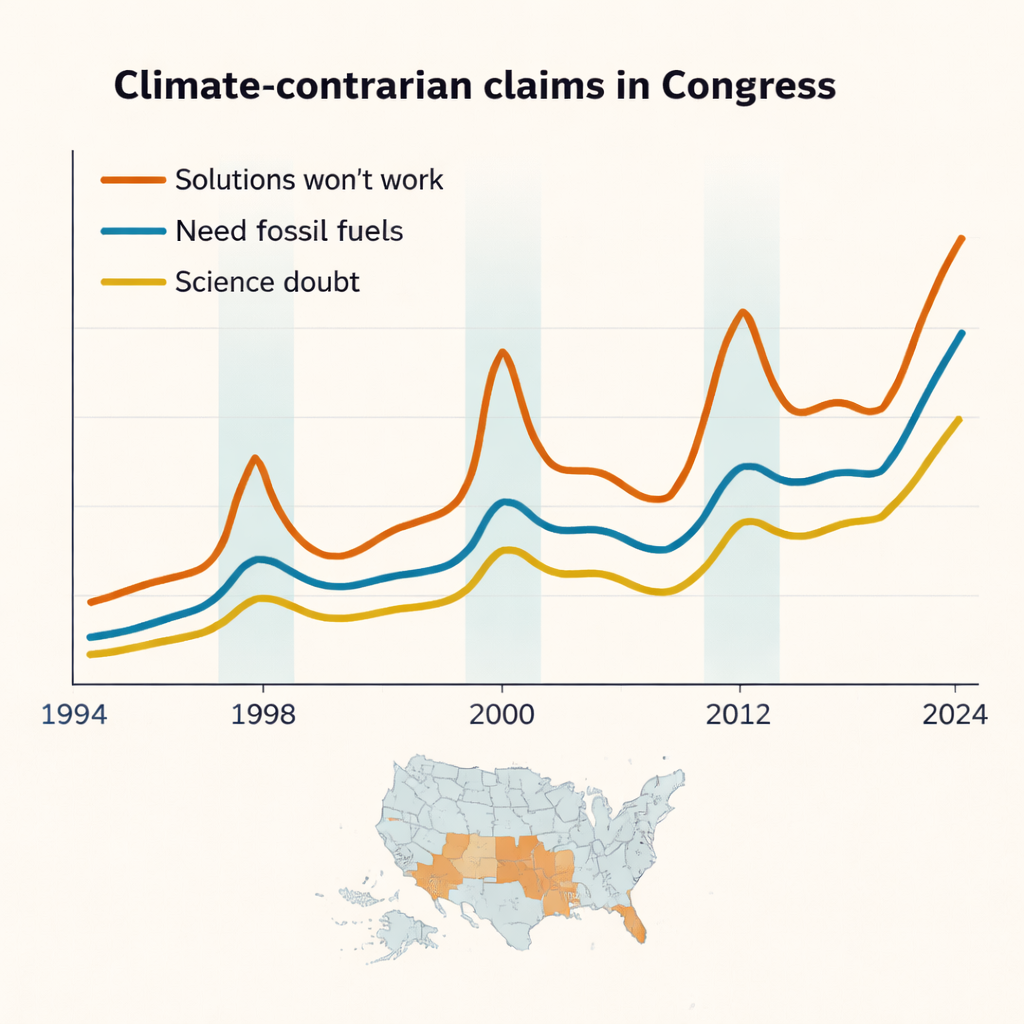
Once trained, the AI scanned climate-related speeches across 30 years of Congressional debate. It found that the most common form of contrarian talk was not outright denial of global warming, but repeated claims that climate solutions are too costly or unworkable. Arguments that policies would kill jobs, hurt vulnerable people, or amount to a “war on American energy” alone made up roughly one third of all contrarian claims. Praise for fossil fuels as necessary for economic growth and energy security was also widespread. Direct attacks on climate science and assertions that warming is not real or not caused by people appeared less often, but they spiked at key political moments such as the 1997 Kyoto negotiations, the 2008–2009 cap-and-trade debate, and the 2015 Paris Agreement and Clean Power Plan. Over time, denial did not vanish; instead, delay-focused arguments piled on top of it.
Who is talking, and where they come from
The analysis uncovered a striking partisan divide. For every floor speech by a Democrat that included a contrarian claim about climate, there were about 13 such speeches by Republicans. Overall, Republicans accounted for more than nine out of ten contrarian speeches across all categories. When the authors adjusted for how many members each state sends to Congress, a handful of fossil-fuel-heavy states—such as Alaska, Wyoming, and West Virginia—stood out as intense hotspots, especially for claims that solutions will not work or that the country needs fossil fuels. Statistical modeling showed that party identity and political ideology were by far the strongest predictors of contrarian speech. Factors like age, gender, campaign contributions from fossil fuel interests, and local fossil fuel employment also mattered, but their effects were comparatively modest.
What this means for public debate
The authors emphasize that not every skeptical remark about climate policy is misinformation; people can raise real concerns about costs or fairness. But because Congressional speeches heavily influence news coverage and public opinion, the systematic use of certain arguments can blur the line between healthy debate and organized obstruction. The study shows that, as climate science has grown more solid, Congressional pushback has shifted toward casting doubt on solutions and defending fossil fuels, especially among Republicans. By combining psychological insights about how misleading arguments work with modern AI that can track them at scale, the authors argue we can better monitor how such narratives spread, design more effective fact-checking and public education, and preserve space for genuine democratic discussion about how to tackle climate change.
Citation: Coan, T.G., Malla, R., Nanko, M.O. et al. Large language model reveals an increase in climate contrarian speech in the United States Congress. Commun. Sustain. 1, 37 (2026). https://doi.org/10.1038/s44458-025-00029-z
Keywords: climate misinformation, US Congress, fossil fuels, climate policy, large language models