Clear Sky Science · en
Impacts into the lunar permanently shadowed regions
Hidden Ice at the Moon’s Dark South Pole
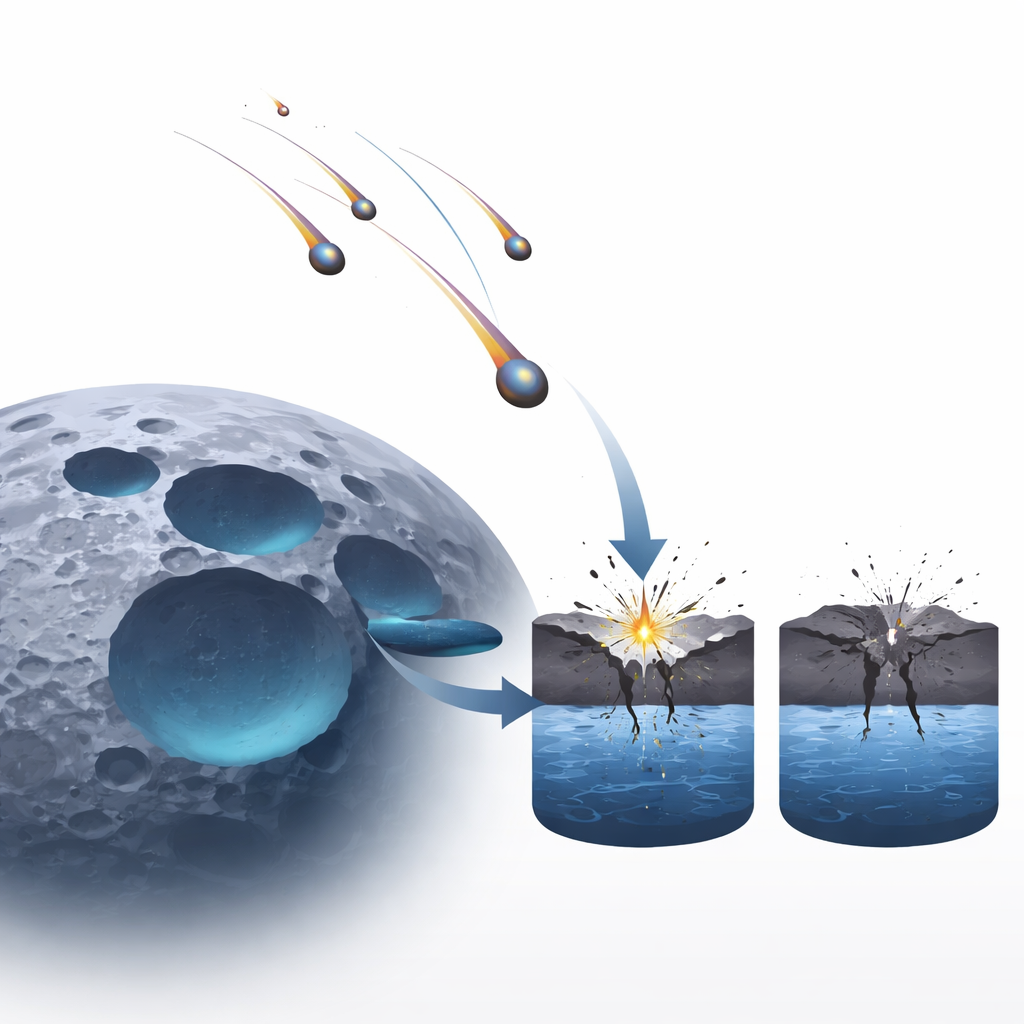
Deep inside craters near the Moon’s south pole, sunlight never shines. These permanently shadowed pockets act as natural freezers, where water ice delivered over billions of years may still survive. Understanding how this ice is stirred, buried, or lost by constant meteor impacts is crucial—not just for science, but for future astronauts who may one day mine this ice for drinking water, air, and rocket fuel. This study asks a simple but important question: after so many impacts, how much of that precious polar ice is likely still there, and where should explorers look for it?
Dark Craters and a Landscape Full of Dents
The researchers focused on the Moon’s south polar region between 85 and 90 degrees south latitude, home to hundreds of permanently shadowed craters. Using ultra-sensitive images from South Korea’s ShadowCam instrument and India’s Chandrayaan-2 orbiter camera, they carefully mapped craters as small as one meter across. They found nearly 87,500 craters larger than five meters inside shadowed areas bigger than one square kilometer, and used detailed counts from a smaller test region to build a model of how many very small craters likely exist across the whole zone. Their analysis suggests roughly 24 million tiny craters between one and twenty meters wide pepper these dark regions.
Where Impacts Hit and Where They Miss
With this crater census, the team estimated how much surface area inside permanently shadowed regions is directly disturbed by small impacts. They found that in the largest shadowed areas with relatively gentle slopes, about 26 percent of the surface is covered by these small craters. That means roughly three-quarters of the flat, shadowed terrain has not been punched through by fresh small craters, even though it is still affected by falling debris and shaking from impacts nearby. The same approach applied to thousands of tiny shadowed pockets suggests that some very small cold traps host only a handful of craters, while others pack many more. In all cases, the picture is of a surface that is heavily dented, but still far from completely churned up.
How Craters Stir, Expose, and Bury Ice
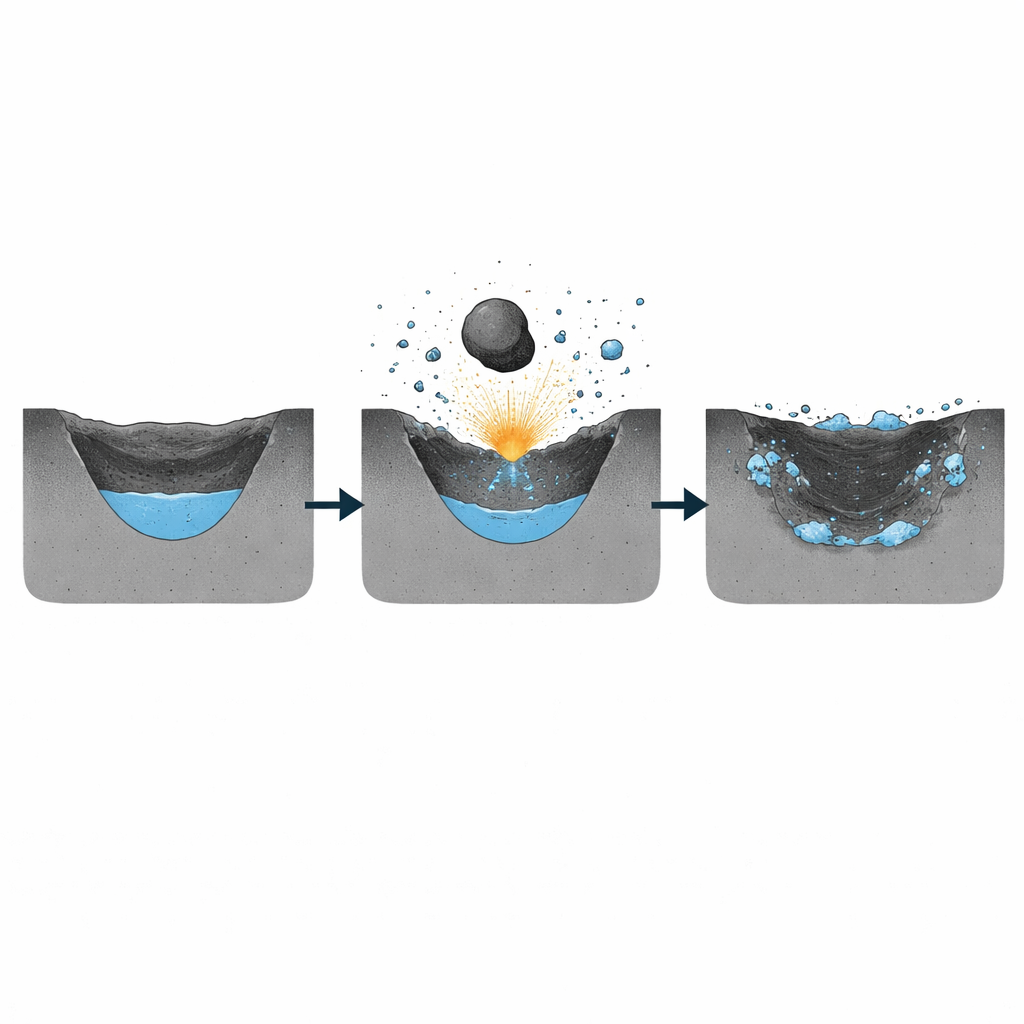
To see what these impacts actually do to buried ice, the team ran computer simulations of projectiles hitting a cold, porous lunar surface laced with subsurface ice. In cross-section, the ground is imagined as a layer of dusty soil sitting on top of ice-rich zones a few to tens of meters down. Simulated one-meter craters disturb ice close to the surface, jostling and mixing it with soil, while a 200-meter crater blasts away almost all the shallow ice inside its bowl. Yet the same large impact also throws some icy material out of the cavity, where it can rapidly cool and be reburied around the crater rim or fall into nearby cold pockets. This process both destroys ice where the crater forms and helps preserve it in sheltered spots just outside.
How Much Ice Gets Excavated Over Time
Using the known amount of water thrown out by the LCROSS impact mission as a reference, the researchers scaled up to estimate how much ice all those millions of tiny south polar craters might have dug out. Their model suggests that small impacts between one and twenty meters across could have excavated on the order of hundreds of millions of kilograms of water ice from shallow layers in the studied polar band alone. This is only a small fraction of the total ice thought to have been delivered to the Moon’s poles, but it shows that the polar “freezer” is not static. Over the last billion years, countless small hits have continually exposed, redistributed, and sometimes removed ice from just a few meters below the surface.
Why This Matters for Future Moon Explorers
Despite the relentless battering by impacts, the study concludes that large portions of the Moon’s south polar shadows still have good odds of preserving shallow buried ice. Most of the gently sloping, permanently shadowed ground has escaped direct hits from the smallest craters, though it has been blanketed by ejecta that can both protect and slowly mix icy layers. Bigger craters can rob their interiors of ice while planting new frozen material around their rims and in nearby micro-cold traps. For future missions hoping to sample or harvest lunar ice, this work highlights promising targets: flat shadowed areas that have avoided too many recent small impacts, as well as rim zones where reburied ice may lurk just a few meters below the surface.
Citation: Vijayan, S., Rama Subramanian, V., Sahoo, R. et al. Impacts into the lunar permanently shadowed regions. npj Space Explor. 2, 17 (2026). https://doi.org/10.1038/s44453-026-00032-1
Keywords: lunar ice, moon south pole, impact craters, permanently shadowed regions, space resources