Clear Sky Science · en
Impact-induced high-temperature formation of metallic copper and bornite in Chang’e-6 lunar soils
Why Moon Dust Can Hide Useful Metals
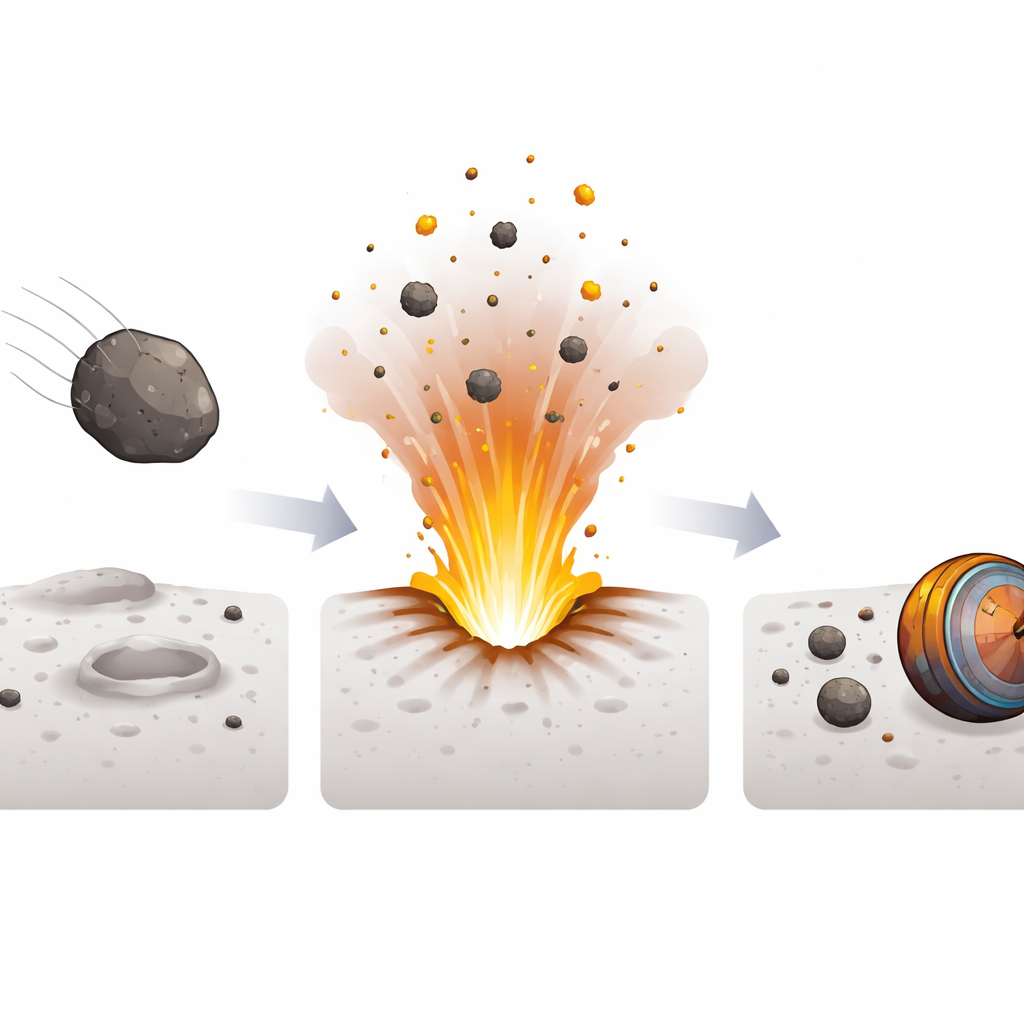
As space agencies and companies look toward mining the Moon and asteroids, a key question emerges: how do valuable metals like copper move and concentrate on worlds with no air? This study of a single, unusual copper-rich grain from China’s Chang’e‑6 lunar mission reveals that violent meteorite impacts act like natural high‑temperature smelters, melting, boiling, and redepositing metals in ways that could shape future extraterrestrial resource use.
A Rare Copper Grain in Far-Side Soil
The Chang’e‑6 lander collected soil from the Moon’s far side, in the giant South Pole–Aitken basin, a region heavily reshaped by impacts. Among more than 100,000 tiny soil particles examined with automated electron microscopes, the team found just one grain about 15 micrometers across that was unusually rich in copper. This grain sat within a glassy clump of material formed by impacts and showed bright signals of copper, iron, and sulfur. Its rarity underlines how sparsely copper is scattered in lunar soil and makes this grain a precious window into how copper behaves under extreme impact conditions.
Peering Inside with Powerful Microscopes
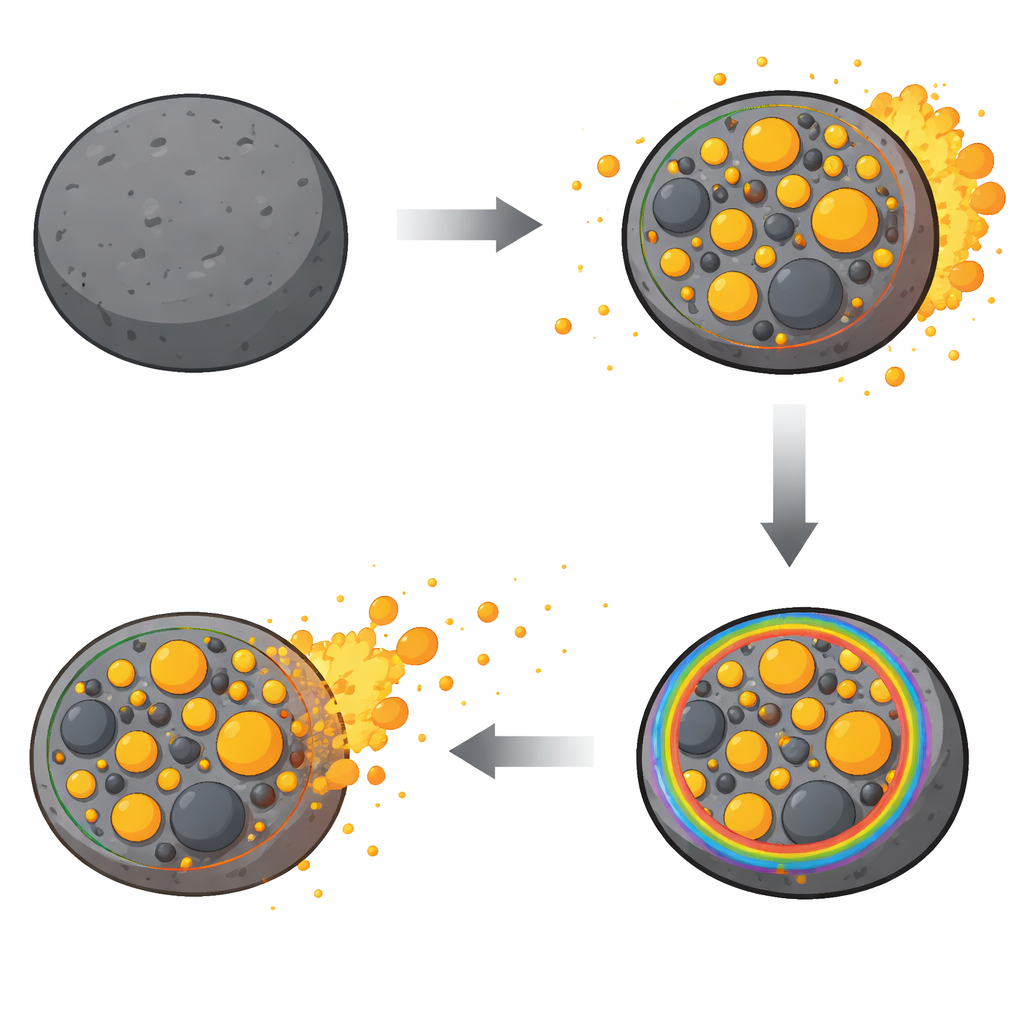
Using focused ion beams, the researchers sliced an ultrathin cross‑section of the grain and examined it with advanced transmission electron microscopes. Inside, they discovered a complex structure: a large particle of pure metallic iron, an enclosing sulfide mineral originally similar to troilite (an iron sulfide), and an accessory crystal of apatite, a phosphate that forms late in cooling lunar lavas. The copper‑bearing region itself was divided into three zones. At the surface lay a thin coating only about 200 nanometers thick; beneath it a narrow band poor in copper but dotted with metallic iron and tiny bubbles; and deeper still, a core zone filled with submicroscopic droplets of nearly pure metallic copper and metallic iron trapped within the sulfide host.
A Natural Furnace and Metal Separator
Chemical signals and diffraction patterns revealed that the outer coating is dominated by the mineral bornite, a copper‑iron sulfide containing copper in high proportion and iron in an oxidized form. The mound‑like texture and uniform thickness of this coating, confined to the grain’s outer skin and lacking silicate material, point to formation from a vapor that condensed back onto the surface. Inside the grain, the mix of metallic copper, metallic iron, and sulfur‑poor sulfide matches what thermodynamic models predict when a copper–iron–sulfur mixture is heated to more than about 1,000 degrees Celsius under low sulfur conditions. In other words, an impact heated the pre‑existing sulfide so strongly that it partly melted, separated into metal‑rich droplets, and released sulfur gas, leaving behind pockets of copper and iron metal.
How Vapor and Cooling Build a Copper-Rich Shell
The intermediate copper‑free band with iron metal and bubbles records a second high‑temperature effect: sulfur boiled away from the outer part of the grain in the vacuum of the lunar surface, turning iron sulfide into metal plus gas. At the same time or in a later impact, components rich in copper and sulfur were driven off as a vapor from the hotter interior zone where copper and iron metals coexisted with sulfide. As this vapor cooled and recondensed, it settled back onto exposed grain surfaces as a thin bornite layer made of many tiny crystals. According to phase‑diagram calculations, bornite is one of the stable end products as a copper–iron–sulfur melt cools, explaining why this coating formed so readily from the vapor.
What This Means for Future Space Resources
To a lay observer, this single speck of dust may seem trivial, yet it captures a full cycle of natural metal processing on an airless world: melting, separation of metals, loss of volatile elements, and recondensation as new mineral coatings. The study shows that impacts can concentrate copper into metallic form and copper‑rich sulfides, even without an atmosphere or flowing water. Over long timescales, such impact‑driven “metallurgy” could help gather useful metals into specific grains and zones within lunar and asteroid soils. Understanding these processes is crucial for judging how and where copper and other industrially important elements might accumulate, guiding future efforts to tap extraterrestrial resources.
Citation: Guo, Z., Song, D., Song, W. et al. Impact-induced high-temperature formation of metallic copper and bornite in Chang’e-6 lunar soils. npj Space Explor. 2, 13 (2026). https://doi.org/10.1038/s44453-026-00027-y
Keywords: lunar soil, copper minerals, meteorite impacts, space resources, bornite