Clear Sky Science · en
Delhi cannot clean its air alone: airshed-scale mitigation outperforms local controls even under unfavourable winter meteorology
Why Delhi’s Dirty Air Matters to Everyone
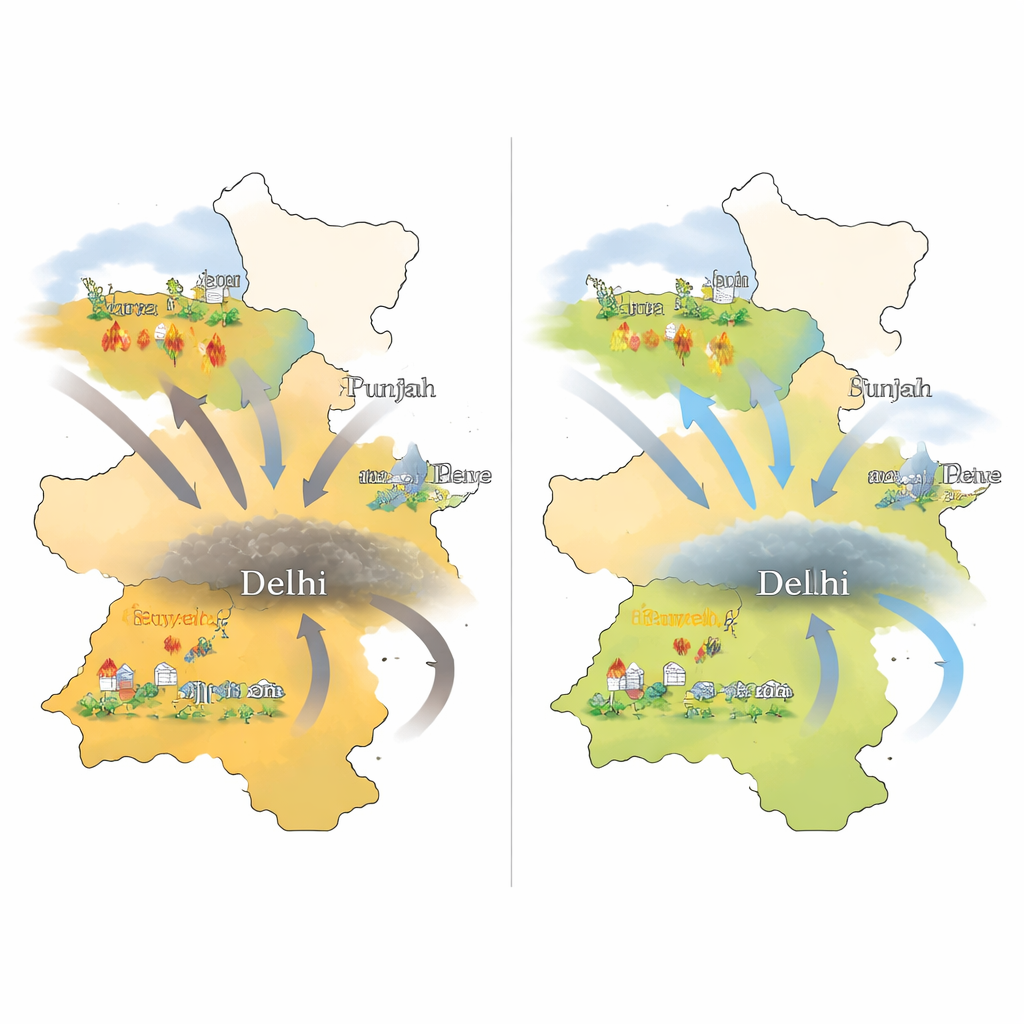
Every winter, headlines about Delhi’s choking smog capture global attention, but the story behind that haze reaches far beyond city limits. This study asks a simple but powerful question: can Delhi clean its air by acting alone, or does it need help from the wider region? Using advanced computer simulations, the authors show that the city’s dirtiest months are shaped by pollution drifting in from surrounding states as well as smoke and fumes generated at home. Their results reveal that only coordinated action across the entire “airshed” – the larger zone of air that flows into Delhi – can deliver the cleaner, healthier winters that millions of residents urgently need.
Where the Winter Smog Really Comes From
Delhi sits in the Indo-Gangetic Plain, a bowl-like region where air often stagnates during the cool months. In late autumn and winter, winds weaken, temperatures drop, and the atmosphere near the ground becomes very stable, trapping pollution close to the surface. At the same time, emissions surge from several sources: smoke from burning crop leftovers after the rice harvest in Punjab and Haryana, fumes from solid fuels used in household stoves, exhaust from vehicles, and pollution from factories and power plants. Together, these create a thick mixture of tiny particles known as PM2.5, which are small enough to penetrate deep into the lungs and bloodstream. Delhi’s yearly average PM2.5 is around 140 micrograms per cubic meter—roughly thirty times higher than the latest World Health Organization guideline.
Testing What City-Only Action Can Do
To untangle how much different sources and regions matter, the researchers used a detailed atmospheric model that tracks weather, chemical reactions, and pollution transport hour by hour from September 2019 through January 2020. They first tested what happens if controls are applied only within the National Capital Region, the broader urban and suburban area around Delhi. Even a total ban on burning crop residues inside this boundary barely moved the needle: winter PM2.5 in Delhi fell by only about 2–3 percent, showing that most of that smoke was blowing in from outside. Strong cuts in city household emissions helped more, reducing PM2.5 by about 13 percent, while similar cuts in traffic and industry gave smaller gains. When all three city sectors were halved and local crop burning banned, pollution still only dropped by roughly one quarter—and winter air remained far from safe.
Seeing the Power of Regional Teamwork
The picture changed dramatically when the same measures were extended across the wider airshed, including Punjab and Haryana. A ban on crop-residue burning across this region reduced Delhi’s particle levels by around 8–10 percent, three to four times more than the city-only ban. When this was combined with 50 percent cuts in residential, transport, and industrial emissions throughout the airshed, Delhi’s PM2.5 fell by about one third. Under this coordinated strategy, the number of winter days rated “Very Poor” on India’s national air quality scale dropped sharply, while “Satisfactory” days became common rather than rare. In an even more ambitious, nationwide scenario with similar cuts and a comprehensive crop-burning ban, Delhi and neighboring states saw reductions approaching half in wintertime PM2.5, and many more days with relatively clean air.
What’s in the Haze and Why It Lasts
The model also revealed what these particles are made of and how they evolve. Across northern India, smoke from homes that burn wood, dung, and other solid fuels turns out to be the single biggest year-round contributor to fine particles, providing roughly half of Delhi’s PM2.5 on average. During the peak burning season, open fires in farm fields dominate in Punjab and Haryana and still add a noticeable share to Delhi’s haze. Much of the pollution is not directly emitted as particles but forms in the air from gases released by fuel and waste burning, especially organic vapors, nitrogen oxides, and sulfur dioxide. In the cold season, these reactions and the stable, shallow air layers near the ground mean that more than half of Delhi’s particle pollution is “secondary” – created in the atmosphere – and difficult to disperse without cutting emissions at their source.
Why Clean Air Requires Shared Solutions
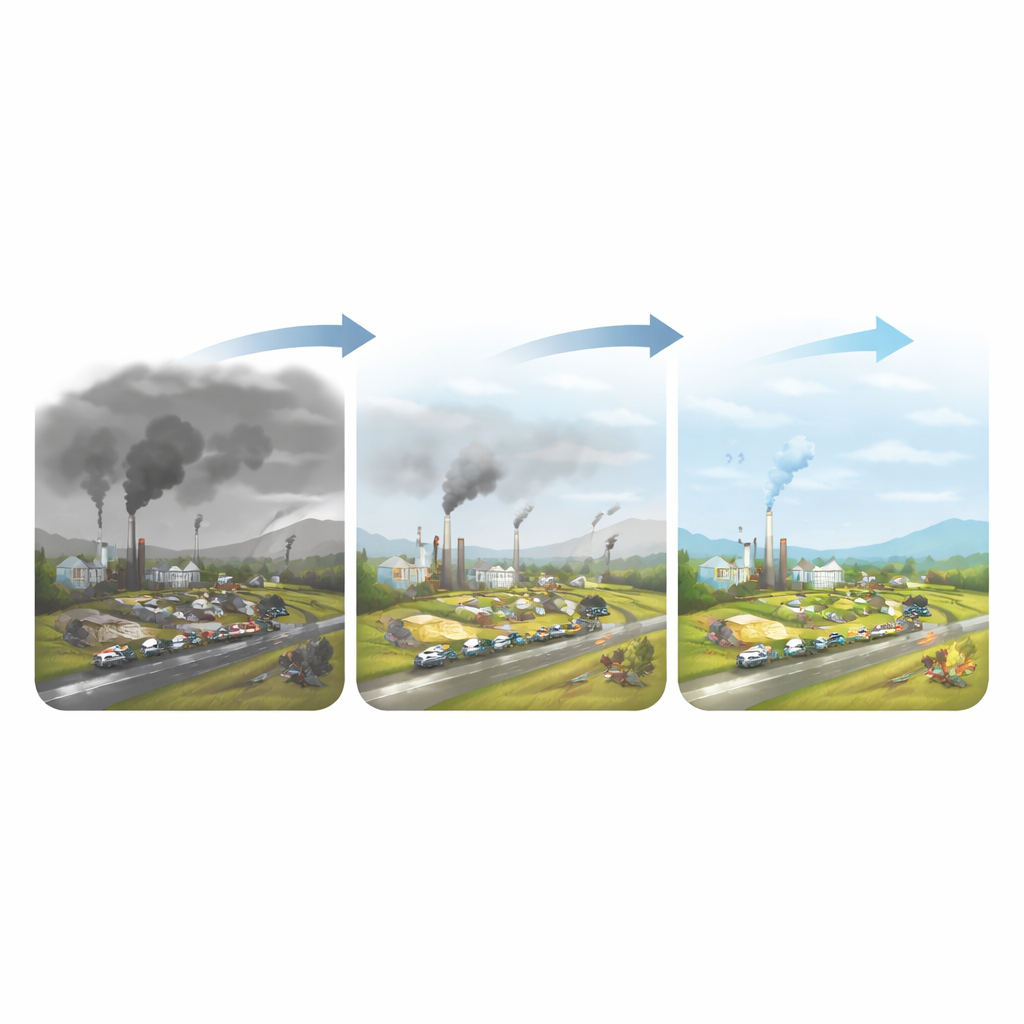
Perhaps the most sobering finding is that harsh winter weather patterns will continue to favor smog buildup, no matter what Delhi does within its own borders. Yet the study also offers a hopeful message: even under the worst stagnant conditions, coordinated cuts in smoke from households, vehicles, industries, and crop burning can still lower particle levels in Delhi by 40–50 percent. For residents, this would mean far fewer days of dangerous air, lower risks of heart and lung disease, and better visibility and sunlight in the city. The lesson is clear for policymakers and the public alike: Delhi cannot breathe easy unless the entire region that feeds its air—across multiple states and sectors—moves together toward cleaner fuels, cleaner technologies, and an airshed-wide approach to managing pollution.
Citation: Nandi, I., Ganguly, D., Habib, G. et al. Delhi cannot clean its air alone: airshed-scale mitigation outperforms local controls even under unfavourable winter meteorology. npj Clean Air 2, 27 (2026). https://doi.org/10.1038/s44407-026-00065-6
Keywords: Delhi air pollution, PM2.5, crop residue burning, airshed management, India winter smog