Clear Sky Science · en
Nuclear Conflict in Eastern Europe: Climate disruption and Radiological fallout
Why this matters for everyone
Most people think of nuclear war in terms of blast zones and mushroom clouds, but the greatest danger for humanity may come from what happens in the sky afterward. This study asks: what if a “limited” nuclear war broke out along the Ukraine–Russia border, far from most of the world’s population? Using an advanced climate model, the authors show that such a regional conflict could still dim sunlight, cool large parts of the planet, disrupt rainfall and crops, and spread radioactive contamination worldwide—affecting food, health, and security far beyond the battlefield.
Smoke that reaches the edge of space
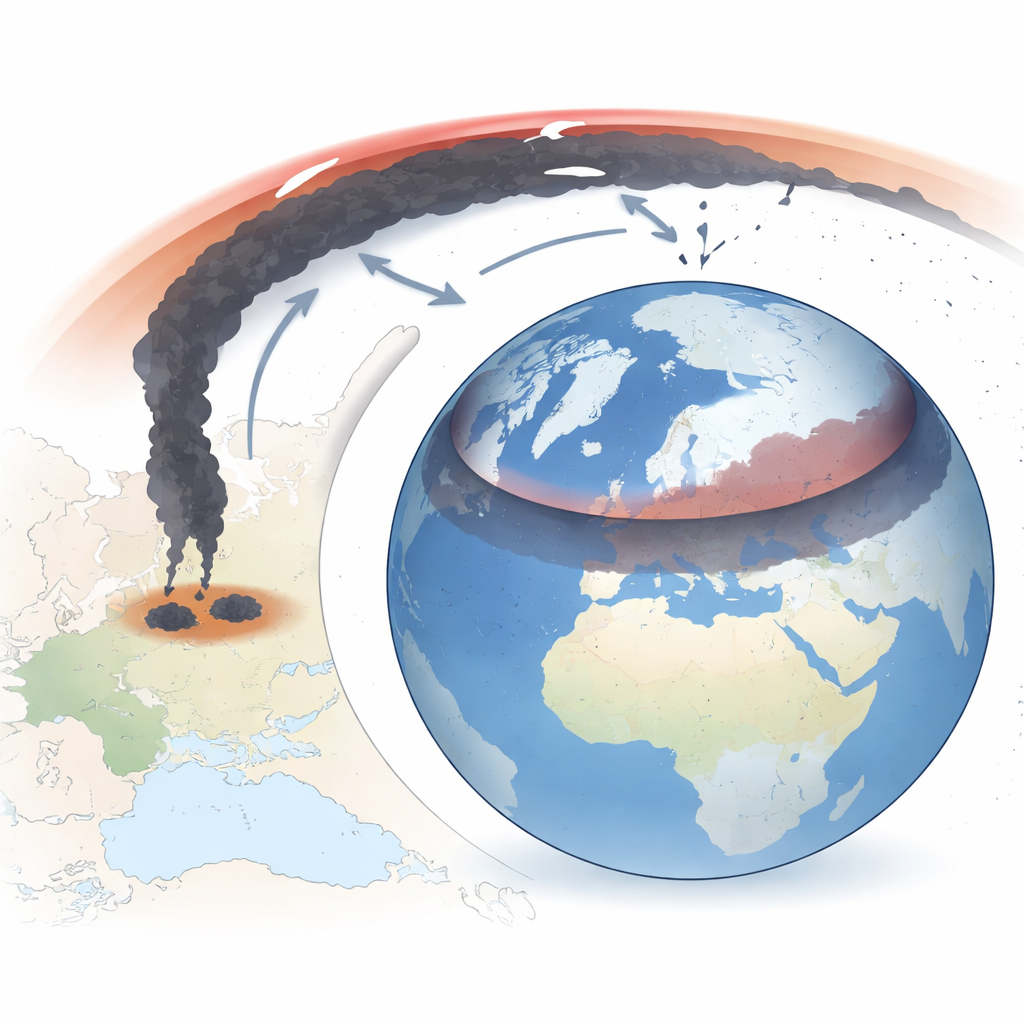
The researchers imagine about 100 nuclear detonations along a swath of Eastern Europe, powerful enough to ignite vast urban and industrial fires. These fires release an estimated five million tons of black carbon—soot—high into the upper atmosphere. There, this dark haze acts like a solar sponge: it absorbs sunlight, heats the thin air around it, and slowly lifts itself higher. Within days, the model shows the smoke plume spreading across the Northern Hemisphere, and within a year it wraps around the globe and leaks into the Southern Hemisphere. Because the soot sits above the clouds and rain that usually wash particles out of the air, it lingers for years, turning what might seem like a local war into a planetary event.
A cooler, darker, and drier north
With less sunlight reaching the ground, the Northern Hemisphere cools by about 1 °C on average in the first year, with land areas hit much harder. Parts of Russia cool by around 5 °C and the United States by about 4 °C in some seasons—enough to shorten growing seasons and increase frost risk. Surface sunlight over the U.S. drops by roughly the same power used by dozens of large coal plants per square kilometer, and plant growth declines across many northern regions. Rainfall patterns also shift dramatically: mid‑latitude farming belts in North America, Europe, and Asia become 20–40% drier, and key monsoon regions such as India and West Africa see sharp drops in seasonal rain. At the same time, some southern lands, including parts of Southern Africa and Australia, actually become wetter as the planet’s main tropical rain band slides a few degrees south.
How place changes the global outcome
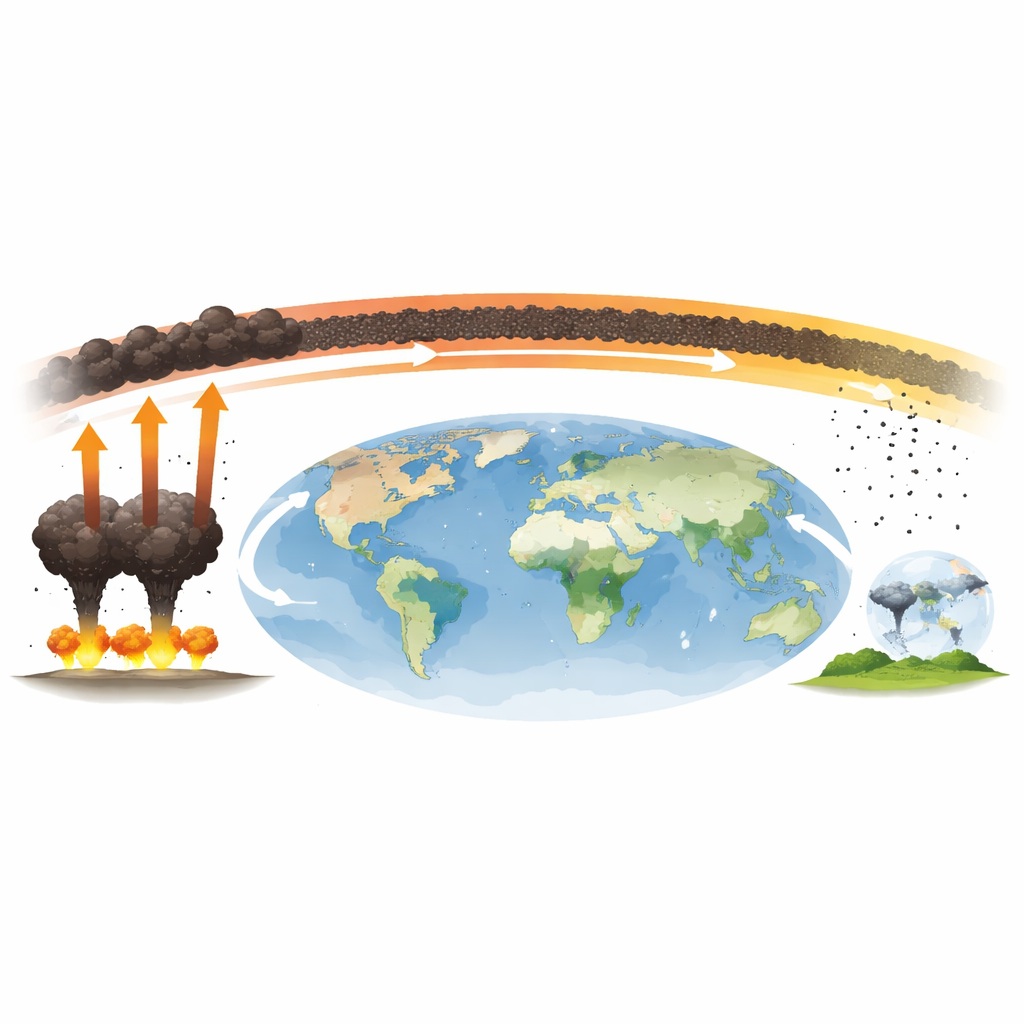
To understand whether the location of war matters, the team compares their Ukraine–Russia scenario with a widely studied India–Pakistan conflict releasing the same amount of soot. Both cool the planet by roughly similar global averages, but where that cooling lands is very different. Smoke from Eastern Europe tends to be steered toward higher northern latitudes, amplifying dimming and cooling over Eurasia and North America while sparing the tropics and Southern Hemisphere to some degree. Smoke from South Asia, by contrast, spreads more through the tropics and into the Southern Hemisphere, shifting the pattern of sunlight loss and rainfall change. This shows that not only the size, but also the latitude of a nuclear war strongly shapes which regions suffer the worst climate shocks.
Radiation close by and far away
The study also looks at radioactive fallout on two very different time scales. In the first 48 hours, surface explosions send heavy, highly radioactive debris downwind over tens of kilometers, creating a patchwork of lethal zones. The authors estimate that, in their scenario, areas larger than the Chernobyl exclusion zone would see dose levels high enough to cause acute radiation sickness or death for hundreds of thousands of people, along with long‑term evacuation and loss of farmland. Over the next decade, a different process unfolds. Lighter, longer‑lived radioactive elements, such as cesium‑137 and strontium‑90, hitch a ride on the high‑altitude soot and slowly settle out across the globe. This produces very low but measurable contamination over much of the Northern Hemisphere and even into the south, with slightly higher average doses in countries lying under favored deposition paths, such as parts of Central and South Asia.
What the study tells us about our future
For a general reader, the key message is sobering: there is no such thing as a purely “regional” nuclear war. Even a conflict confined to a slice of Eastern Europe could cool large parts of the Northern Hemisphere for years, slash rainfall over major breadbaskets, and send radioactive material around the world—while only slowly fading back to normal after about six years. The long‑range radiation levels themselves would be small compared with natural background, but when combined with food shortages, displacement, and stressed health systems, they would add to an already dire humanitarian picture. The work reinforces that preventing nuclear conflict and reducing nuclear arsenals are not only security goals, but essential steps to protect the global climate, food supply, and public health on which everyday life depends.
Citation: Ranjithkumar, A., Mayne, N., Jones, A.C. et al. Nuclear Conflict in Eastern Europe: Climate disruption and Radiological fallout. npj Clean Air 2, 28 (2026). https://doi.org/10.1038/s44407-026-00064-7
Keywords: nuclear war climate effects, nuclear winter, radiological fallout, black carbon soot, global food security