Clear Sky Science · en
FuXi-Air: air quality forecasting based on emission-meteorology-pollutant multimodal machine learning
Why Cleaner Air Needs Faster Forecasts
Air pollution is one of the most persistent health threats in modern cities, yet the tools we use to predict bad air days are often slow, expensive, and not always accurate where people actually live and work. This study introduces FuXi‑Air, an artificial‑intelligence–based system that can forecast the main urban air pollutants for the next three days in just seconds, aiming to give city officials and the public earlier and more reliable warnings so they can better protect their health.
Seeing the City’s Air as a Moving System
Traditional air quality forecasts rely on large computer models that simulate how gases and tiny particles are formed, transported, and removed in the atmosphere. These models capture physical and chemical details, but they demand powerful computers and many hours of processing time, and their accuracy is limited by how well they represent local weather and pollution sources. At the same time, many machine‑learning approaches have focused only on pollution measurements at single sites or for single pollutants, which makes them hard to use in real‑world, city‑wide forecasting. FuXi‑Air is designed to bridge this gap by treating the city’s air as a connected system, combining information about weather, emissions, and existing pollution levels into one unified framework.
How the New AI Model Works
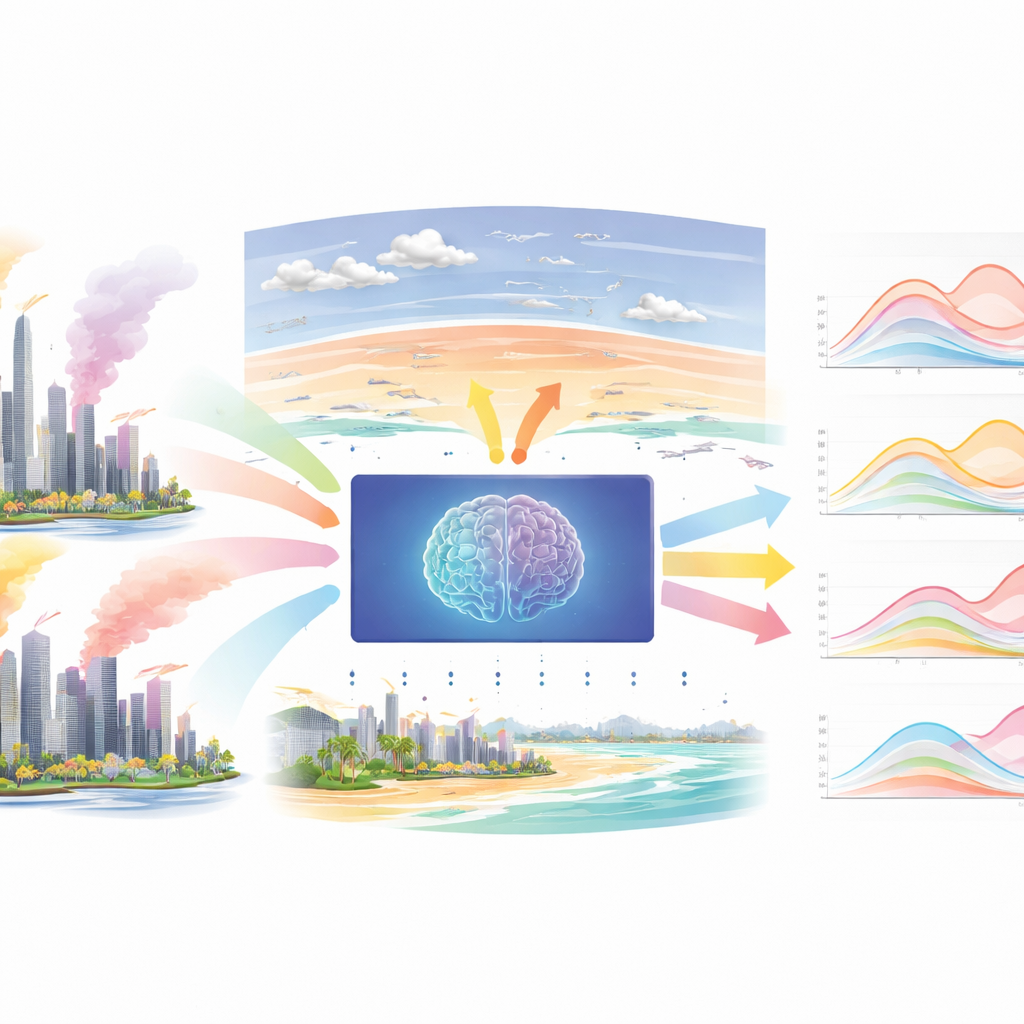
FuXi‑Air brings together three major data streams: high‑resolution weather forecasts from a separate AI weather model, detailed emission inventories that describe how much pollution is released from traffic, industry, and other sources, and continuous readings from ground monitoring stations. Inside FuXi‑Air, specialized deep‑learning modules learn how pollution at different sites is related to one another and how it evolves over time. Another module focuses on how weather patterns and emissions shape these changes, effectively teaching the system to recognize the conditions that lead to pollution build‑up or clearing. By first predicting pollution in six‑hour steps and then refining these into hourly values, FuXi‑Air can deliver 72‑hour forecasts for six key pollutants at dozens of sites in each city within about half a minute.
Putting the System to the Test in Three Megacities
The researchers tested FuXi‑Air in Beijing, Shanghai, and Shenzhen—three Chinese megacities with very different climates and pollution patterns. They compared its forecasts for ozone, nitrogen dioxide, sulfur dioxide, carbon monoxide, and two sizes of particulate matter against measurements from 2023. In general, the model reproduced the timing and size of pollution peaks well, especially for ozone and fine particles (PM2.5). It also proved robust when pollution levels were relatively low and stable, as in Shenzhen. Some challenges remained for coarse particles (PM10), particularly in Beijing, where dust storms and long‑distance transport play a bigger role and are harder to capture with the available data.
Beating Conventional Models and Probing What Matters Most
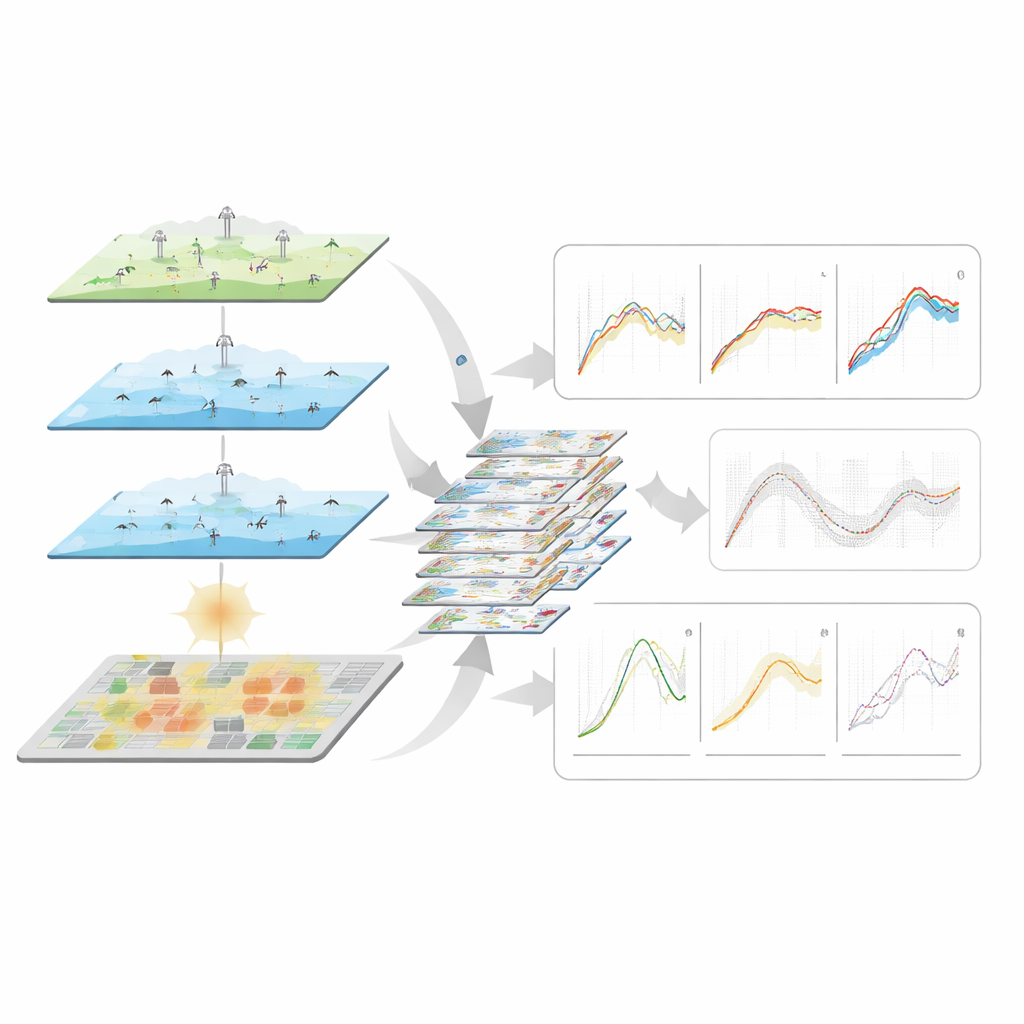
To see whether FuXi‑Air is ready for practical use, the team compared it with a widely used conventional forecasting system that couples a weather model with a detailed air quality model. Over nine months of forecasts for Shanghai, FuXi‑Air consistently reduced prediction errors for all six pollutants, cutting some errors by more than half while running in seconds instead of hours. The researchers also ran systematic “ablation” experiments, turning different data sources on and off. When they removed weather information, the model lost its ability to track day‑night cycles and pollution peaks, especially for ozone and fine particles. Leaving out emission data weakened its skill in cities where local sources dominate. These tests showed that combining weather, emissions, and monitoring data is crucial, but that weather often provides the strongest single boost to forecast quality.
Different Cities, Different Drivers of Dirty Air
By comparing results across cities, the study also sheds light on how local conditions shape pollution. In Beijing, winter heating and regional dust events mean that large‑scale wind patterns and stability of the air strongly control particle levels, so weather data mattered most. In Shenzhen, with its warm, humid coastal climate and strong ventilation, local industrial and traffic emissions played a larger role in determining fine particle levels. Shanghai fell between these extremes, influenced both by land–sea breezes and by local sources. For gases like carbon monoxide and sulfur dioxide, emissions were the main drivers, but even then, local terrain and weather sometimes amplified their build‑up.
What This Means for Protecting Public Health
FuXi‑Air demonstrates that carefully designed AI systems can deliver fast, city‑scale air quality forecasts that rival or surpass traditional methods while using far fewer computing resources. Although the model still struggles with some coarse particle events and relies on emission inventories that could be improved, it already offers a practical tool for early warnings and smart city management. With better, more timely information on when and where air will turn unhealthy, authorities can target emission controls more efficiently, and residents can adjust their activities to reduce exposure—turning complex data about the atmosphere into actionable guidance for cleaner, healthier urban living.
Citation: Geng, Z., Fan, X., Lu, X. et al. FuXi-Air: air quality forecasting based on emission-meteorology-pollutant multimodal machine learning. npj Clean Air 2, 21 (2026). https://doi.org/10.1038/s44407-026-00061-w
Keywords: air quality forecasting, urban air pollution, deep learning, meteorology and emissions, public health protection