Clear Sky Science · en
Techno-economic feasibility analysis of floating photovoltaic systems on 58 Moroccan dams: energy potential, economic viability, and water evaporation
Why Putting Solar Panels on Water Matters
As countries race to cut carbon emissions, they face a practical problem: where to put all the new solar panels. In a place like Morocco, where sunshine is plentiful but land and water are under pressure, the answer may lie on the surface of the nation’s dams. This study explores how floating solar farms placed on 58 Moroccan reservoirs could deliver large amounts of clean electricity while also saving precious water from evaporating into the air.
Sunshine, Thirsty Dams, and a Growing Energy Need
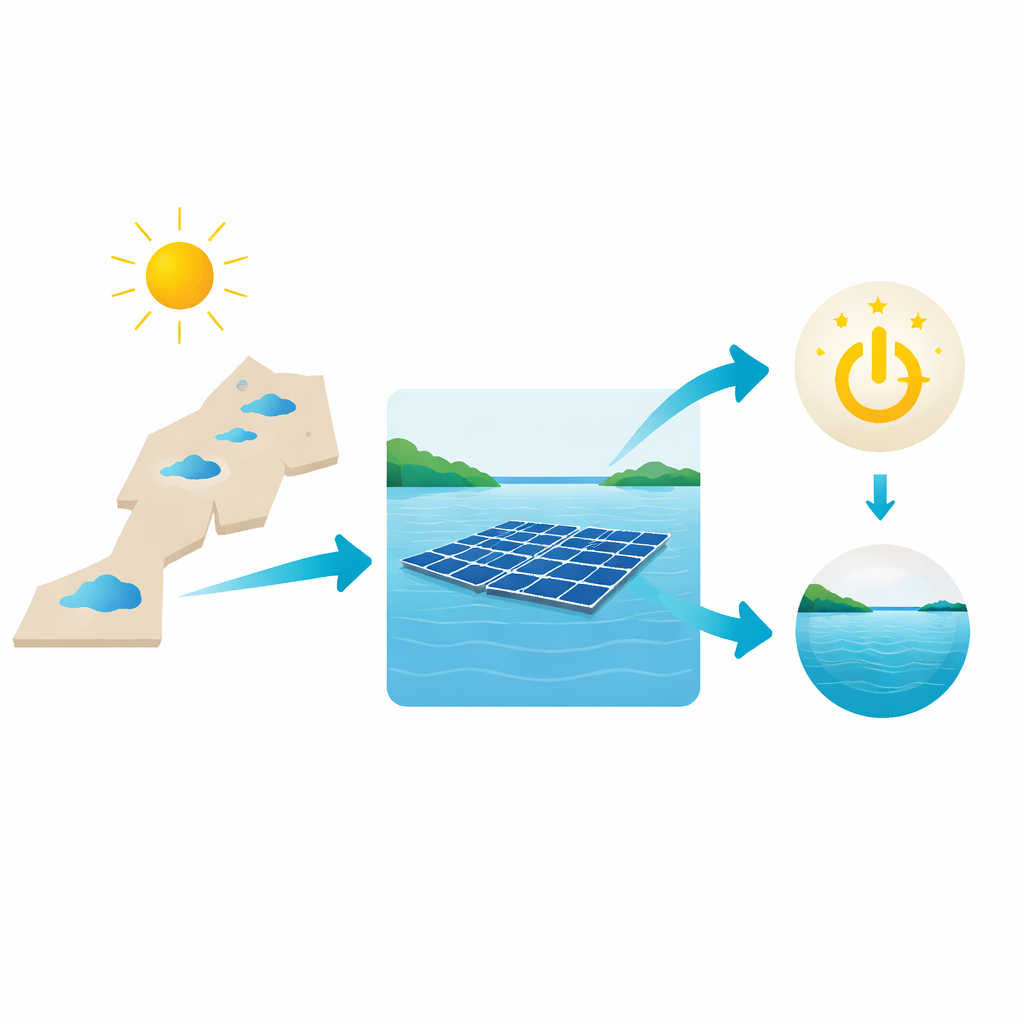
Morocco has set an ambitious goal: by 2030, more than half of its electricity should come from renewable sources. The country enjoys about 3000 hours of sunshine each year and strong solar radiation, making solar power especially attractive. At the same time, Morocco relies heavily on dams to store water for drinking, farming, and industry. These reservoirs, however, lose huge volumes of water to evaporation in a warming, drier climate. The authors identify floating solar, or floating photovoltaic (FPV) systems, as a way to tackle both challenges at once by turning dam surfaces into energy producers and shade providers.
How Floating Solar Farms Work
In an FPV installation, standard solar panels are mounted on buoyant platforms that float on a reservoir, while the inverters and transformers sit safely on land, connected via underwater cables. The water cools the panels, slightly boosting their efficiency compared with land-based systems, and the panels in turn shade the surface, helping to keep water from evaporating. The study evaluates two leading platform designs already used internationally and finds that both can be adapted to Moroccan dams, with one design offering a clear advantage in cost per unit of power produced.
Measuring Water Loss and Solar Gain
To understand what FPV could do at a national scale, the researchers first had to quantify the size and behavior of Morocco’s reservoirs. Because official surface data were incomplete, they used satellite maps and color-based image analysis to estimate the water area of 58 dams, finding a combined surface of about 433 square kilometers. They then applied a well-known evaporation model, fed with sunlight and temperature data, to estimate that these dams lose roughly 909 million cubic meters of water each year—nearly a billion tons. At the same time, they calculated how much solar energy panels on these reservoirs could harvest, testing different panel tilt angles and confirming that a range around 11–31 degrees offers strong performance; a modest 11-degree tilt was chosen as a practical and stable compromise.
How Much Power and at What Cost?
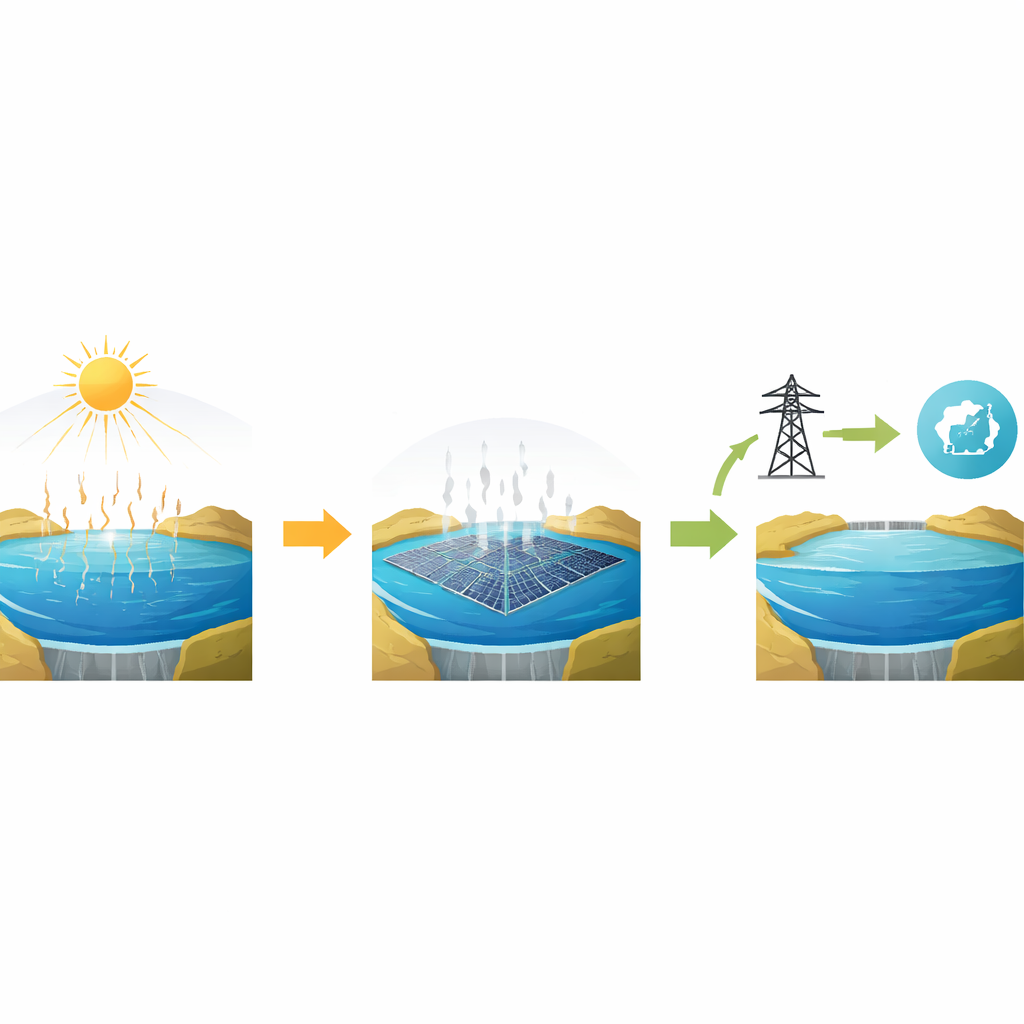
The team then asked a striking question: if a portion of each dam were covered with floating solar panels, could the resulting electricity meet Morocco’s current demand? Their modeling suggests that covering about 40% of the combined reservoir surface would be enough to generate roughly the country’s entire annual electricity consumption. Even using just 1% of the surface on selected dams would yield meaningful supplies to the national grid. Large reservoirs such as Al Wahda and Al Massira stand out as especially powerful sites. On the financial side, the authors estimate that, under reasonable assumptions for equipment prices and modest gains in efficiency from water cooling, such projects could pay for themselves in under a decade. They caution, however, that real-world operation and maintenance costs are poorly documented, so profit forecasts remain uncertain.
Balancing Energy, Water, and Future Risks
Beyond raw numbers, the study looks at design choices and risks. Tilt angle, for example, is not just about capturing sunlight: flatter panels shade more of the water and can further cut evaporation, while steeper ones may slightly increase energy yield but allow more water to escape. The authors argue that around 11 degrees offers a good balance between energy production, stability of the floating structures, and water savings. They also highlight missing pieces of information, such as detailed dam depth and drought behavior, which are essential for designing safe anchoring systems and for understanding how platforms would cope during extreme dry spells. Integrating floating solar with energy storage options like pumped hydro and green hydrogen, as well as smart grid management, is identified as key to turning intermittent sunshine into dependable power.
What This Means for Morocco’s Future
In plain terms, this research shows that covering a fraction of Morocco’s dam surfaces with floating solar panels could supply a large share—potentially all—of the country’s electricity needs while also protecting scarce water from evaporating. The approach uses existing infrastructure, avoids competition with farmland, and takes advantage of the natural cooling of water to make solar panels work slightly better. While questions remain about long-term costs, maintenance, and behavior under severe drought, the study lays out a strong case that floating solar could become a central pillar of Morocco’s cleaner and more water-smart energy future.
Citation: Mouhaya, A., El Hammoumi, A., El Ghzizal, A. et al. Techno-economic feasibility analysis of floating photovoltaic systems on 58 Moroccan dams: energy potential, economic viability, and water evaporation. npj Clean Energy 2, 8 (2026). https://doi.org/10.1038/s44406-026-00025-9
Keywords: floating solar, renewable energy, water conservation, Morocco dams, solar power planning