Clear Sky Science · en
MOFMeld: a structure–language fusion framework for MOF property prediction in carbon capture
Why Smarter Materials Matter for Cleaning the Air
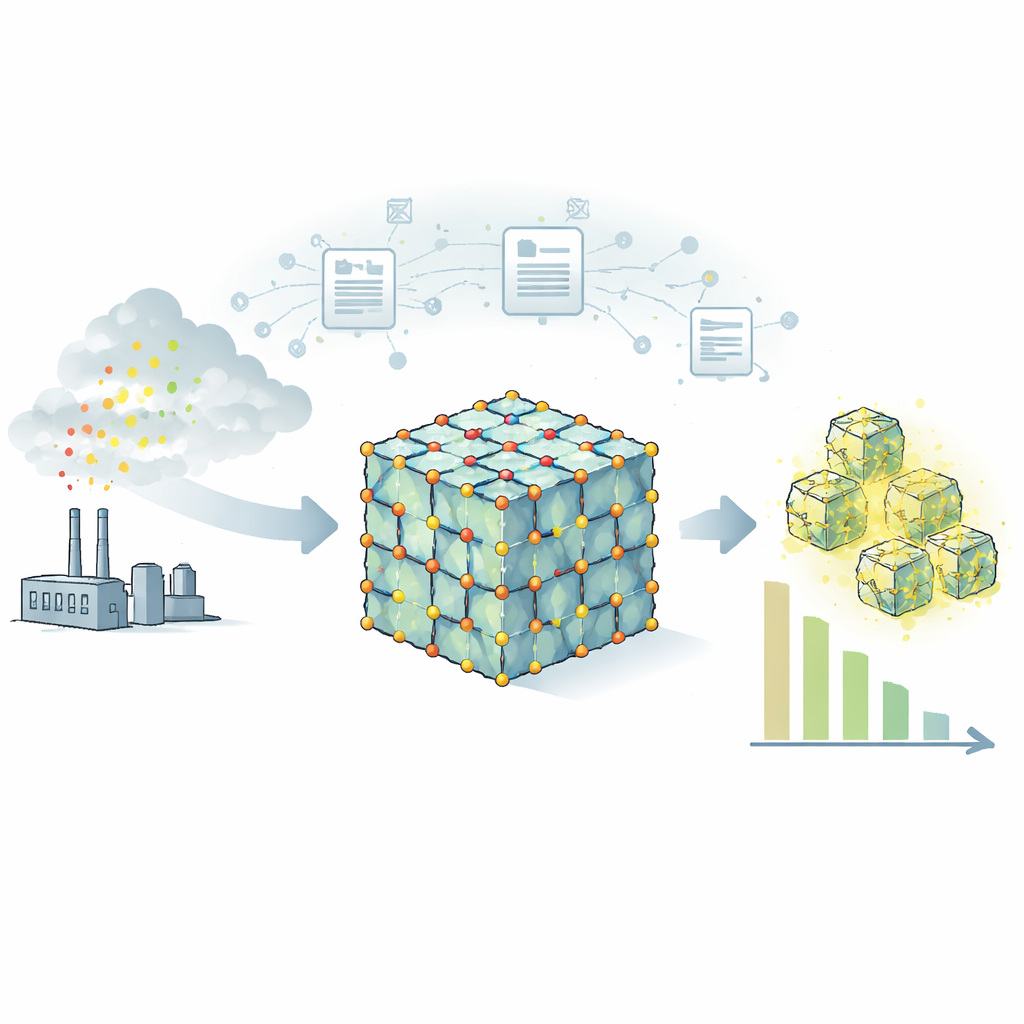
Cutting greenhouse gases like carbon dioxide is essential to slow global warming, but capturing CO2 efficiently from air and industrial exhaust is still very hard. A promising class of porous crystals called metal–organic frameworks (MOFs) can soak up CO2 like sponges, yet only a tiny fraction of possible MOFs has been tested. This paper introduces MOFMeld, a new artificial intelligence system that helps scientists search through vast numbers of candidate MOFs more quickly and transparently by combining what we know from lab measurements, computer models, and the scientific literature.
From Climate Challenge to Material Search
Carbon capture technologies, including direct air capture plants, depend on special materials that can strongly grab CO2, let it go again with little energy, and survive repeated use in humid, real-world conditions. MOFs are attractive because their building blocks can be mixed and matched to tune pore size, surface area, and chemistry. However, testing each design experimentally or with heavy computer simulations is slow and expensive. Most available data are scattered across thousands of papers, often buried in text and figures rather than in tidy databases. As a result, much of our hard-won knowledge of which MOFs work well—and why—remains underused.
Blending Structure with Scientific Language
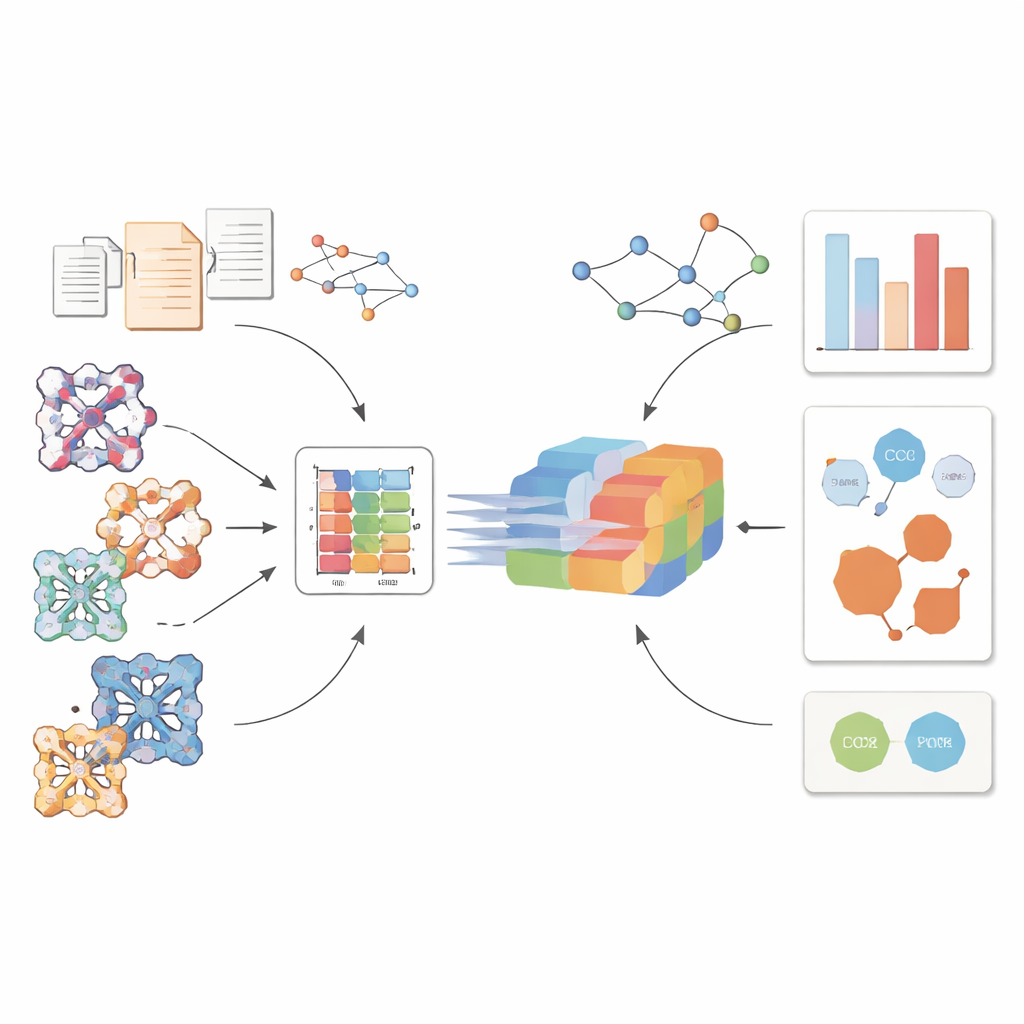
MOFMeld tackles this problem by marrying two kinds of AI strengths. On one side, it uses a large language model, called MOFLLaMA, that has been specially trained on about 1,500 MOF–CO2 papers and more than 20,000 question–answer pairs distilled from them. This language model is further grounded in a "knowledge graph" that links MOFs to experimentally reported properties and synthesis details, so its answers can be traced back to sources rather than guessed. On the other side, MOFMeld employs a graph-based neural network that reads the true three-dimensional atomic layout of a MOF crystal, turning its pore network and connectivity into a compact numerical fingerprint. A lightweight "bridge" module then connects these fingerprints to the language model so that the system can answer questions and make predictions while taking the actual crystal structure into account.
Predicting How Well MOFs Capture Carbon
The authors tested MOFMeld on a large collection of hypothetical MOFs with known computer-calculated properties. The system was asked to predict six important quantities: two measures of pore size, overall surface area, how much empty space the solid contains, and CO2 uptake at both moderate and very low pressures. Even though MOFMeld was trained on only about 30,000 structures—far fewer than traditional graph-based models—it matched or outperformed strong structure-only neural networks on most targets. In particular, it was very accurate for geometric traits like pore sizes and porosity, and it stood out at predicting CO2 capture at low pressure, where performance depends on subtle chemical binding sites rather than just overall pore volume.
Testing on Real-World Materials and Peeking Inside the Model
To see how well MOFMeld behaves beyond simulated structures, the team applied it to thousands of experimentally reported MOFs from a curated database. The system ranked candidates by predicted CO2 uptake, and when the top group was checked with detailed simulations, many indeed showed high capture capacity. While the numerical errors were larger than in the purely hypothetical test set—reflecting the broader and messier chemistry of real-world MOFs—the tool still steered attention toward promising materials. The authors also visualized the internal representations learned by the bridge module. MOFs with similar porosity clustered together smoothly, and when they disrupted the structure signals feeding into the language model, prediction quality dropped. This suggests the model truly relies on meaningful structural cues rather than just memorizing text patterns.
What This Means for Future Carbon Capture
In everyday terms, MOFMeld acts like a specialized research assistant that not only reads the MOF literature but also "sees" each crystal’s internal architecture, then combines both views to guess how well a material will trap CO2. By being accurate, relatively data-efficient, and interpretable, it offers a scalable way to focus experiments and more expensive simulations on the most promising candidates. While further work is needed to better handle the full diversity of real MOFs and more natural user queries, the framework points toward smarter, literature-aware tools that can accelerate the discovery of advanced materials for carbon capture and, ultimately, help bring cleaner technologies to market faster.
Citation: You, H., Zhang, S., Du, L. et al. MOFMeld: a structure–language fusion framework for MOF property prediction in carbon capture. npj Artif. Intell. 2, 47 (2026). https://doi.org/10.1038/s44387-026-00106-1
Keywords: carbon capture materials, metal–organic frameworks, machine learning for materials, large language models, structure–language fusion