Clear Sky Science · en
Spectral element solution of the depth-dependent kernel functions in wavenumber integration theory of underwater acoustic propagation
Listening to sound beneath the waves
Sound is the main way we sense what happens underwater, from tracking submarines to listening for whales. But predicting how sound moves through the real ocean, with its changing temperatures and layered seafloor, is a serious computing challenge. This paper introduces a new numerical tool that promises clearer, faster simulations of underwater sound, helping scientists and engineers design better sonar, communication links, and monitoring systems.
Why underwater sound is hard to predict
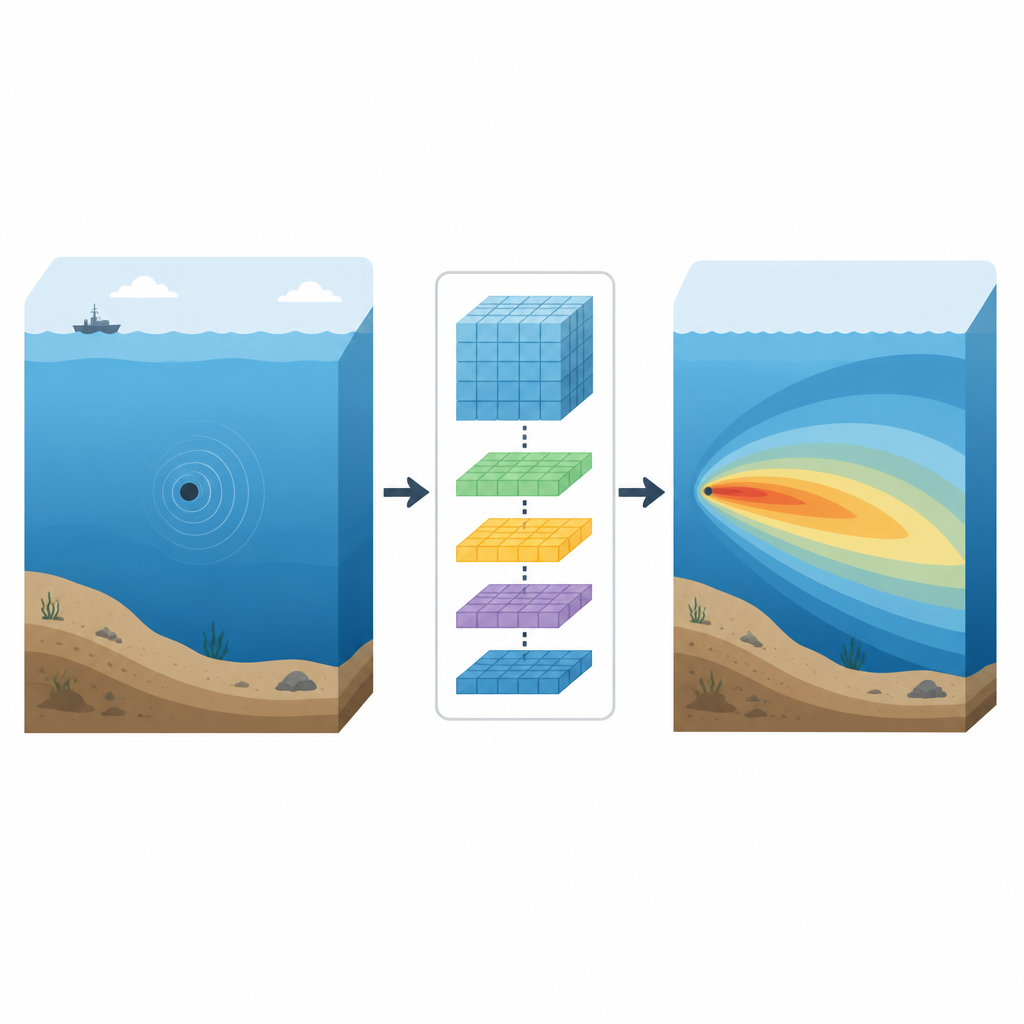
In the ocean, sound does not travel in straight lines. It bends, reflects, and spreads as it passes through layers of water with different temperatures and salt levels, and as it hits the surface or the seabed. To forecast how sound from a ship or instrument will spread, researchers use mathematical models that solve the wave equation, a core rule for how sound behaves. One powerful family of models, called wavenumber integration, breaks the problem into horizontal and vertical parts. The vertical part, which describes how sound changes with depth, is especially tricky and largely determines how accurate and how fast a simulation will be.
Old methods and their trade offs
Two main approaches have dominated this vertical calculation. Finite element models cut the water column into many thin layers and approximate the sound in each layer with simple functions. They are efficient on a computer but require very fine layering to reach high accuracy, so their errors shrink only slowly as more detail is added. Spectral models take the opposite path: they represent the sound field using smooth global shapes built from special polynomials, reaching extremely high accuracy with relatively few unknowns. However, they produce dense matrices that are costly to solve, which makes them slow for large or detailed problems. Until now, users generally had to choose between speed and precision.
A middle way using spectral elements
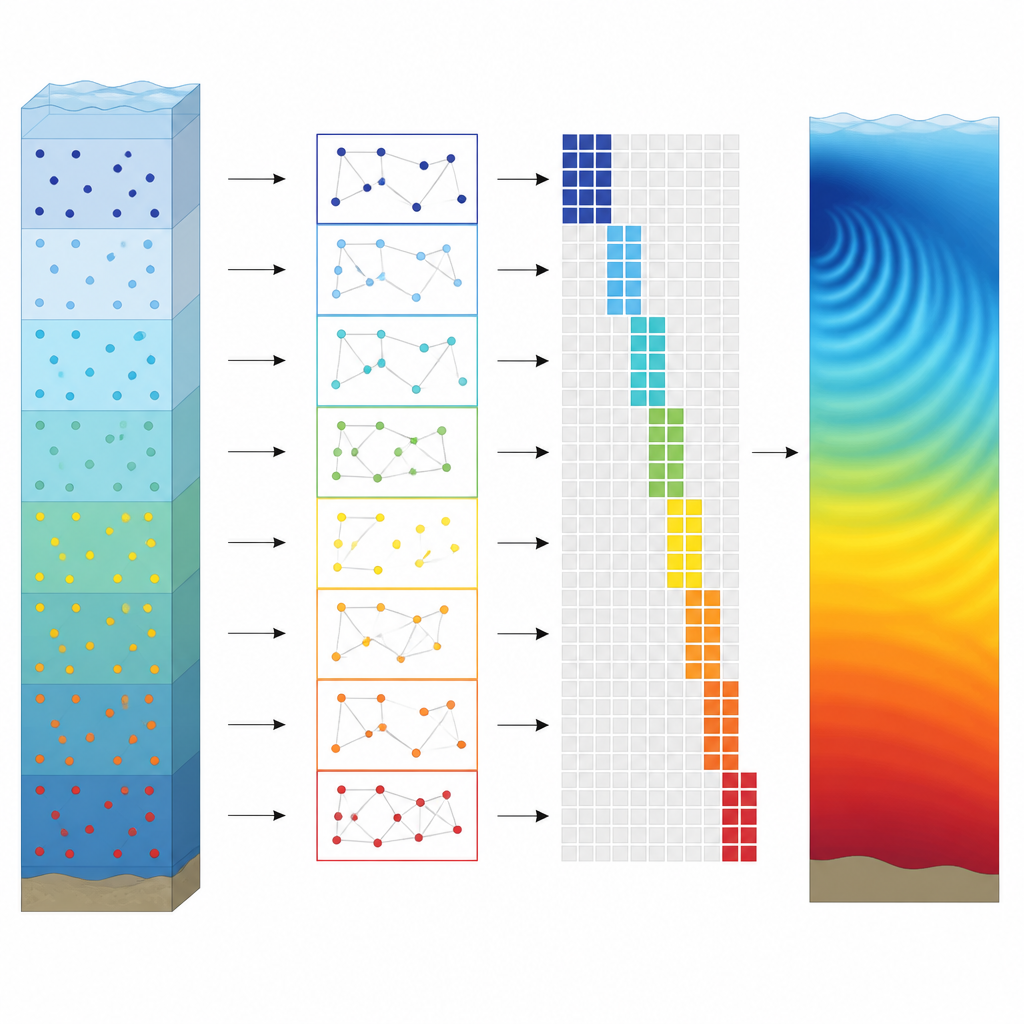
The authors present SemWI, a new version of the wavenumber integration model that uses the spectral element method to handle the depth calculation. The idea is to split the water column into elements, much like finite elements, but to represent the sound inside each element with high order curves built from carefully chosen interpolation points. These points cluster near element edges, which improves accuracy where sound features change quickly. When all elements are assembled, the resulting system of equations forms a block diagonal, symmetric matrix that is much sparser than in standard spectral models. This structure can be solved more quickly while still enjoying the rapid error reduction typical of spectral techniques.
Putting the new method to the test
To judge SemWI, the team ran three sets of numerical experiments that mimic common ocean settings. First, they examined a simple single layer water column whose behavior is known exactly from Airy functions. SemWI reproduced both the detailed depth dependent “kernel” functions and the overall sound transmission loss almost perfectly, matching the exact solution. Next, they modeled a more realistic shallow water case with a surface duct above an absorbing seabed. Here they compared SemWI with two established programs: SCOOTER, a finite element code, and WISpec, a spectral code. All three gave nearly identical sound fields, including subtle energy leakage into the seabed, for both point and line sources. Finally, they turned to a deep ocean profile with a strong sound channel and found that SemWI captured distant convergence zones out to 100 kilometers just as well as the benchmark models.
Balancing speed and accuracy
Beyond matching known results, the authors explored how SemWI behaves as they adjust its numerical settings. By holding the number of depth elements fixed and increasing the number of interpolation points inside each element, they observed a rapid, almost exponential drop in error, reflecting true spectral behavior that rivals the pure spectral WISpec model. When they instead fixed the points per element and increased the number of elements, SemWI behaved more like a finite element code but still converged faster than SCOOTER. Timing tests showed that SemWI is usually as fast as or faster than SCOOTER in shallow water cases, and sits between SCOOTER and WISpec in a demanding deep water case, while delivering noticeably higher accuracy than the finite element approach.
What this means for ocean sensing
In plain terms, this work shows that it is possible to get the best of both worlds when simulating underwater sound. SemWI offers a flexible dial between speed and precision by changing how many elements and interpolation points are used, and it can even mimic existing finite element or spectral models as special cases. Because the depth calculations for different wavenumber samples can be done in parallel, the method is also well suited to modern multi core computers. This makes SemWI a practical and powerful new tool for scientists and engineers who need reliable predictions of how sound travels in complex oceans.
Citation: Tu, H., Wang, Y., Wang, Y. et al. Spectral element solution of the depth-dependent kernel functions in wavenumber integration theory of underwater acoustic propagation. npj Acoust. 2, 19 (2026). https://doi.org/10.1038/s44384-026-00055-8
Keywords: underwater acoustics, sound propagation, numerical modeling, spectral element method, ocean waveguide