Clear Sky Science · en
Bidirectional highly nonlinear analog memristor based on band-to-band tunneling for reliable crossbar array operation
Why New Memory Matters
Every time you use your phone or computer, information is constantly shuttled back and forth between a processor that does the math and a memory that stores the data. This traffic jam, known informally as a data bottleneck, wastes time and energy. The research in this paper explores a tiny electronic component called a memristor that can both store data and help perform calculations inside the memory itself. By redesigning how these devices behave in large grids, the authors aim to make future artificial intelligence hardware faster, more efficient, and simpler to build.
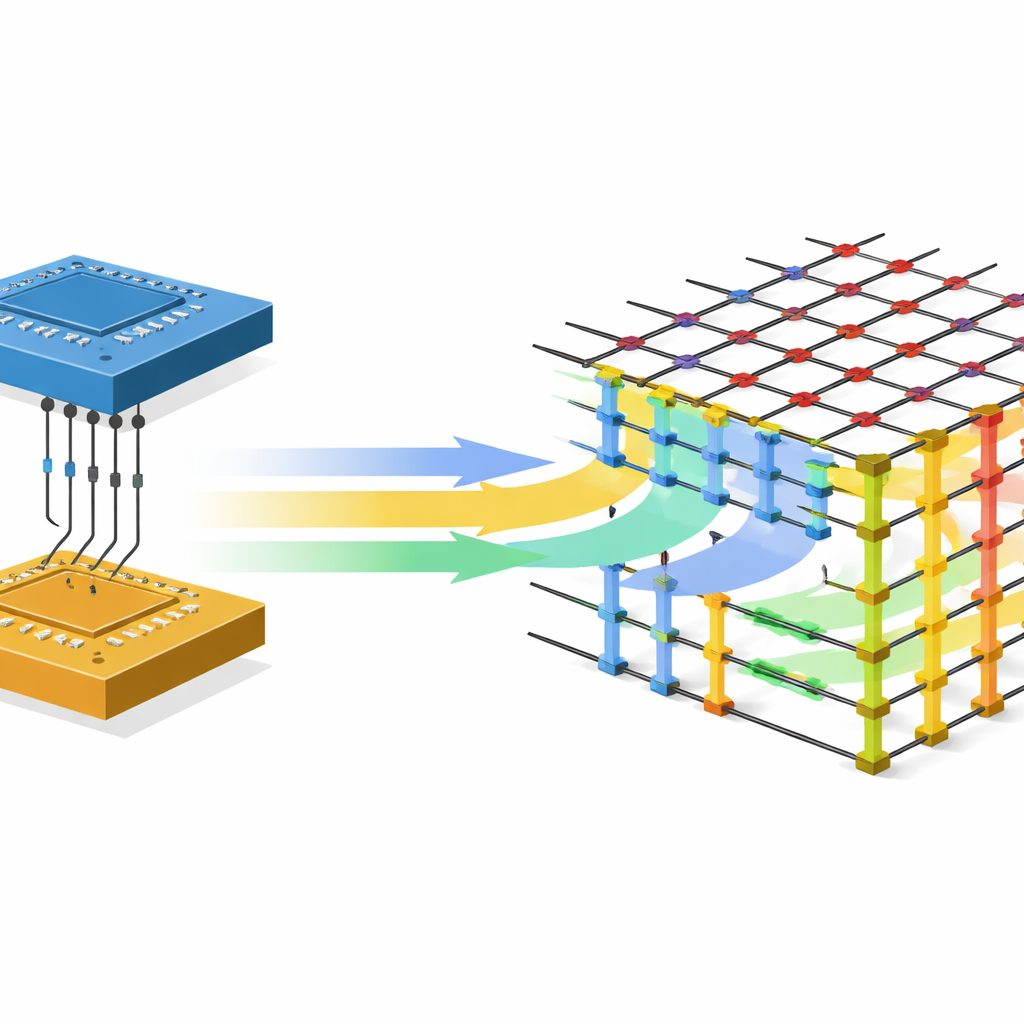
From Traffic Jam to Built‑In Shortcuts
Traditional computers separate computing and memory, forcing information to travel long “roads” on a chip. As data‑heavy tasks like artificial intelligence, smart sensors, and edge devices grow, this back‑and‑forth movement becomes a serious limitation. Memristors—tiny elements whose electrical resistance can be tuned and remembered—offer a way to move part of the computation directly into the memory grid itself. In a crossbar layout, where many wires cross and a memristor sits at each intersection, large blocks of math can be done in parallel. However, when many of these elements are packed together, unwanted side effects during writing and reading—such as stray voltage on neighboring cells and leakage currents along unintended paths—can corrupt data unless each memristor is paired with an extra “selector” element, adding complexity and cost.
A Self‑Selecting Memory Cell
The authors introduce a single device that tries to solve these array‑level problems by itself. Their memristor uses a layered sandwich of materials—platinum and two metal oxides, nickel oxide (p‑type) and zinc oxide (n‑type)—stacked symmetrically as Pt/p‑NiO/n‑ZnO/p‑NiO/Pt. Thanks to the way these oxides align electronically, the device naturally resists current at low voltages but allows it to grow sharply once a certain “turn‑on” threshold is reached. Crucially, this strong nonlinearity appears for both positive and negative voltages, so the same cell can be written, erased, and read in either direction without a separate selector. At the same time, the memristor behaves in an analog fashion: its conductance can be smoothly adjusted over about two orders of magnitude using voltage pulses, rather than flipping only between simple on and off states.
How the Tiny Layers Do Their Work
To understand what makes this possible, the team carefully mapped the energy landscape inside the layered stack. Measurements of work function and bandgap showed that the nickel‑oxide/zinc‑oxide junction forms a small offset between the top of one energy band and the bottom of another. Under low voltage, only a small, nearly Ohmic current flows. When the voltage gets large enough, electrons begin to “tunnel” directly from the filled states of one layer into the empty states of the other—an effect similar to what happens in Zener diodes. This band‑to‑band tunneling causes the current to rise steeply. On top of that, oxygen ions inside the oxides drift when an electric field is applied. Their motion subtly changes how strongly each layer is doped and shifts the tunneling threshold, giving a built‑in way to tune the conductance gradually with voltage polarity and pulse history.

Making Large Grids Behave
Armed with detailed current–voltage data from many devices, the researchers simulated how this memristor would behave inside large crossbar arrays. During write operations, only one cell is supposed to receive the full voltage, while neighboring cells see roughly half. Because the new device carries very little current at half the write voltage, these “half‑selected” cells experience negligible unintended changes, widening the safe operating window. During read operations, the main concern is “sneak‑path” currents that snake through neighboring cells and blur the distinction between high‑ and low‑resistance states. The strong nonlinearity at the chosen read voltage sharply suppresses these leakage paths. Using circuit models, the authors show that, with an optimized pull‑up resistor, arrays as large as about 1,200 by 1,200 cells could still reliably distinguish stored states without external selector components.
Promises and Next Steps
In practical terms, this work points toward memory chips that can pack millions of self‑selecting memristors into dense three‑dimensional grids, performing neural‑network‑style calculations where the data sits, rather than dragging it through distant processors. The demonstrated device already supports multiple stable conductance levels and shows good performance in simulated pattern recognition tasks, though further improvements—such as lowering the operating voltages and proving behavior in nanoscale arrays—are still needed. For a general reader, the key message is that by carefully engineering how atoms and electrons move inside a single tiny component, it may be possible to simplify the entire architecture of future AI hardware, making it faster and more energy‑efficient.
Citation: Chung, P.H., Ryu, J., Seo, D. et al. Bidirectional highly nonlinear analog memristor based on band-to-band tunneling for reliable crossbar array operation. npj Unconv. Comput. 3, 19 (2026). https://doi.org/10.1038/s44335-026-00065-5
Keywords: memristor crossbar, in-memory computing, neuromorphic hardware, nonlinear memory devices, band-to-band tunneling