Clear Sky Science · en
Timed exercise modulates inter-coupling strength between evening and morning oscillators in mice
Why the timing of your workout might matter
Most of us know that regular exercise is good for sleep, mood, and overall health. But this study asks a more specific question: does the time of day when you exercise actually change the way your internal “body clocks” keep time? Using mice as a model, the researchers show that workouts at different points in the night can subtly rewire the internal circuits that decide when activity begins and ends each day. Those changes, in turn, affect how easily the animals adjust to a sudden shift in their light-dark schedule—much like human jet lag or shift work.
Two inner clocks that share the night
In nocturnal animals like mice, activity at night is not driven by a single timer. Instead, scientists think there are two coupled clocks within the brain’s master timekeeping center: an “evening” clock that helps set when activity starts, and a “morning” clock that helps set when it stops. Together, these clocks shape how long the active period lasts and how it lines up with the outside world. The new study explores whether scheduled exercise can tilt the balance between these two partners, strengthening one clock’s pull over the other and changing daily rhythms as a result.
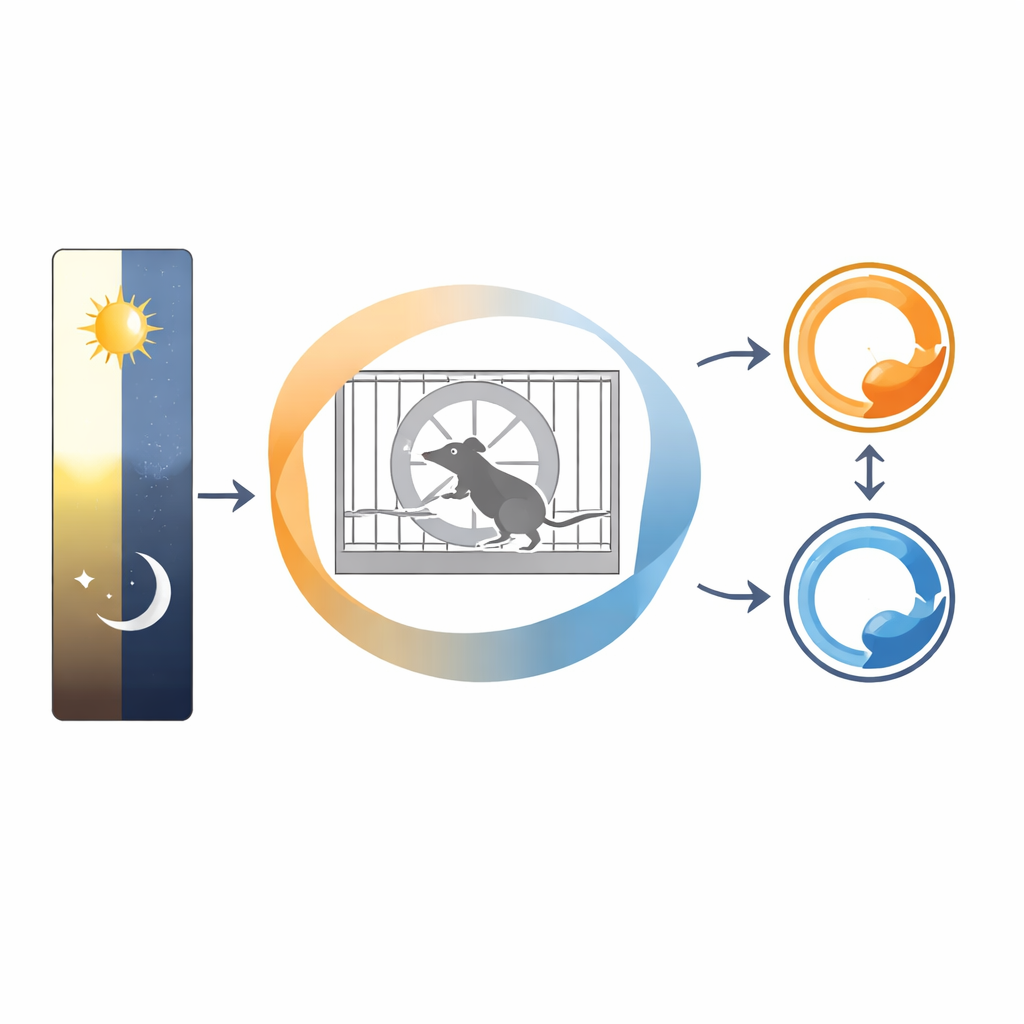
Running wheels as timed daily appointments
The team worked with male laboratory mice kept on a regular 12-hours-light, 12-hours-dark schedule. Normally, the animals lived in cages without running wheels. On specific days, however, each mouse was gently moved for three hours into a new cage that contained a running wheel—a combination of novelty and voluntary exercise known to strongly stimulate the circadian system. This happened five days a week for three weeks at one of two times: right at lights-off (early night) or late in the night just before lights-on. Across three experiments, the researchers then measured how the mice behaved in constant darkness, how quickly they adjusted when the light-dark cycle was suddenly advanced by eight hours, and how a single advanced light cycle changed the phase of their activity.
Early-night exercise pulls the system forward
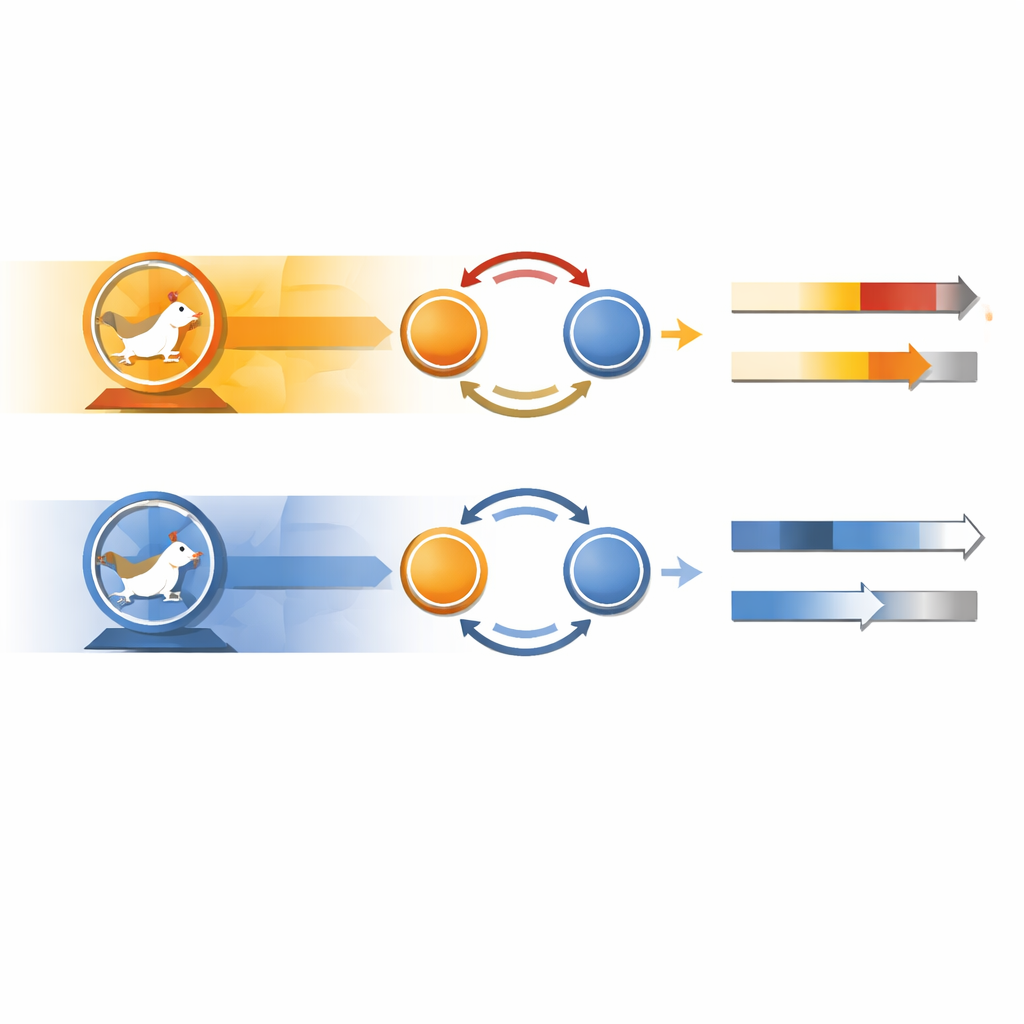
When mice had their scheduled run at the start of the night, their free-running daily rhythm in constant darkness became slightly shorter, indicating that the overall internal day was compressed. These mice also started their activity closer to the time when the lights went out. After an eight-hour advance of the light-dark cycle, they adjusted their activity start time more quickly than control mice that had no scheduled running. In an additional test using a single advanced light cycle followed by constant darkness, these animals showed stronger forward shifts in both the start and end of their active period. Taken together, these findings suggest that early-night exercise strengthens the influence of the “evening” clock over the “morning” clock and makes the whole system more willing to move forward in time.
Late-night exercise tugs in the opposite direction
Late-night runs produced a different pattern. Mice that exercised near the end of the night tended to show slightly longer internal days and took more time to adjust to the advanced light-dark schedule. Some even showed a brief tendency to shift their activity in the wrong direction, a behavior reminiscent of “antidromic” adjustment where clocks move backward before finally re-aligning. Despite running about as much as their early-night counterparts, these late-night runners appeared to have the “morning” clock exerting a stronger pull on the “evening” clock, resisting the forward push from the new light schedule. The contrast between early and late exercise was not explained by simple differences in how much the mice ran, pointing instead to timing as the key factor.
What this could mean for sleep and jet lag
By combining carefully timed exercise with controlled light conditions, the study shows that daily workouts can do more than nudge the body’s master clock—they can rebalance the conversation between its internal components that govern when we get going and when we wind down. In mice, early-night exercise reinforces signals that pull activity earlier and speed adjustment to a new schedule, while late-night exercise has a weaker, partially opposing effect. Although these experiments were done in nocturnal animals, the principle that the timing of physical activity can shape internal clock coupling may help guide strategies to ease jet lag, adapt to shift work, or manage circadian-related sleep problems in people, especially when combined with well-timed light exposure.
Citation: Miyagi, N., Matsuura, N. & Yamanaka, Y. Timed exercise modulates inter-coupling strength between evening and morning oscillators in mice. npj Biol Timing Sleep 3, 12 (2026). https://doi.org/10.1038/s44323-026-00075-3
Keywords: circadian rhythm, timed exercise, sleep timing, jet lag, biological clock