Clear Sky Science · en
Single-shot full-Stokes polarization and quantitative phase imaging via a single-layer metalens
Seeing More Than Brightness
Most cameras, from phone sensors to telescopes, only record how bright a scene is. But light secretly carries two more rich layers of information: how its waves bend as they pass through objects, and how they twist as they vibrate. This paper reports a tiny new lens that can capture all three at once—brightness, bending, and twisting—in a single shot. The approach could shrink room‑sized lab instruments for studying cells and materials into compact, portable devices.
Why Hidden Light Clues Matter
When light passes through something transparent, such as a living cell or a thin glass coating, its wavefront is delayed in a way that reveals thickness and internal structure. This subtle delay is known as phase. At the same time, the way light vibrates—its polarization—carries clues about surface texture, internal organization, and molecular handedness, including chiral structures important in biology and chemistry. Conventional cameras ignore these extra dimensions, so researchers have relied on complex setups with moving parts, spinning polarizers, or delicate interference schemes to measure them, making real‑time, portable use difficult.
A Tiny Lens With a Hidden Pattern
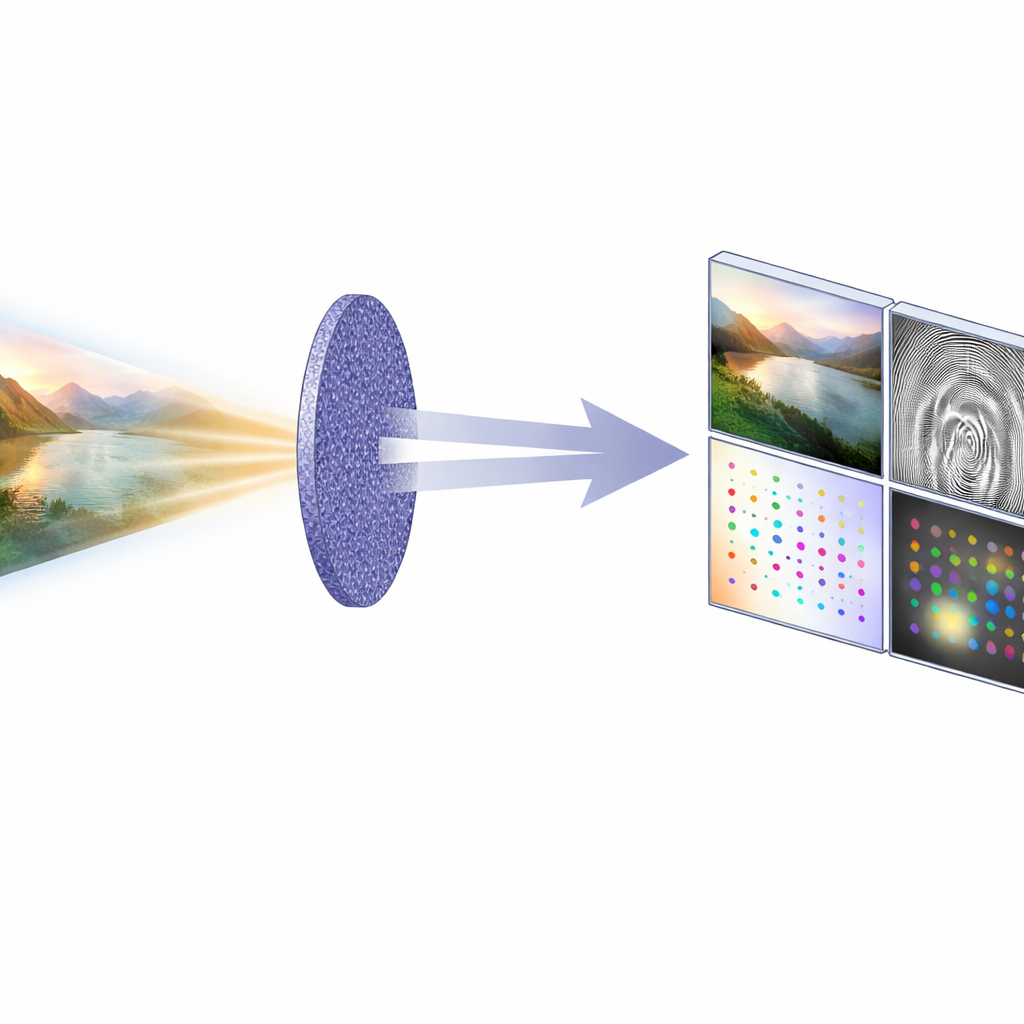
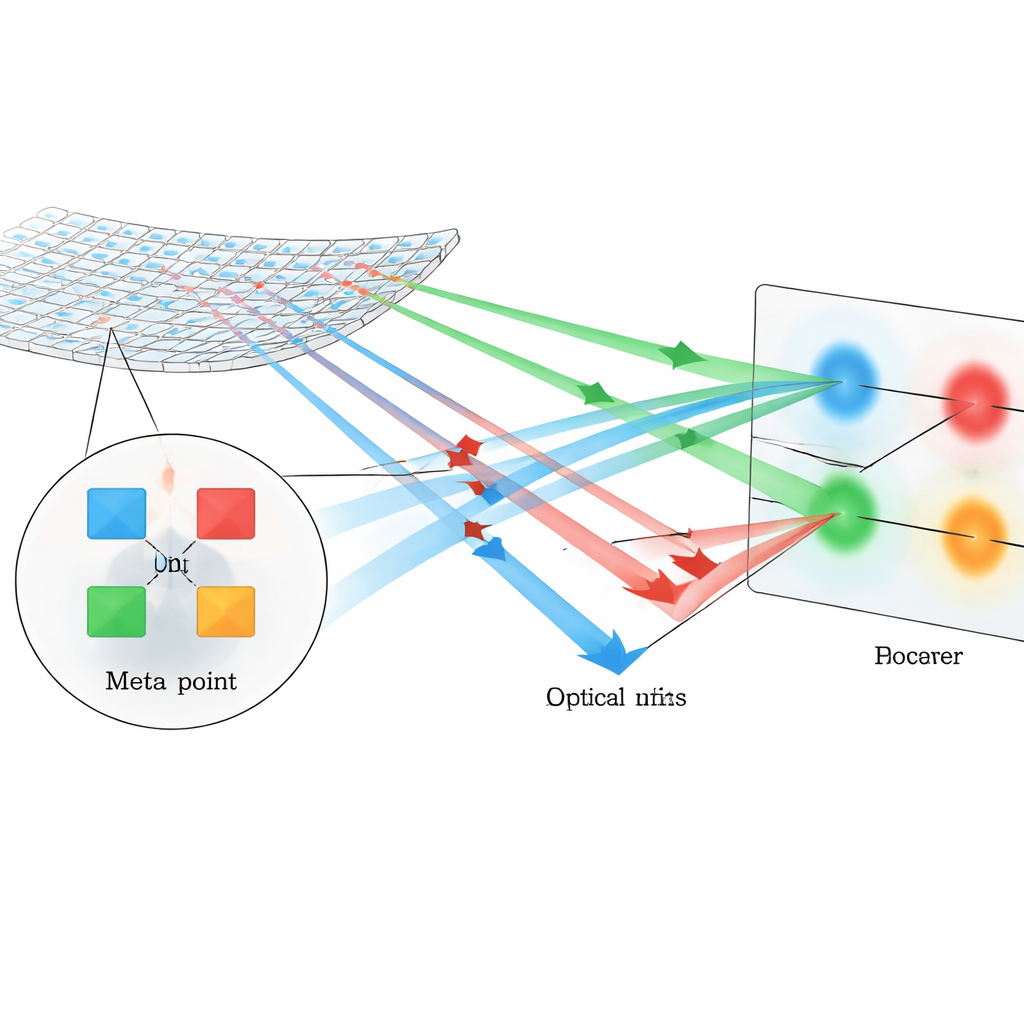
The authors introduce a flat, nanostructured lens, or metalens, that replaces stacks of bulk optics with a single patterned layer of amorphous silicon. At its heart is a repeating “four‑in‑one” building block: four microscopic pillars arranged like a square tile. Two pillars are symmetric and focus light without caring about its polarization, but at slightly different distances, providing a focused and a gently defocused view of the same scene. The other two pillars are asymmetric and act like tiny polarization filters that send left‑twisting and right‑twisting light to different regions. When this pattern is spread over the 1.8‑millimeter‑wide lens and paired with a specialized camera chip that already senses linear polarization, the incoming scene is automatically split into four complementary images in one exposure.
Turning Four Snapshots Into a Full Picture
Those four sub‑images are the raw ingredients for reconstructing everything the researchers care about. The pair formed by the symmetric pillars gives two slightly different focus planes of the same objects. A known mathematical relation—the transport‑of‑intensity equation—uses this tiny focus shift to infer how much the light wave has been delayed at each point, turning intensity images into a quantitative map of optical thickness. At the same time, the sub‑images formed by the asymmetric pillars cleanly separate left‑handed and right‑handed polarization components, which, combined with the camera’s own polarization sensitivity, allow the full polarization state (the so‑called Stokes parameters) to be recovered at every pixel without scanning or moving parts.
Testing With Patterns, Materials, and Living Cells
To show that their compact system is accurate, the team first measured artificial phase targets: patterned silica regions of known thickness. Using a simple light‑emitting diode filtered around a near‑infrared color, they reconstructed thickness maps that matched independent measurements from a white‑light interferometer, a standard precision tool. They then imaged a deliberately anisotropic nanostructured surface, recovering not only how its height varied but also how strongly it converted light into different polarization states—confirming that the device can probe engineered materials. Finally, they placed the metalens in a microscope configuration to watch a single U2OS cell as it detached from a surface under a mild enzyme treatment. Over about 12 minutes, the cell rounded up, and the phase images showed its center becoming optically thicker, all captured continuously without fluorescent labels.
What This Could Mean for Future Imaging
In simple terms, this work shows that a single ultra‑thin lens can teach a camera to see three properties of light at once: how bright it is, how much it is delayed, and how it vibrates. By avoiding lasers and using a speckle‑free light source, the researchers reduce grainy artifacts that often plague similar systems. The result is a small, motion‑free platform that can quantitatively measure phase and full polarization in real time. Such technology could evolve into handheld tools for inspecting micro‑devices, monitoring cell health without dyes, or guiding medical diagnostics at the bedside, especially if combined with machine learning to automatically interpret the rich, multidimensional images.
Citation: Zhang, Q., Lin, P., Jiang, X. et al. Single-shot full-Stokes polarization and quantitative phase imaging via a single-layer metalens. npj Nanophoton. 3, 24 (2026). https://doi.org/10.1038/s44310-026-00122-8
Keywords: metalens imaging, polarization imaging, quantitative phase imaging, multidimensional optical sensing, label-free cell imaging