Clear Sky Science · en
Exploring the role of interfacial Dzyaloshinskii–Moriya interaction in write error rate anomalies of spin-transfer torque magnetic tunnel junctions
Why tiny memory magnets matter
Our phones, laptops, and data centers increasingly rely on a new kind of memory called spin‑transfer torque magnetic random‑access memory, or STT‑MRAM. It promises fast, durable, and energy‑efficient storage. But when engineers push these tiny magnetic bits to switch extremely quickly, their behavior can become oddly unreliable: write errors can suddenly increase just when you drive the devices harder. This paper digs into that puzzle and uncovers how a subtle atomic‑scale effect at material interfaces can quietly sabotage the reliability of next‑generation memory chips.

A strange bulge in error rates
In an ideal digital memory, increasing the strength of the write signal should steadily reduce the chance of an error. Experiments with STT‑MRAM, however, have revealed a quirk known as the “ballooning effect.” For very short write pulses lasting only a few billionths of a second, the write error rate first drops as the current increases, then unexpectedly rises again before finally falling at even higher currents. This non‑monotonic curve is a headache for designers of high‑speed electronics, because it makes it difficult to guarantee reliable switching in tightly packed, nanometer‑scale memory cells.
The hidden influence of the interface
The authors focus on a subtle interaction that lives at the boundary between a magnetic layer and a heavy metal layer: the Dzyaloshinskii–Moriya interaction, or DMI. This interaction slightly prefers neighboring atomic magnets to twist relative to one another rather than line up perfectly. In ultra‑thin layers commonly used in magnetic tunnel junctions—the building blocks of STT‑MRAM—DMI can be strengthened or weakened by details such as the choice of materials, the presence of oxygen at the interface, and how the stack is processed. Because modern memory bits are only tens of nanometers across, even a modest amount of this twisting tendency can drastically reshape how the magnetization reverses during a write operation.
From smooth flips to tangled patterns
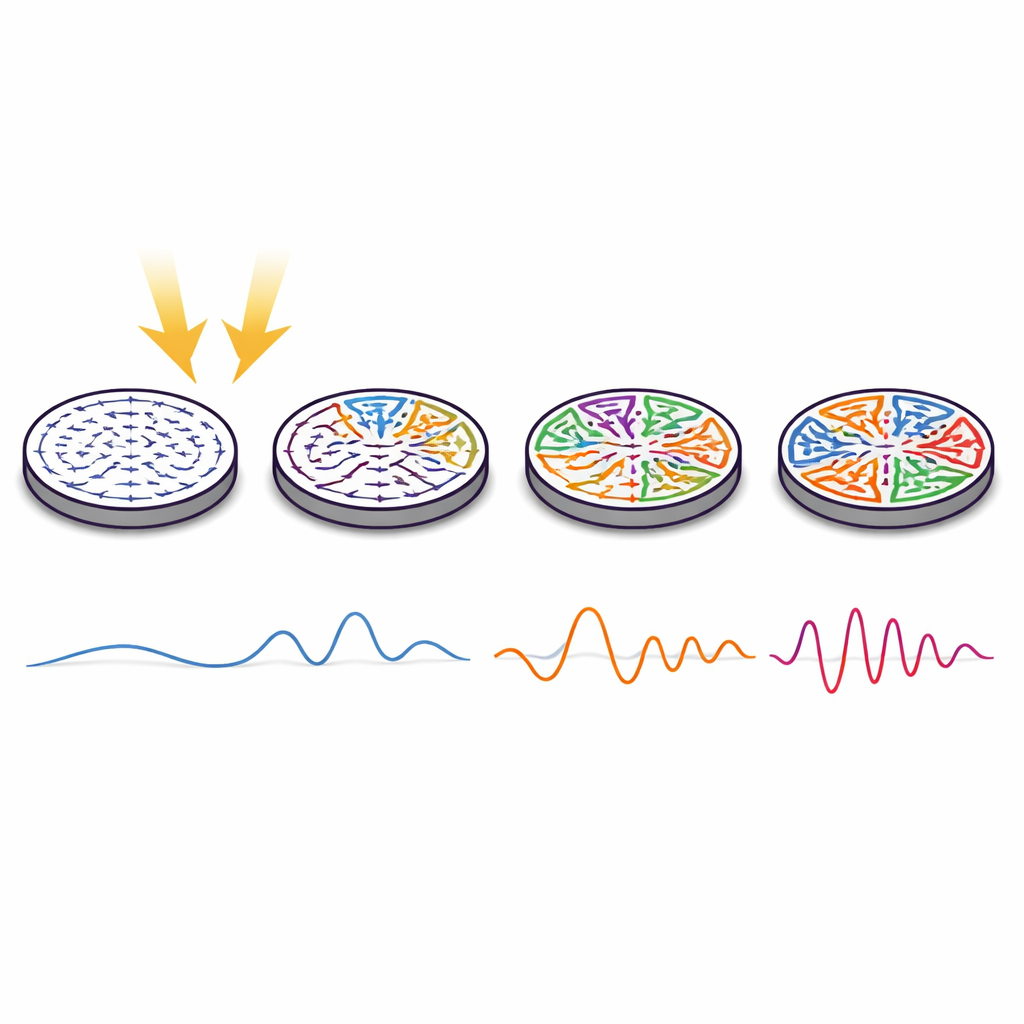
Using detailed micromagnetic simulations of 20‑ and 50‑nanometer‑wide memory disks, the researchers compared switching with and without interfacial DMI. When DMI was absent, the magnetization flipped in a largely coherent way: the tiny magnetic moments inside the disk rotated together, quickly reaching a new uniform orientation. Introducing realistic levels of DMI changed the picture dramatically. The magnetization began to tilt in‑plane and break into multiple regions pointing in different directions, forming so‑called multidomain states. These complex patterns slowed down the overall reversal and could persist even after a write pulse ended, leaving the bit in an in‑between state rather than a clean “0” or “1.”
How twisting leads to ballooning
By sweeping both the DMI strength and the write current, the team mapped out how often switching succeeded or failed. Without DMI, the write error rate fell smoothly as current increased. With moderate DMI, higher currents were required to reach the same reliability. At still larger DMI values, the characteristic ballooning shape emerged: error rates dipped, rose again at intermediate currents, and then finally dropped at very high currents. Physically, near a critical DMI value the energetic cost of forming domain walls nearly vanishes, so multidomain states form easily and become stubbornly stable. Short pulses do not last long enough to sweep away these patterns, so some bits never complete their reversal even under strong drive, inflating the error rate.
Longer pulses as a practical fix
The simulations also explain why longer write pulses reported in experiments do not show ballooning. When the pulse was extended from 5 to 50 nanoseconds, the same devices had time to smooth out the twisted, multidomain configurations into a uniform final state. The result was a steadily decreasing error rate with current and much better reliability at lower write currents. This suggests two practical levers for engineers: keep the interfacial DMI below a dangerous threshold through careful material and interface design, or, when that is not possible, use slightly longer write pulses or operate outside the current range where ballooning appears.
What this means for future memory
To a lay reader, the key takeaway is that a tiny, invisible twisting force at the atomic interface of magnetic layers can cause large, unexpected spikes in memory errors when devices are driven very fast. By showing that this interfacial interaction can generate the ballooning effect all by itself, the study points directly to interface engineering—controlling materials, oxygen content, and processing—as a powerful way to make STT‑MRAM more predictable and robust. With these insights, designers can better balance speed, energy use, and reliability as they turn this promising technology into everyday, large‑scale memory for electronics.
Citation: Das, P., Rajib, M.M. & Atulasimha, J. Exploring the role of interfacial Dzyaloshinskii–Moriya interaction in write error rate anomalies of spin-transfer torque magnetic tunnel junctions. npj Spintronics 4, 18 (2026). https://doi.org/10.1038/s44306-026-00137-z
Keywords: STT-MRAM, magnetic tunnel junctions, Dzyaloshinskii–Moriya interaction, write error rate, spintronics reliability