Clear Sky Science · en
Quantized piezospintronic effect in antiferromagnetic Moiré systems
Turning Gentle Stretching into Spin Power
Imagine if simply stretching a material—much like bending a flexible screen—could generate a flow of tiny magnetic moments, or spins, without wasting energy as heat. This paper explores exactly that possibility in a new class of ultra-thin, layered crystals. By twisting and gently straining two atomically thin magnetic sheets, the authors show how to create perfectly precise, “quantized” spin currents that could one day power ultra-efficient memory and logic devices. 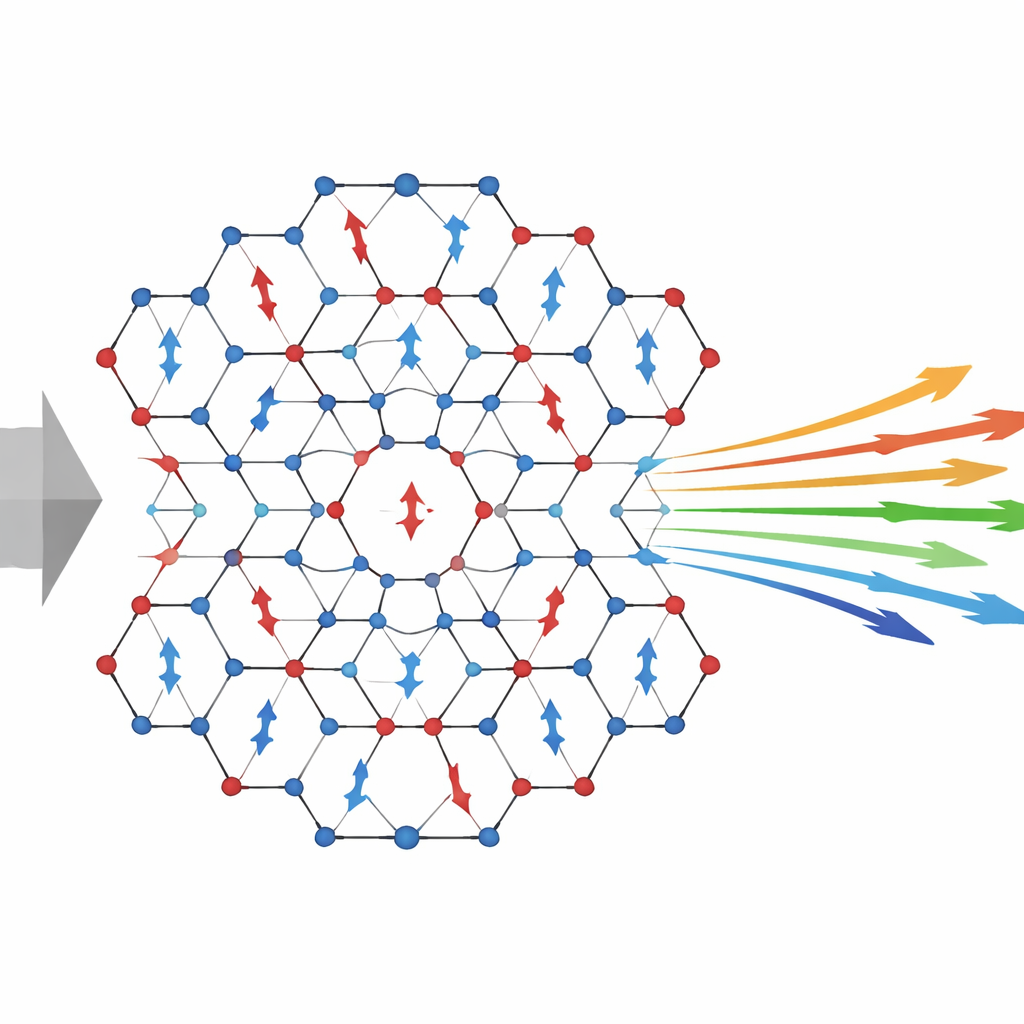
From Charge Electronics to Spin Electronics
Conventional electronics move electric charge around wires and circuits, but this approach is reaching limits in speed and energy use. Spintronics aims to go further by using the electron’s spin—a sort of built‑in compass needle—rather than just its charge. If engineers can generate and control flows of spin as easily as they now guide electric currents, they could build devices that switch faster, use less power, and remember information even when turned off. The challenge is to find materials where spin currents can be created cleanly and predictably without dragging along unwanted charge.
Using Moiré Patterns as a Spin Engine
The authors focus on a special kind of “moiré” material: two honeycomb‑shaped layers (similar to graphene) that are slightly rotated relative to each other and host antiferromagnetic order, where neighboring spins point in opposite directions. This gentle twist creates a large, repeating interference pattern that profoundly reshapes how electrons move. On top of that, a small mechanical strain is applied to one of the sheets, and a built‑in energy difference between the two sublattices can be introduced, for example by aligning one layer with a hexagonal boron nitride substrate. Together, twist, strain, and magnetism form a tunable playground where the quantum structure of the electronic bands can be carefully engineered.
How Strain Turns Into Pure Spin Flow
To understand how stretching the crystal translates into spin transport, the researchers use a powerful theoretical framework based on Berry phases, which capture the geometric “twists” in the quantum wavefunctions of electrons. When certain symmetries are broken—specifically inversion symmetry by the sublattice potential and time‑reversal symmetry by the antiferromagnetic exchange—the material develops a built‑in response to strain. Under these conditions, pushing or pulling the lattice creates equal and opposite currents for up and down spins. The net electric charge cancels out, but the spins themselves flow, yielding a pure spin current. Remarkably, the strength of this response does not vary smoothly: in key regimes it locks to exact values set by integer “Chern numbers,” topological quantities that count how many times the bands wrap around a mathematical space. 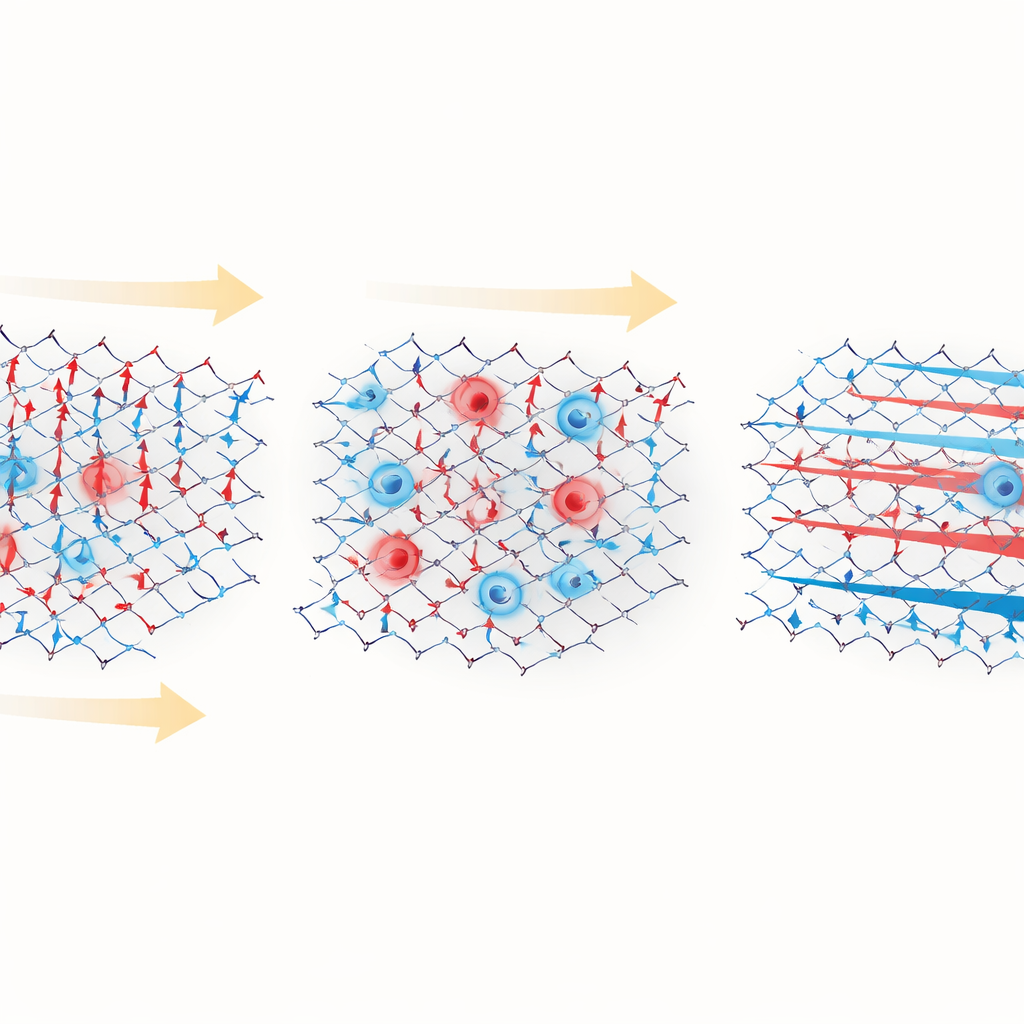
Switching Between Charge and Spin Responses
By tuning two knobs—the sublattice potential and the magnetic exchange—the system can be pushed across sharp topological transitions. On one side of this boundary, both spin species contribute in the same way, giving a quantized electrical (piezoelectric) response when the material is strained, while the spin response is nearly absent. On the other side, their contributions oppose each other, cancelling charge flow but producing a precisely quantized piezospintronic response: a pure spin current driven by mechanical deformation. Because strain affects different quantum “valleys” in opposite ways, their contributions reinforce rather than cancel, making the quantization robust even when the magnitude or direction of the strain is slightly varied.
Hidden Orbital Magnetism in the Pattern
The same twisted structure also hosts strong orbital magnetism, where electrons circulating in the moiré pattern behave like tiny current loops. The calculations show that these orbital moments are concentrated near special points in the moiré Brillouin zone and remain sizable even when magnetic exchange is present, though their overall strength decreases as the exchange grows. In an ideal antiferromagnetic arrangement, contributions from different valleys cancel, hiding this orbital magnetization from direct view. But the authors argue that carefully designed perturbations—such as non‑uniform strain, valley‑selective scattering, or in‑plane currents—could unbalance these contributions and make a net orbital magnetization experimentally observable.
Why This Matters for Future Devices
In simple terms, this work shows how to build a “spin current pump” whose output is tied to fundamental quantum rules rather than to messy material details. By twisting, straining, and magnetizing certain two‑dimensional crystals, it should be possible to generate perfectly calibrated spin currents and robust orbital magnetization, both highly desirable for spin‑based information technology. The authors point to realistic candidates—such as magnetic compounds from the MPX3 family stacked with wide‑gap materials like hexagonal boron nitride—where these ideas could be tested. As long as the antiferromagnetic order survives and the operating temperature is low enough, the predicted quantized plateaus in the spin response should be visible, offering a new route to precise, low‑power spintronic and valleytronic devices.
Citation: Castro, M., Mancilla, B., Wolff, F. et al. Quantized piezospintronic effect in antiferromagnetic Moiré systems. npj Spintronics 4, 16 (2026). https://doi.org/10.1038/s44306-026-00135-1
Keywords: piezospintronics, moiré materials, antiferromagnets, spin currents, orbital magnetism