Clear Sky Science · en
Storylines of summer streamflow droughts in western Canadian watersheds: historical attribution and future projections
Why shrinking summer rivers matter to everyone
In southern British Columbia, big rivers like the Fraser and Columbia are the region’s lifelines, supplying drinking water, power, irrigation, and vital habitat for salmon. In 2023 and 2024, these rivers ran unusually low in summer, disrupting electricity generation, triggering water restrictions, and adding stress to already warming streams. This study asks a question that affects communities, ecosystems, and economies far beyond Canada: how are today’s summer water shortages being shaped by climate change, and what do they foreshadow for our future?
Two bad summers, two different stories
The authors focus on two neighboring, snow-fed watersheds: the Fraser and the upper Columbia River basins. They reconstruct how the 2023 and 2024 summer droughts unfolded using a detailed computer model of the water cycle, driven by observations of temperature, snow, and rainfall. In 2023, river flows in summer were about one-third below the long-term average, even though the winter snowpack was not exceptionally low. In 2024, the rivers were again depleted, but this time they followed one of the leanest winter snowpacks on record. These contrasting years offered a natural experiment for teasing apart how heat, snow, and rainfall combine to produce summer streamflow drought.
Heat, snow, and rain working together
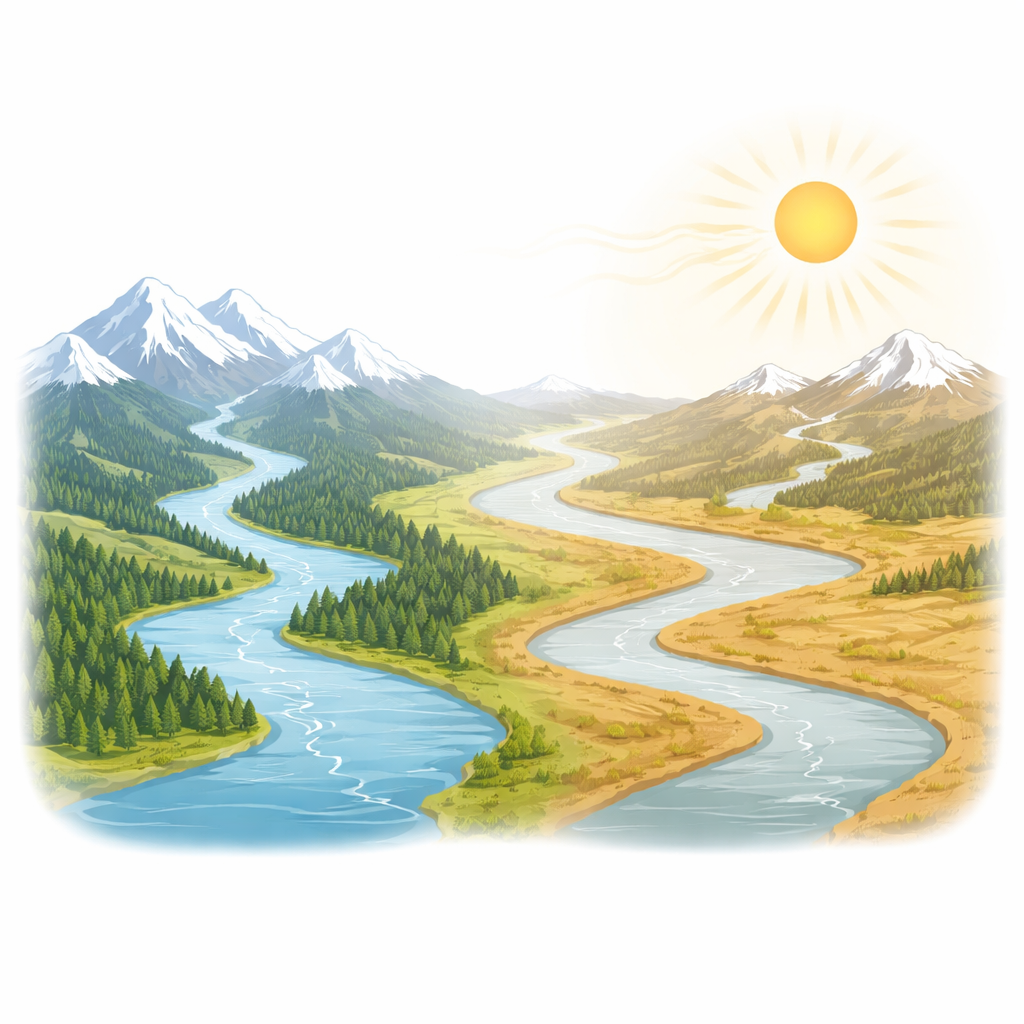
By running controlled “what if” simulations, the researchers built storylines that isolate each major driver. For 2023, they swapped in different combinations of initial snow conditions and spring–summer weather patterns. The clearest result: unusually hot May and June weather rapidly melted the snow and shifted much of the runoff earlier into spring, leaving summer high and dry. In 2024, the critical factor was different. The model showed that the very low winter snowpack alone was enough to cause serious summer shortages, and that pairing this with drier or hotter weather would have pushed flows even lower. Across many years of data, the analysis confirmed that snow conditions on April 1 exert the strongest control on summer river flow, while warm-season rainfall and heat play important, but secondary, roles.
Comparing our world with a cooler one
To understand how much long-term warming has already altered these rivers, the team also created a “counterfactual” climate: a version of recent decades with the same year-to-year weather patterns but without the modern warming trend. Feeding this cooler world into their hydrological model revealed that both 2023 and 2024 would have had deeper snowpacks and higher summer flows. In the actual, warmed climate, snow reserves on April 1 were about 4–20% lower, and summer river flows were 8–31% lower than they would have been without long-term climate change. In other words, human-driven warming has already upgraded both events from moderate to much more severe droughts.
A future with more frequent and deeper lows
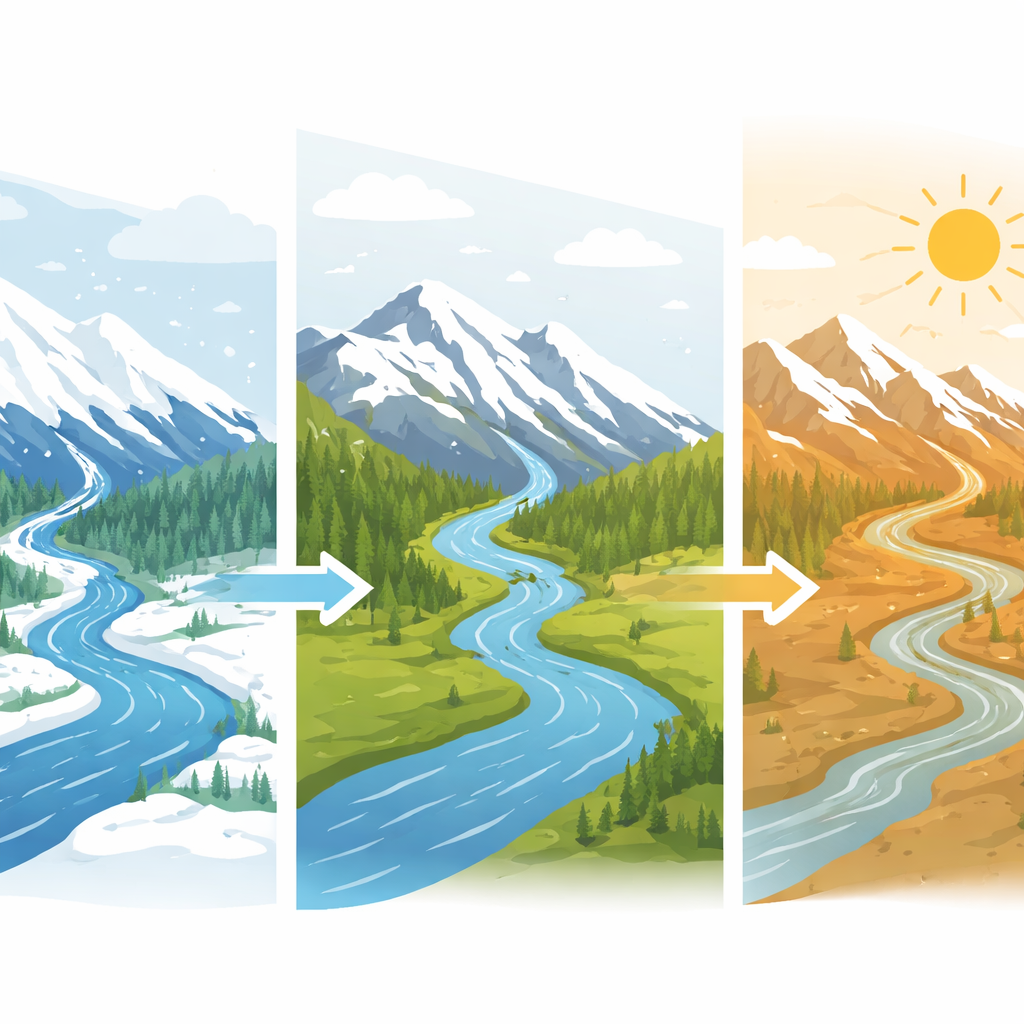
The study then looked ahead using climate projections from 11 global climate models, downscaled to the regional scale. As global temperatures climb, winters in these basins are expected to get warmer and somewhat wetter, but increasingly that extra precipitation will fall as rain instead of snow. The model suggests a steady decline in snowpack and a shift towards earlier melt, while summers become hotter and drier. By the time the planet reaches about 3 °C of warming above preindustrial levels, more than half of the years in these watersheds are projected to experience snow and summer streamflow conditions below today’s moderate drought thresholds. Droughts as severe as, or worse than, the record-setting 2023 event become common rather than rare.
When droughts pile on top of each other
Beyond how often drought will occur, the authors explore how different types of drought may compound each other. They track “snow drought” (very low winter snowpack), “meteorological drought” (dry, hot spring and summer), and “streamflow drought” (low river flow). Today, severe summer river shortages most often coincide with poor snow years. In a warmer world, however, years that mix both low snow and hot, dry weather become more frequent and much more extreme. By 4 °C of global warming, these triple-compound drought years make up a substantial share of all summers in both basins. The analysis suggests that relying on snowmelt as a natural reservoir will become increasingly risky, and that summer rainfall and heat will play a larger role in driving water shortages.
What this means for people and rivers
The paper concludes that climate change has already made recent summer water shortages in southern British Columbia significantly worse and is on track to turn historically rare events into regular occurrences. As snowpacks shrink and heat intensifies, rivers that communities, hydropower systems, farmers, and salmon depend on will face more frequent and more severe low-flow summers. Planning for this future—by improving water storage, managing demand, and protecting vulnerable ecosystems—will be essential if society is to stay ahead of the growing risk of summer streamflow droughts in snow-fed river systems worldwide.
Citation: Shrestha, R.R., Cannon, A.J. Storylines of summer streamflow droughts in western Canadian watersheds: historical attribution and future projections. npj Nat. Hazards 3, 41 (2026). https://doi.org/10.1038/s44304-026-00204-9
Keywords: streamflow drought, snowpack, climate change, British Columbia rivers, water resources