Clear Sky Science · en
Increasing the circularity of methane pyrolysis by using the solid carbon co-product in cements: a plant-scale study
Turning a Climate Problem into a Building Solution
Methane gas is a major source of both industrial hydrogen and climate-warming carbon dioxide. At the same time, making cement for concrete releases enormous amounts of CO2. This study explores an intriguing two-for-one idea: can we make cleaner hydrogen while locking away carbon inside everyday building materials—without weakening the structures we rely on?
Splitting Methane Without the Usual Smoke
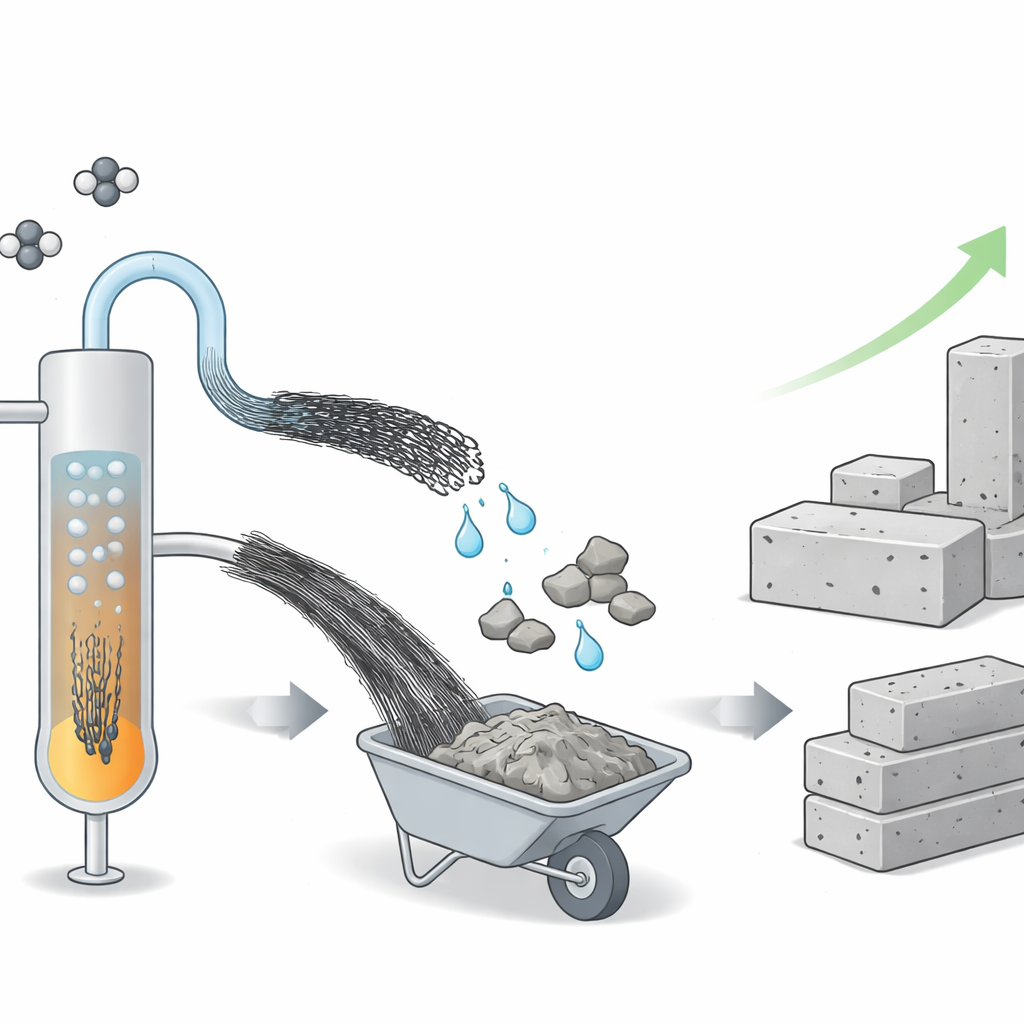
Today most hydrogen is made by reacting methane with water, a process that vents large amounts of carbon dioxide. Methane pyrolysis offers a different route: it breaks methane into hydrogen gas and solid carbon rather than CO2. If this method were used to supply the world’s hydrogen demand, hundreds of millions of tons of solid carbon would be produced each year—far more than current markets can absorb. The building sector, which already consumes over 4 billion tons of cement annually and is responsible for nearly a tenth of global CO2 emissions, is one of the few industries large enough to store this carbon at scale. The authors investigate whether the solid carbon coming out of a commercial methane pyrolysis plant, in the form of carbon nanotube pulp, can be blended into cement-based materials in meaningful amounts.
Mixing High-Tech Carbon into Everyday Cement
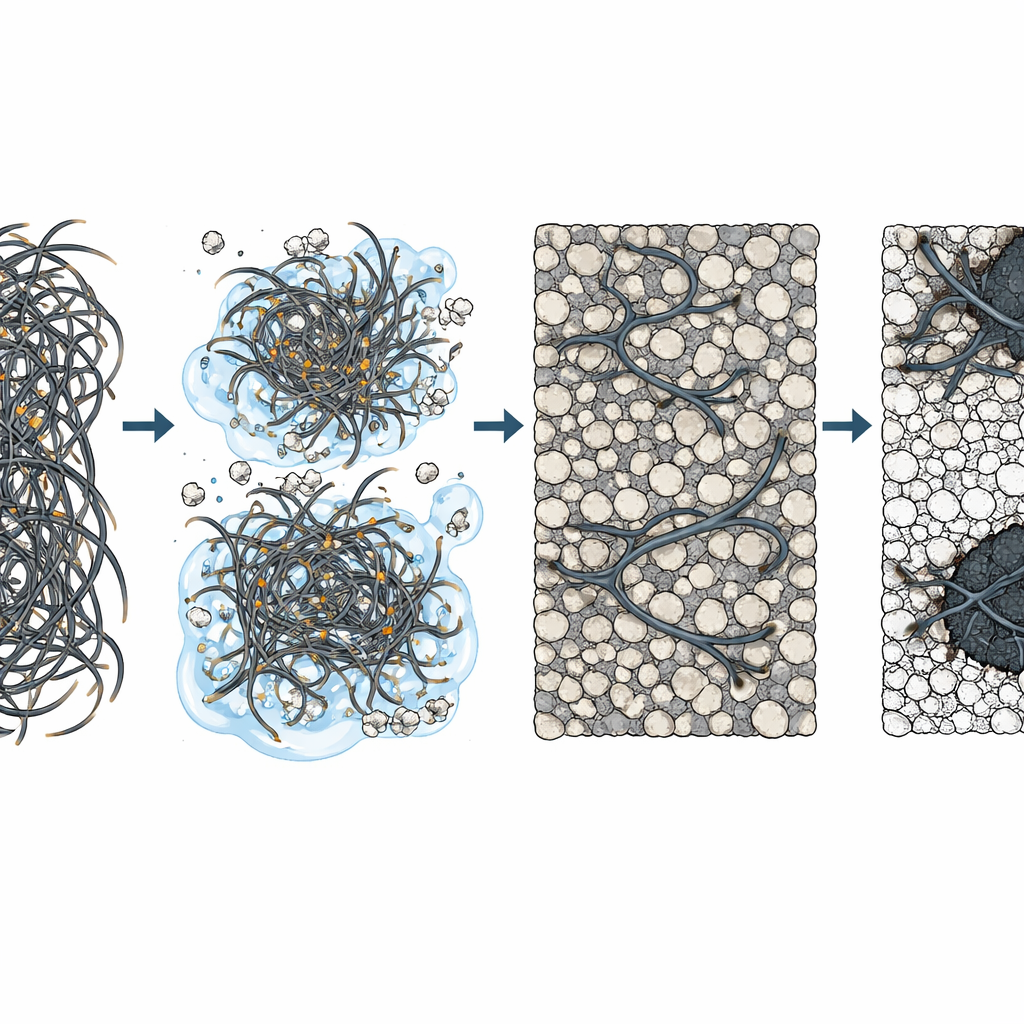
The carbon studied here is a dense mat of ultra-thin, hairlike tubes, with bits of iron left over from the production process. The researchers replaced up to 1% of the cement (by weight) with this carbon pulp in cement pastes and mortars, then mixed and cured them much like standard building materials. Under the microscope, the carbon does not disperse as individual tubes; instead it forms crumpled fabric-like clusters tens to hundreds of micrometers across. These clusters disturb how cement grains pack around them, creating a narrow zone of weaker paste at their edges. At the same time, some nanotubes do break free and thread through the hardened material, where they can bridge tiny cracks.
Strength Gains Early, Trade-Offs Later
To see how these changes play out in practice, the team measured how hard the materials were to crush and pull apart after curing for one week and four weeks. When a small portion of cement was replaced with carbon pulp, the compressive strength at early ages rose modestly before leveling off. The researchers attribute this to a “filler” effect: tiny iron-rich particles and chemically active carbon surfaces speed up the early stages of cement hardening. By four weeks, however, the overall compressive strength of carbon-containing samples was similar to plain mortar—neither clearly better nor worse—because the large carbon clusters act like soft inclusions or voids that concentrate stress. In tension, where concrete is naturally weak, the picture is a bit brighter: mixtures with 1% carbon showed an increase of about 16% in tensile strength, likely because well-separated nanotubes can hold microcracks together even as the larger clusters behave like flaws.
Workability and the Hidden Cost of Thickening
Fresh concrete must be fluid enough to pump, pour, and fully fill molds. The study found that even modest amounts of carbon pulp made the cement paste much stiffer. At 1% replacement, the yield stress—a measure of how hard the material is to start flowing—rose by about three quarters, and the spread of the paste in a standard slump test shrank noticeably. This loss of workability comes from several sources: the carbon’s enormous surface area ties up water, its clusters obstruct flow, and its surface chemistry draws in more liquid. To regain normal flow, the researchers had to add a modern plasticizing additive. That extra ingredient, however, slightly erodes the climate benefit and can slow cement hardening, partially offsetting the early strength gains.
Climate Benefits and Real-World Hurdles
Using carbon pulp as a small cement replacement trims the “embodied carbon” of the binder by roughly 1% at the 1% substitution level, even after accounting for transport and, where needed, the added plasticizer. Scaled up, this could translate to meaningful emission savings, especially if methane pyrolysis expands under future carbon pricing. Yet technical and safety questions remain. The workability penalty is severe enough that real construction projects would likely need careful mix redesign. Economic viability is also uncertain: today, this kind of carbon is too valuable to be poured into concrete, and its fine fibrous nature raises occupational health concerns similar to those for other carbon nanotube materials. Overall, the study shows that cement can indeed host significant amounts of methane-pyrolysis carbon without sacrificing core strength, offering a promising path toward more circular, lower-carbon infrastructure—provided that dispersion, handling safety, and cost can be brought under control.
Citation: McElhany, S., Konwar, A., Zheng, Q. et al. Increasing the circularity of methane pyrolysis by using the solid carbon co-product in cements: a plant-scale study. npj Mater. Sustain. 4, 18 (2026). https://doi.org/10.1038/s44296-026-00107-w
Keywords: methane pyrolysis, low-carbon cement, carbon nanotubes, hydrogen production, carbon sequestration