Clear Sky Science · en
Motivation biases behavior but not perception
Why our wishes don’t literally change what we see
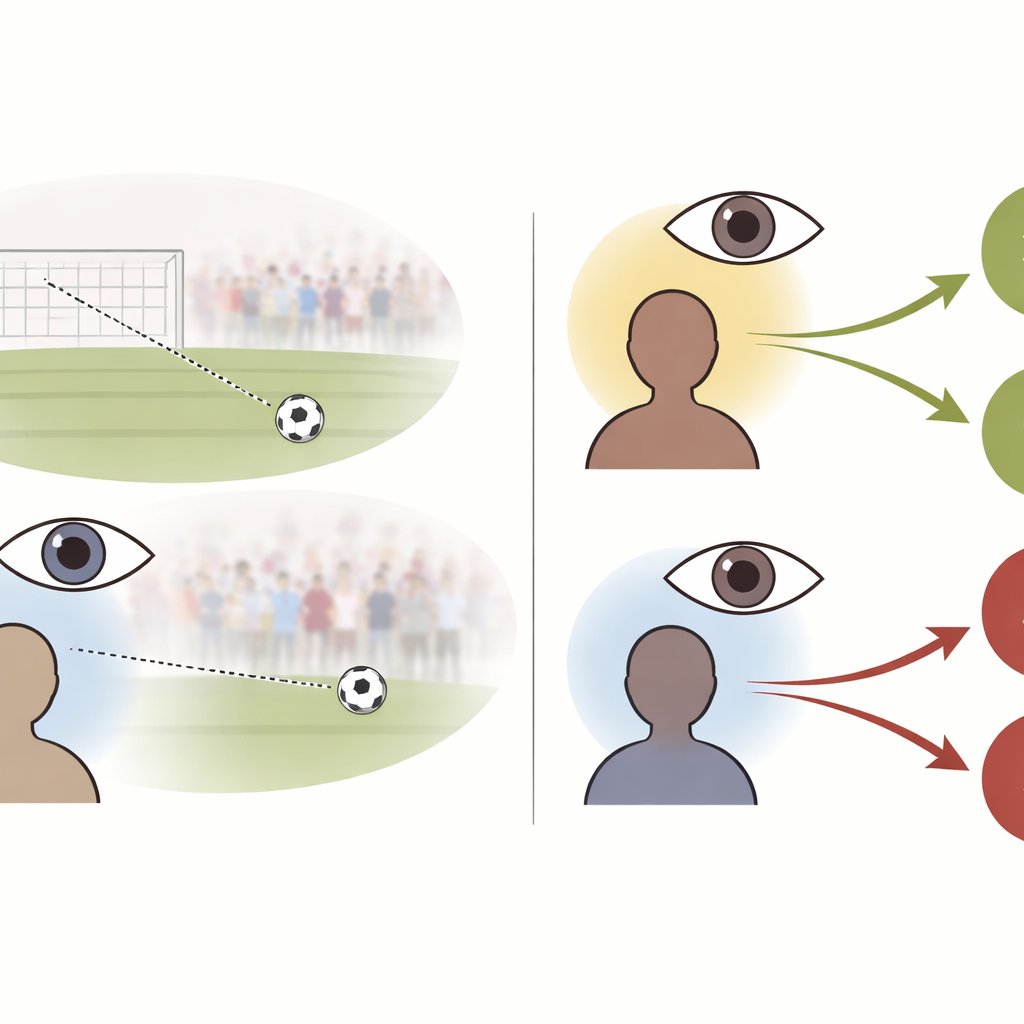
People often claim we “see what we want to see,” from disputed goals in a soccer match to arguments over whether a picture shows one thing or another. This study asks a precise question behind that everyday idea: does motivation actually change what our eyes and brain perceive, or does it mainly change where we look and how we choose to respond? Across four tightly controlled experiments, the authors show that motivation shapes our gaze and our decisions, but leaves the basic visual impression itself largely untouched.
Wanting something and seeing clearly
The authors start from the popular theory of “motivated perception,” which holds that our desires can bend perception itself. Earlier work reported, for example, that desirable objects seem closer or larger. But critics argued that many of those studies could not cleanly separate perception (what is experienced) from response (what is reported). Here, the researchers set out to pull these pieces apart. They varied how valuable particular outcomes were to participants and measured two fundamental aspects of perception: sensitivity (how well faint or noisy signals are detected) and bias (which of two alternatives someone tends to choose). At the same time, they tracked eye movements and attention, and they distinguished explicit reports from more automatic eye-movement readouts that do not require conscious judgment.
Motivation moves the eyes, not the seeing
In the first experiment, people tried to detect digits hidden in snowy visual noise at two locations, one usually containing higher-value digits than the other. Participants knew which location could pay more, so they were motivated to find digits there. At first glance, sensitivity appeared slightly better where the payoff was higher. However, eye-tracking revealed that people tended to land their gaze closer to the high-value location. Once this difference in gaze position was factored out, the apparent advantage in sensitivity vanished: both locations were seen equally well when the eyes were in comparable positions. In other words, motivation did not enhance the visual system’s raw ability to pick up the digits; instead, it changed where people looked, and that change in viewing angle explained the subtle differences in performance.
Biased answers without biased sight
The second experiment tackled bias more directly. Participants watched two moving dots in sequence and judged which moved faster, while their eyes smoothly tracked the motion. In one block, correct answers favoring one of the two options were rewarded more highly, creating a clear motivational pull toward that choice. Participants’ verbal judgments shifted toward the better-paid option, revealing a strong bias. But their smooth pursuit eye movements—a sensitive, continuous reflection of perceived motion—showed no corresponding shift. This mismatch indicates that motivation biased the decision stage (what people said) without altering the underlying motion signal their eyes were following, arguing against a genuine change in perception.
Ambiguous pictures and the power of gaze
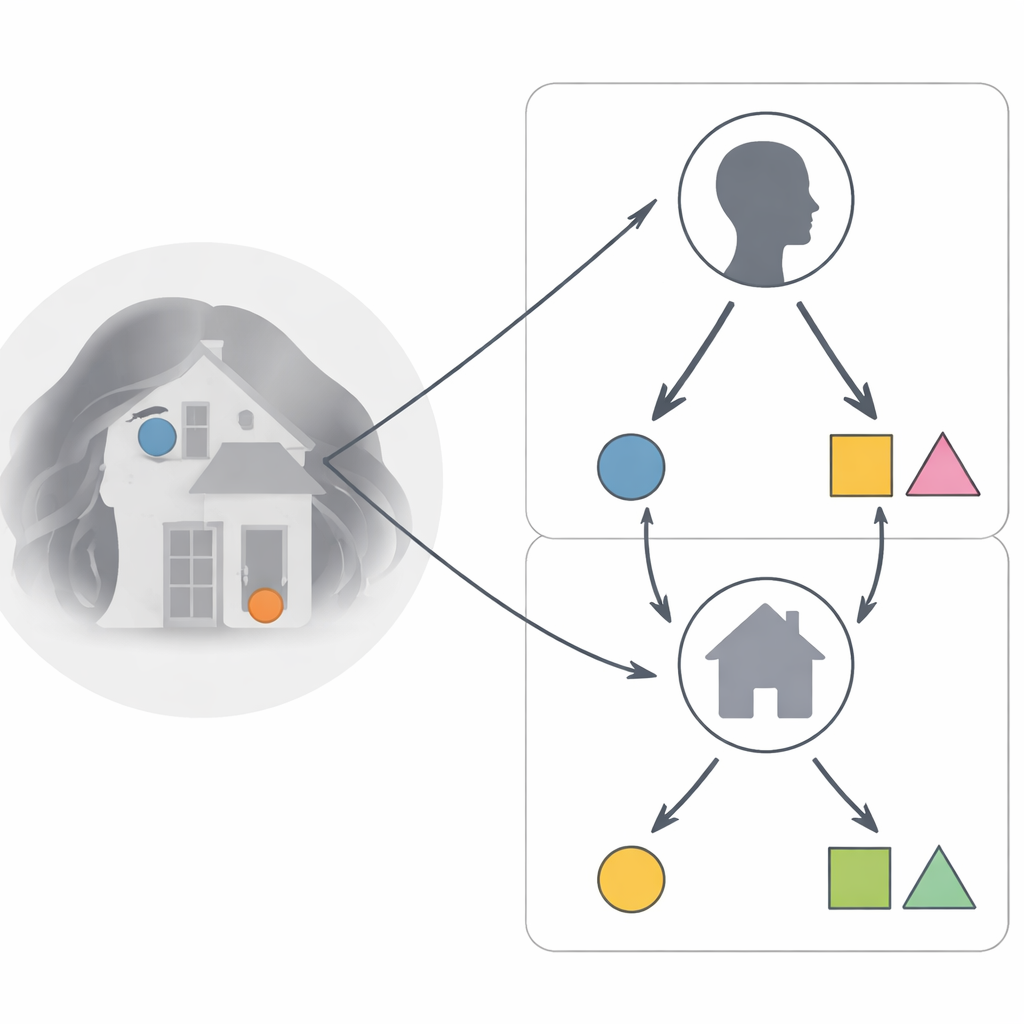
The remaining experiments explored classic ambiguous images, such as face–house blends or illusions that can be seen as two different objects. First, when people freely viewed these pictures and their perception flipped from one interpretation to the other, those flips were reliably preceded by shifts in gaze to different parts of the image. Next, when participants were asked to intentionally favor one interpretation, they did so by spontaneously fixating different regions, even without being told to move their eyes. Finally, when the researchers forced participants to look at specific diagnostic parts of the image, their reported interpretations shifted in predictable ways. Together, these results show that where we look can drive which of several possible perceptions wins out, especially when the stimulus is inherently ambiguous.
Quality of motivation makes little difference here
Beyond how much people cared about rewards, the authors also measured why they were motivated, distinguishing more internal, self-endorsed motivation from more external pressure. This “quality” of motivation, a central idea in contemporary motivation theory, did not predict any consistent differences in perception, gaze, or response patterns across the tasks. The key driver of the observed effects was the immediate value structure of the task, not deeper motivational style.
What this means for everyday disagreements
Putting it all together, the study challenges the strong claim that we literally see the world differently just because we want different outcomes. Instead, motivation works through a behavioral pathway: it steers our eyes toward particular parts of a scene and nudges our choices and reports in desirable directions. Two fans watching the same borderline soccer goal may disagree not because their visual systems turned the same photons into different images, but because they looked at different details or were more willing to declare “goal” when it favored their team. In everyday life, our goals and desires shape perception mainly by guiding our attention and by biasing what we say, not by rewriting the basic visual information arriving at our eyes.
Citation: Wolf, C., Lappe, M. & Riddell, H. Motivation biases behavior but not perception. Commun Psychol 4, 72 (2026). https://doi.org/10.1038/s44271-026-00461-4
Keywords: motivated perception, visual attention, eye movements, decision bias, ambiguous images