Clear Sky Science · en
Intercropping with legumes in the Congo Basin increases maize yields but not greenhouse gas emissions
Balancing Food Needs and Climate in the Congo Rainforest
The Congo Basin holds one of the world’s largest tropical rainforests, but a fast-growing population is clearing more land to grow food, especially maize. This study asks a pressing question: can farmers harvest more maize from land they already farm without greatly increasing the gases that warm the planet? By comparing simple changes that real smallholders could adopt, the researchers explore how to raise yields while protecting both the climate and the surrounding forest. 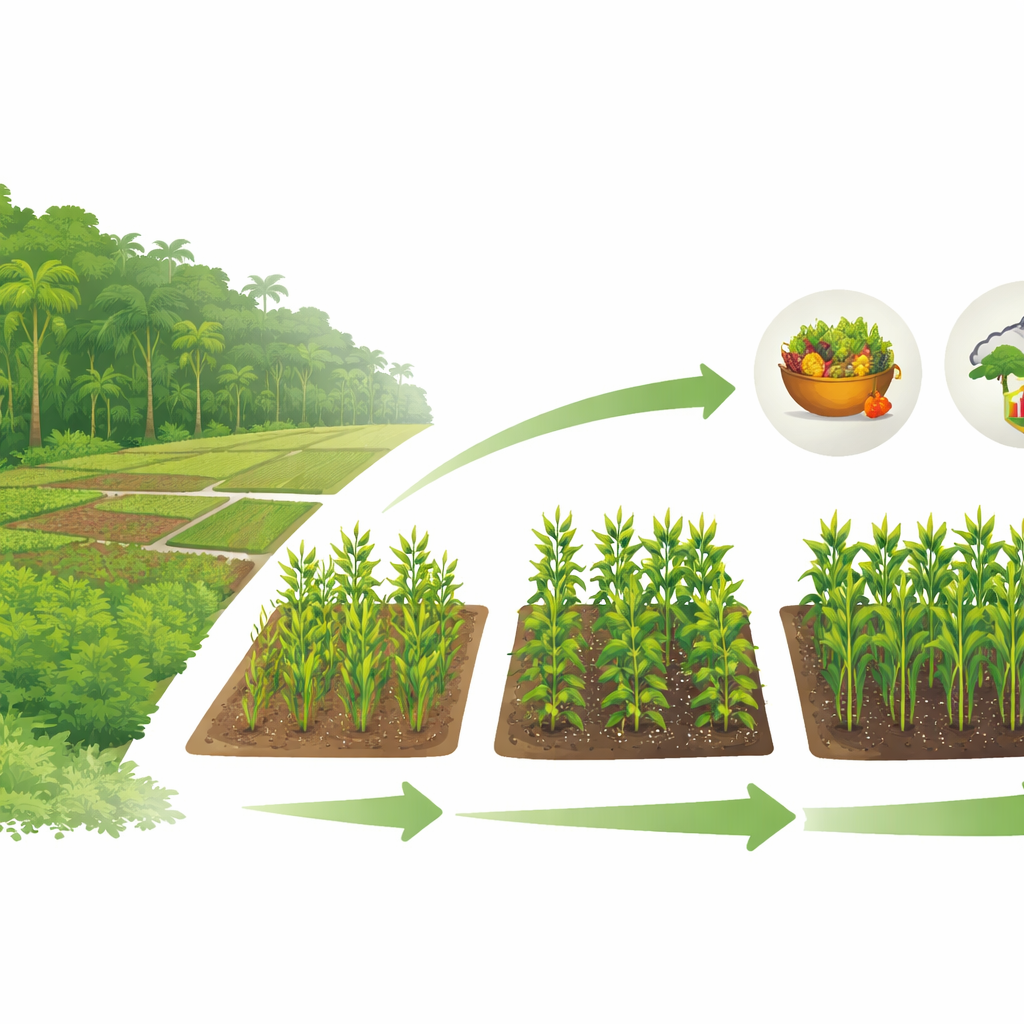
Why Forest Edges Matter
The Congo Basin’s forests store vast amounts of carbon and support millions of people. Yet most new deforestation comes from many small fields carved out by families using slash-and-burn methods and low-input farming. Yields on these poor, acidic soils are modest, so farmers often clear fresh forest rather than coax more grain from existing plots. Improving productivity on current fields could ease pressure on forests, but only if it does not unleash large new emissions of powerful greenhouse gases like nitrous oxide and methane from the soil.
Testing Simple Changes Farmers Can Make
In Cameroon, the team set up three small maize fields at the forest margin and followed them over two growing seasons. One field used local practice: maize without fertilizer (the control). A second field grew maize together with beans that can draw nitrogen from the air through their roots. A third field had maize fertilized with a moderate dose of mineral nitrogen, representing a step toward a more conventional “Green Revolution” approach. Nearby secondary forest served as a reference for natural greenhouse gas levels. The scientists tracked maize harvests, total plant growth, and continuous exchanges of carbon dioxide, nitrous oxide, and methane between soil and air.
More Grain, Different Climate Costs
Both intensification strategies boosted harvests compared with unfertilized maize. Intercropping with beans raised maize grain by about 40 percent and increased total plant biomass, while also providing an extra bean crop rich in protein. Mineral fertilizer more than doubled maize yield and produced the most plant biomass, confirming how strongly the crop responds to added nitrogen on these soils. Yet the soil’s response in terms of gas emissions was sharply different. With beans, nitrous oxide emissions stayed low and similar to the unfertilized maize, and the soil kept drawing methane from the air at about the same rate. With fertilizer, nitrous oxide emissions jumped roughly fivefold and even exceeded those measured in nearby forest soils, while the soil’s ability to absorb methane weakened. 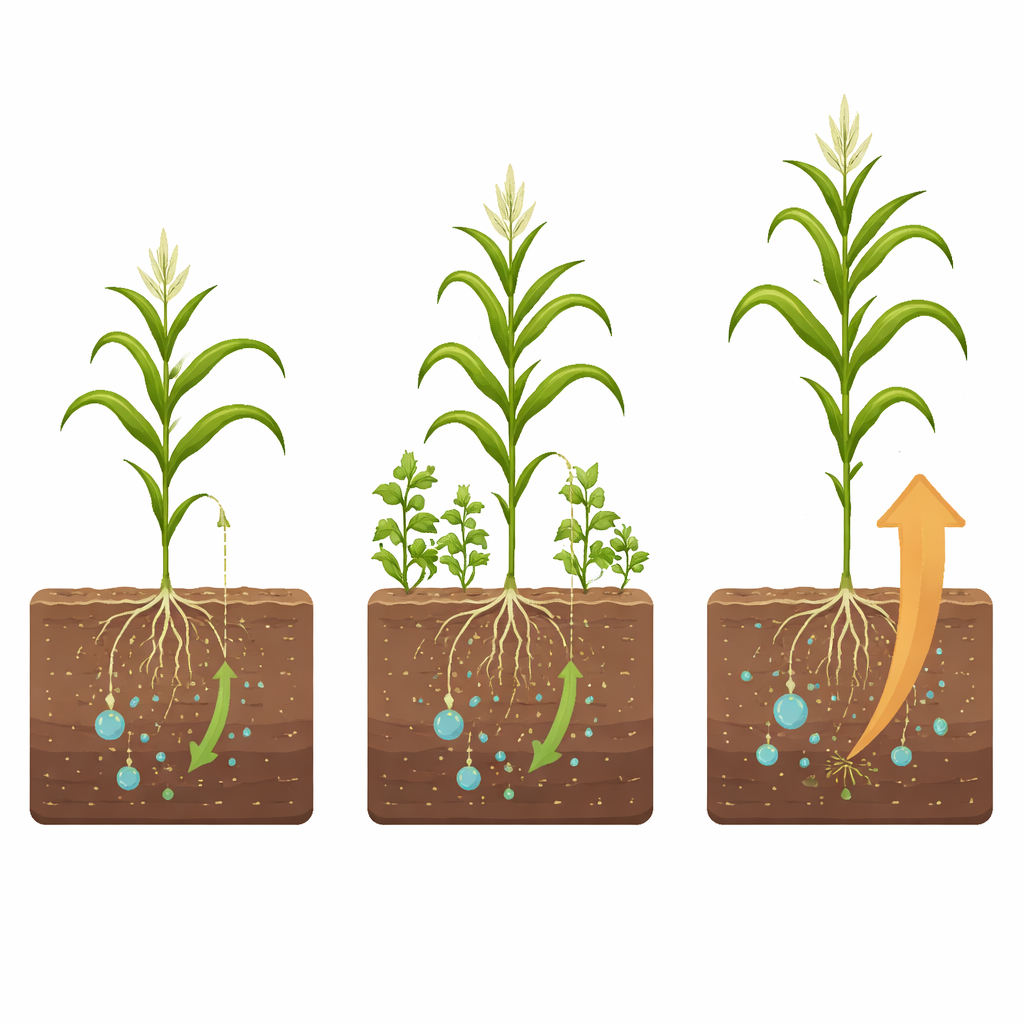
Looking Under the Soil Surface
Close inspection of the soils helps explain these patterns. All croplands had already lost some organic carbon compared with forest, reflecting earlier clearing. Despite the fertilizer, measured mineral nitrogen in the soil was usually low, showing that plants and microbes quickly grabbed what was applied. When heavy rains followed fertilization, water filled soil pores and created oxygen-poor spots where microbes convert nitrogen into nitrous oxide that escapes to the air. These wet, warm tropical conditions make each kilogram of fertilizer nitrogen far more potent for nitrous oxide release than in drier African regions, so the climate cost per ton of extra maize is unusually high.
Choosing Smarter Intensification Paths
To compare options fairly, the researchers calculated nitrous oxide emitted per ton of maize grain and per ton of harvested protein. On both counts, the maize–bean intercrop performed best: it raised food and protein supply while keeping emissions per unit of harvest lowest. Fertilized maize delivered the most grain but also the highest emissions per ton, well above global averages for maize. In other words, in this humid forest region, pushing yields with mineral fertilizer alone risks trading forest protection for strong greenhouse gas releases from existing fields.
What This Means for Farmers and Forests
For communities along the Congo forest frontier, the study suggests that mixing maize with nitrogen-fixing beans can be a powerful “middle way.” It does not fully close the yield gap, but it improves maize harvests, adds a protein-rich food, keeps methane uptake intact, and avoids the surge in nitrous oxide seen with mineral fertilizer. Where fertilizers are costly, supply chains are weak, and soils are prone to high emissions when wet, legume intercropping offers a practical, lower-risk path to produce more food without greatly increasing the climate footprint of agriculture or the pressure to clear more forest.
Citation: Kwatcho Kengdo, S., Djatsa, L.D., Njine-Bememba, C.B. et al. Intercropping with legumes in the Congo Basin increases maize yields but not greenhouse gas emissions. npj Sustain. Agric. 4, 38 (2026). https://doi.org/10.1038/s44264-026-00146-9
Keywords: Congo Basin agriculture, maize–legume intercropping, nitrous oxide emissions, tropical smallholder farming, sustainable intensification