Clear Sky Science · en
Forest islands sustain more temporally stable insect metacommunities in a heterogeneous tropical mountaintop landscape
Life on the mountaintop
High mountain landscapes in the tropics are home to a surprising wealth of insects that quietly keep ecosystems running, from recycling nutrients to pollinating plants. This study looks at how those insect communities change through time in two neighboring habitats on Brazilian mountaintops, helping us understand which areas are more stable refuges as climate and land use continue to shift.

Two very different mountain worlds
The researchers worked in the southern Espinhaço Range, a highland region where open rocky grasslands, called campo rupestre, surround patches of forest known as forest islands. Although these habitats sit at similar elevations, they feel very different. Campo rupestre is sunny, windy, and dry, with shallow, poor soils and low plants. Forest islands are cooler, more humid, and shaded, with taller trees and deeper soils. These contrasts create distinct living conditions for insects, shaping which species can thrive where.
The insects under the microscope
Over several years between 2013 and 2020, the team repeatedly sampled three kinds of insects that are commonly used as indicators of environmental change: ants, dung beetles, and fruit feeding butterflies. In total they recorded 326 species. Although overall numbers of species were similar in grasslands and forest islands, most species were unique to one habitat or the other, meaning each habitat contributes its own share to the region’s total biodiversity. Only a smaller fraction of species could use both environments, reflecting the strong environmental divide between open grasslands and forest patches.
Change and stability through time
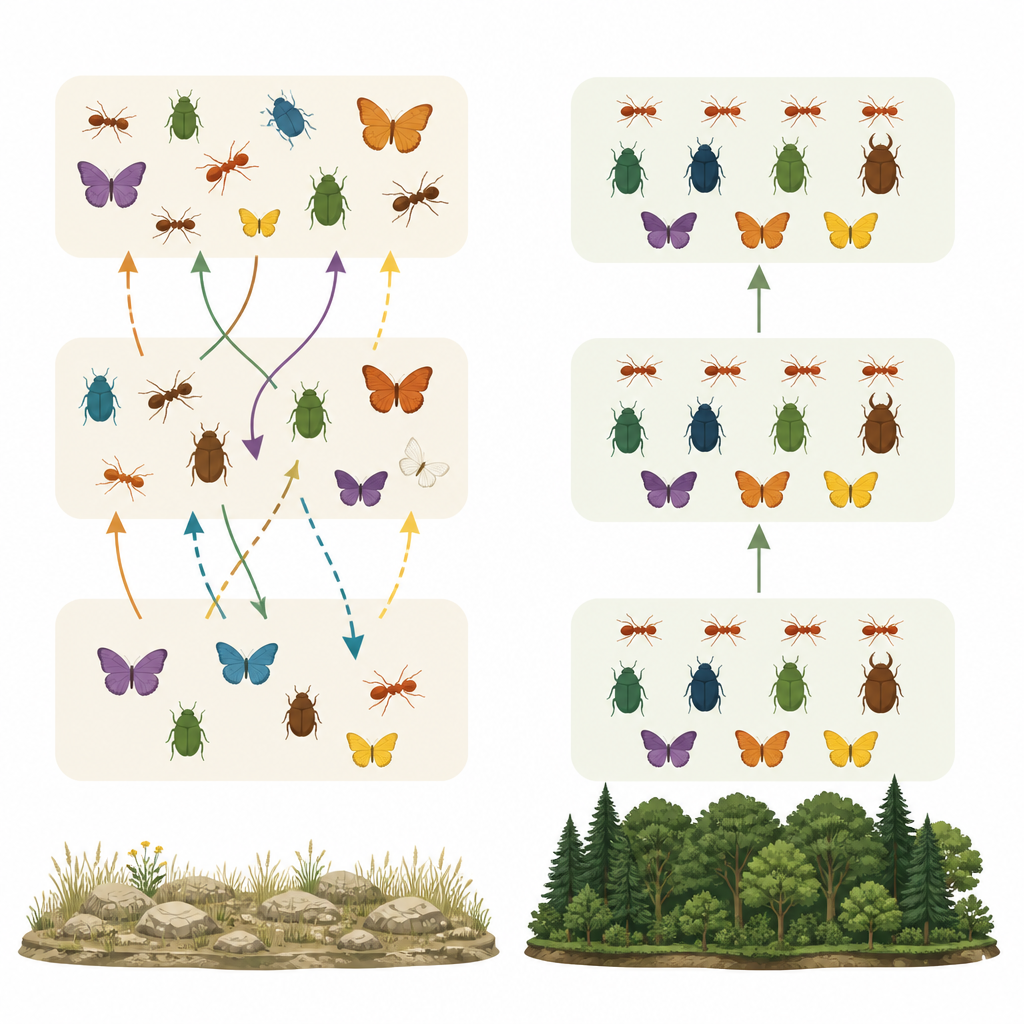
The scientists then asked how insect communities in each habitat changed from one sampling period to the next. They tracked gains of new species and losses of previous ones, and they looked at whether local communities were becoming more alike or more different from each other over time. In the open campo rupestre, insect communities were more restless. Dung beetles and butterflies showed larger swings in the number of species, and both ants and butterflies experienced stronger shifts in which species were present. Many of these changes were driven by common species that spread among sites, making grassland communities more similar to one another.
Forest islands as calmer refuges
In forest islands, the picture was calmer. Ants, dung beetles, and butterflies still changed over time, but their communities fluctuated less overall. For dung beetles, gains and losses of species tended to balance out, so the mix of species stayed relatively stable. Ants in forests showed more local disappearances than new arrivals, while butterflies showed the opposite trend, but neither group changed as dramatically as their grassland counterparts. The sheltered and more humid conditions inside forests appear to buffer insects from some of the harsh temperature swings and other stresses found in the open.
Why mobility and habitat matter
Differences among insect groups also helped explain the patterns. Butterflies, which can fly long distances and depend on vegetation for food and shelter, were the most dynamic group, especially in the exposed grasslands. Ants and dung beetles, which are closer to the ground and often protected in soil or nests, were less mobile and less sensitive to short term shifts in the landscape. Together, these findings suggest that both habitat harshness and the ability of insects to move between patches govern how fast communities change over time.
What this means for conservation
To a lay observer, the key message is that not all parts of the mountaintop are equally stable for insects. Forest islands act as more steady refuges, while open grasslands host communities that churn more rapidly, especially for mobile insects like butterflies. Because each habitat holds many unique species, conserving both is crucial for maintaining the overall web of life and the ecosystem services it supports on these threatened tropical mountaintops.
Citation: da Silva, P.G., Camarota, F., Beirão, M.d.V. et al. Forest islands sustain more temporally stable insect metacommunities in a heterogeneous tropical mountaintop landscape. npj biodivers 5, 16 (2026). https://doi.org/10.1038/s44185-026-00130-z
Keywords: tropical mountains, insect communities, forest islands, grassland ecology, biodiversity change