Clear Sky Science · en
Bioinspired underwater soft robots: from biology to robotics and back
Why Soft Underwater Robots Matter
Imagine a submarine that glides like a tuna, squeezes into crevices like an octopus, and “feels” the water like a school of fish. This review article explains how engineers are building such soft, flexible underwater robots by borrowing ideas from sea creatures—and how, in turn, these robots are becoming powerful tools for discovering how marine animals actually move and survive. The work points toward safer, more adaptable machines for ocean exploration, while also giving biologists new ways to test ideas about evolution and animal behavior.
Learning Tricks from Ocean Life
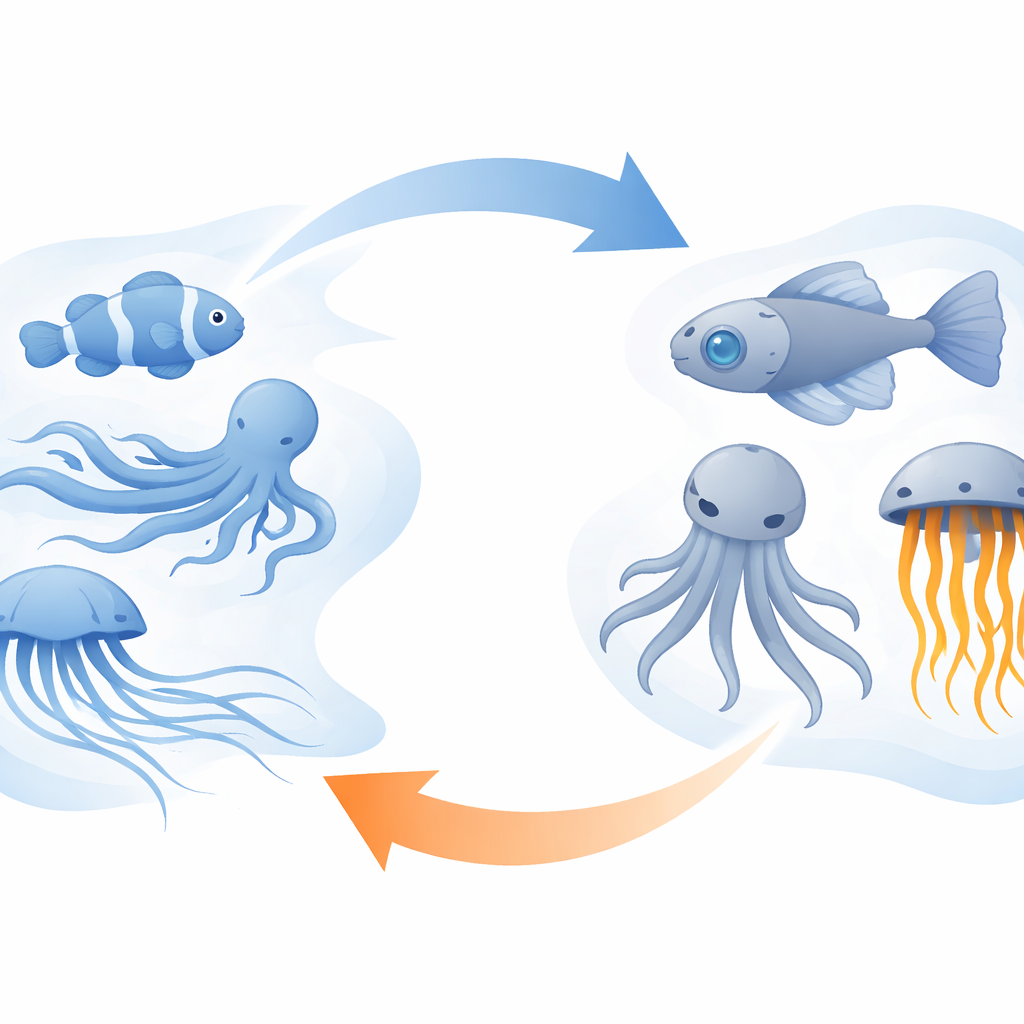
The authors begin by describing a gap between today’s underwater vehicles and real marine animals. Traditional autonomous submarines are rigid, propeller-driven, and designed to fight currents. Fish, jellyfish, and octopuses instead use soft bodies, flexible fins, and clever control strategies that work with swirling water, not against it. The review distills four broad lessons from biology: swimming that couples body motion with water flow; body shapes and internal structures that distribute force and store energy; sensing that is spread across skin, fins, and whiskers; and control systems that rely on simple rhythmic patterns fine-tuned by feedback from the body and environment. Together these ideas form a blueprint for underwater soft robots that are agile, efficient, and safe to use around fragile habitats.
Turning Biology into Soft Machines
Next, the article surveys how these biological ideas are realized in actual robots. Engineers build fish-like swimmers with flexible tails, manta-like gliders with wide flapping fins, jellyfish-inspired “bells” that pulse water, and limb-based robots that crawl and paddle like sea stars or turtles. Instead of metal frames, many use silicone rubbers, hydrogels, and smart materials that bend, stretch, or change stiffness. The authors explain how designers tune overall body shape, internal layering, and embedded tendons or fibers so that the robot naturally bends in useful ways and can push on water or rocks without damage. Soft “skins” can hide stretchable electronics and tiny channels that feel pressure or flow, echoing fish lateral lines, seal whiskers, and octopus suckers.
Robots that Sense, Adapt, and Learn
The review then turns to how these soft machines are controlled. Because their bodies have many degrees of freedom and interact strongly with water, traditional rigid-robot control methods fall short. Instead, researchers often start from simple rhythmic patterns—much like the central pattern generators in animal spinal cords—that drive tails, fins, or arms. Local feedback from pressure, strain, or flow sensors adjusts these rhythms on the fly, allowing robots to stay stable in currents or during contact. Some systems embed “intelligence” directly in hardware: for example, suction cups and fluidic valves that automatically adjust grip as pressure changes. Machine-learning approaches are increasingly used to discover efficient strokes and gaits that exploit vortices and body elasticity, although transferring these learned behaviors from simulations to the real ocean remains challenging.
Robots as Testbeds for Biology
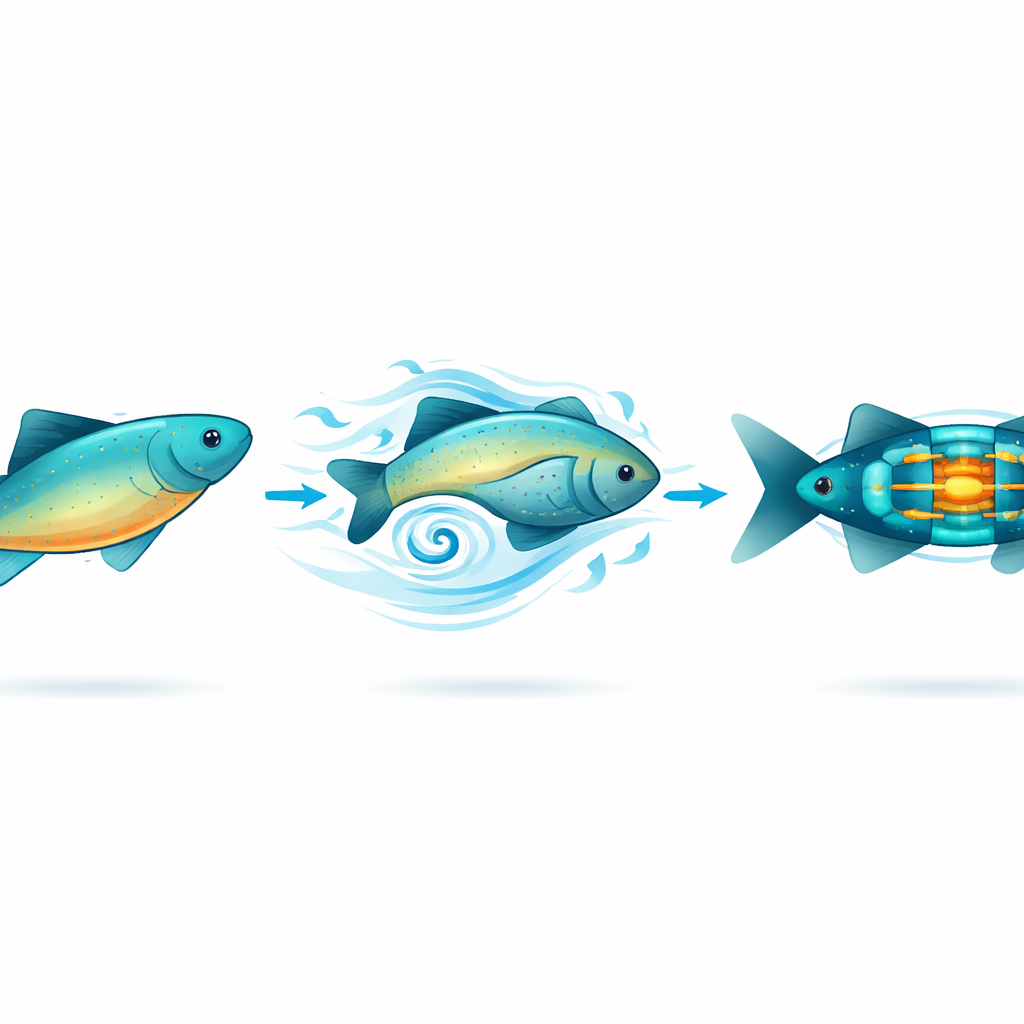
A central message of the paper is that inspiration runs both ways. Carefully designed robots act as physical models that can test biological ideas that are hard or impossible to probe in live animals. For instance, manta-like and jellyfish-like robots with adjustable stiffness and actuation patterns have shown how pulsed motions and elastic recoil shape the wakes that boost thrust. Remora-inspired suction pads with tunable lips, chambers, and microscopic textures reveal how fish cling to rough, fast-moving surfaces. Artificial lateral-line sensors and whisker arrays clarify how cupula gels and whisker shapes amplify water signals before they ever reach nerves. Even extinct species are studied this way: robotic plesiosaur flippers and dinosaur tails help evaluate which ancient body plans could actually swim efficiently.
Shared Rules for Animals and Machines
Finally, the authors look ahead to a future in which biology and robotics are linked through common design rules. By comparing distant species that evolved similar solutions—such as wings, flippers, suction organs, or spiral-shaped grasping limbs—they argue for “biouniversal” principles that apply across scales and lineages. Robotic families can systematically explore these principles by varying shapes, stiffness patterns, and control strategies beyond what evolution has tried. The review also calls for digital “twins” that represent both animals and robots within the same virtual framework, enabling co-design of morphology, materials, and control. In parallel, early biohybrid robots that incorporate living tissues hint at machines that might one day share some of the adaptability and self-repair of real organisms.
What It All Adds Up To
For non-specialists, the key takeaway is that the next generation of underwater robots will look and behave far more like marine life than like mini-submarines. Soft bodies, distributed senses, and simple yet adaptive control loops will let them navigate cluttered reefs, handle delicate samples, and ride currents instead of fighting them. At the same time, these robots will serve as experimental stand-ins for real animals, helping scientists uncover the physical rules that have guided millions of years of evolution in the oceans. In short, by closing the loop between biology and engineering, soft underwater robots promise both better technology and deeper insight into how life thrives underwater.
Citation: Li, L., Qin, B., Gao, W. et al. Bioinspired underwater soft robots: from biology to robotics and back. npj Robot 4, 25 (2026). https://doi.org/10.1038/s44182-026-00088-x
Keywords: underwater soft robotics, bioinspired design, aquatic locomotion, distributed sensing, marine biomechanics