Clear Sky Science · en
Domain knowledge embedded anti-disturbance autonomous navigation for marine vehicles
Why steering ships in rough seas matters
Modern science and industry increasingly depend on robot ships and underwater drones to inspect cables, service offshore wind farms and explore the deep ocean. Yet these vehicles must work in a restless sea where wind, waves and currents constantly shove them off course. This article introduces a new way to help marine robots stay on track even when the ocean is at its most unruly, promising safer operations, lower maintenance costs and more reliable data from the world’s waters.
The ocean as a moving obstacle course
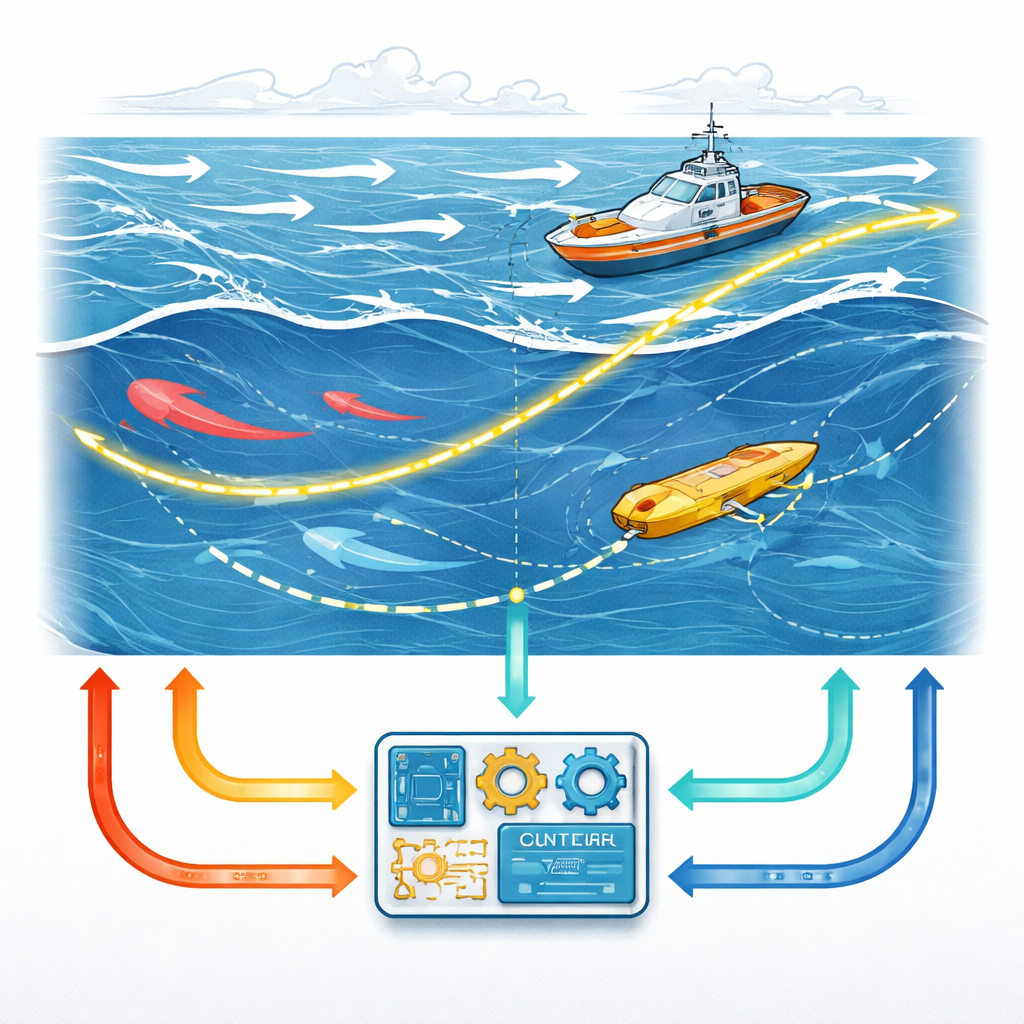
Today’s marine missions range from surveying Antarctic ice shelves to checking the health of undersea cables that carry global internet traffic. In all of these jobs, a ship or underwater vehicle must follow a prescribed path with meter-level accuracy, sometimes threading between dense structures such as wind-turbine foundations. The problem is that the ocean is not a calm test tank. Gusty winds, steep waves and shifting currents push vehicles sideways, twist them around and slow them down. Traditional control methods assume engineers can write down precise equations for how a vessel moves, but in real seas those equations are incomplete and quickly become outdated. The result can be large navigation errors and, in extreme cases, accidents.
Teaching machines the language of waves
Researchers behind this study take a different tack: instead of relying on a perfect mathematical model, they let a learning system watch what the sea is doing and respond in real time. At the heart of their approach is a special form of neural network called a Specialized Kolmogorov–Arnold Network, or SKAN. Unlike a typical black-box AI, SKAN is built with the ocean’s rhythms in mind. The designers feed in simple wave-like functions that capture how wind, waves and currents tend to rise and fall over time. These building blocks act like a set of musical notes from which the network can compose the complex “melody” of real disturbances, speeding up learning and reducing the amount of data needed.
A control partner that thinks with experience
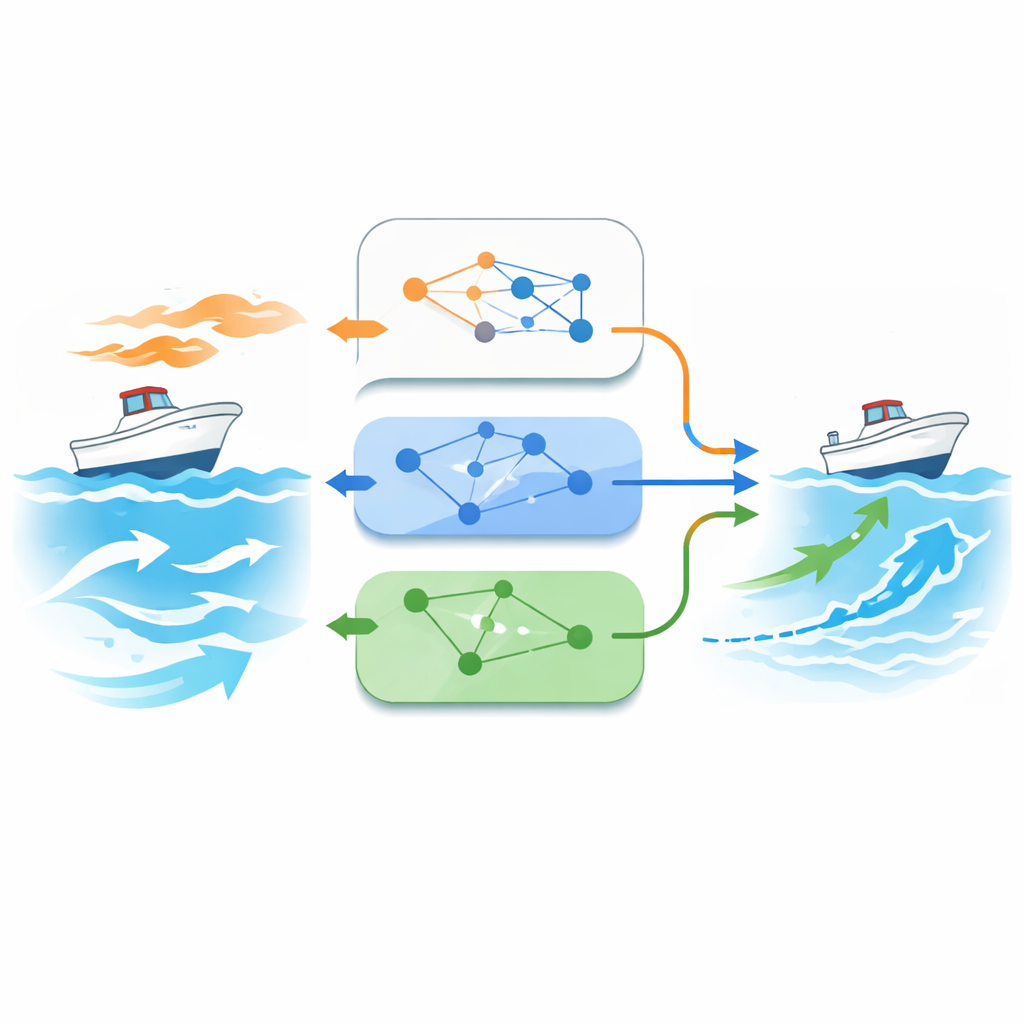
The framework combines two main pieces: a disturbance observer and a model-free controller. The observer uses the SKAN network to estimate the invisible pushes and pulls acting on the vessel in several directions at once. At each instant it digests recent motion and sea-state information and outputs a best guess of the current forces and turning moments. The controller, trained from data rather than a handcrafted model, decides how to adjust thrust and steering. Crucially, it receives both the vessel’s state and the observer’s estimates of the disturbances, allowing it to cancel out much of the ocean’s mischief before it grows into large errors. To make training efficient, the authors slice recorded motion data into many overlapping snippets, effectively multiplying the useful training examples without needing long and risky sea trials.
Putting virtual ships and submarines to the test
To see whether this idea works, the team built detailed simulations of an offshore wind farm—an especially harsh proving ground where currents bend around towers, waves are choppy and safe clearances are tight. They sent a virtual surface vessel along six cable-inspection routes while subjecting it to realistic wind speeds, wave heights and current patterns. Compared with a popular deep reinforcement learning controller, their SKAN-based system cut average path-following errors by about one-fifth, and kept the vessel stable even in strong gusts and cross seas. They then turned to an autonomous underwater vehicle tasked with looping around wind-turbine foundations along spiral and dumbbell-shaped tracks. Again, the method kept deviations small and motions smooth, even as underwater currents and depth changes tried to nudge the vehicle away.
Learning more from less data
The study also probed how well the disturbance observer itself performed. By training with the augmented snippets of motion data, the SKAN-based observer could match around 90% of the accuracy achieved when using the full original dataset, even though only a tenth of that raw data had been expanded. This means the system can be readied with far fewer examples—an important advantage when collecting real-world data from ships and submersibles is expensive and time-consuming. When waves, wind and currents were strong, the controller equipped with this observer kept path errors clustered tightly, while a system without compensation showed far larger and more scattered deviations.
Safer, smarter voyages ahead
In plain terms, the authors show that by blending human knowledge of how the sea behaves with data-hungry machine learning, it is possible to steer marine robots more accurately through rough conditions without meticulously modeling every physical detail. Their framework turns messy ocean motion into usable information that a controller can act on quickly, leading to smoother and safer paths for both surface ships and underwater vehicles. While the results so far come from simulations, the same ideas could help future fleets of ocean robots—and even flying drones and self-driving cars—cope with unpredictable environments while relying on less data and simpler models.
Citation: Zhao, Y., Ma, Y., Zhu, G. et al. Domain knowledge embedded anti-disturbance autonomous navigation for marine vehicles. Commun Eng 5, 82 (2026). https://doi.org/10.1038/s44172-026-00666-9
Keywords: autonomous marine vehicles, ocean disturbances, machine learning control, offshore wind farms, path following