Clear Sky Science · en
Microstructure-informed constitutive modeling of granular media under multidirectional loading: From particle-scale to continuum
Why the ground beneath turbines matters
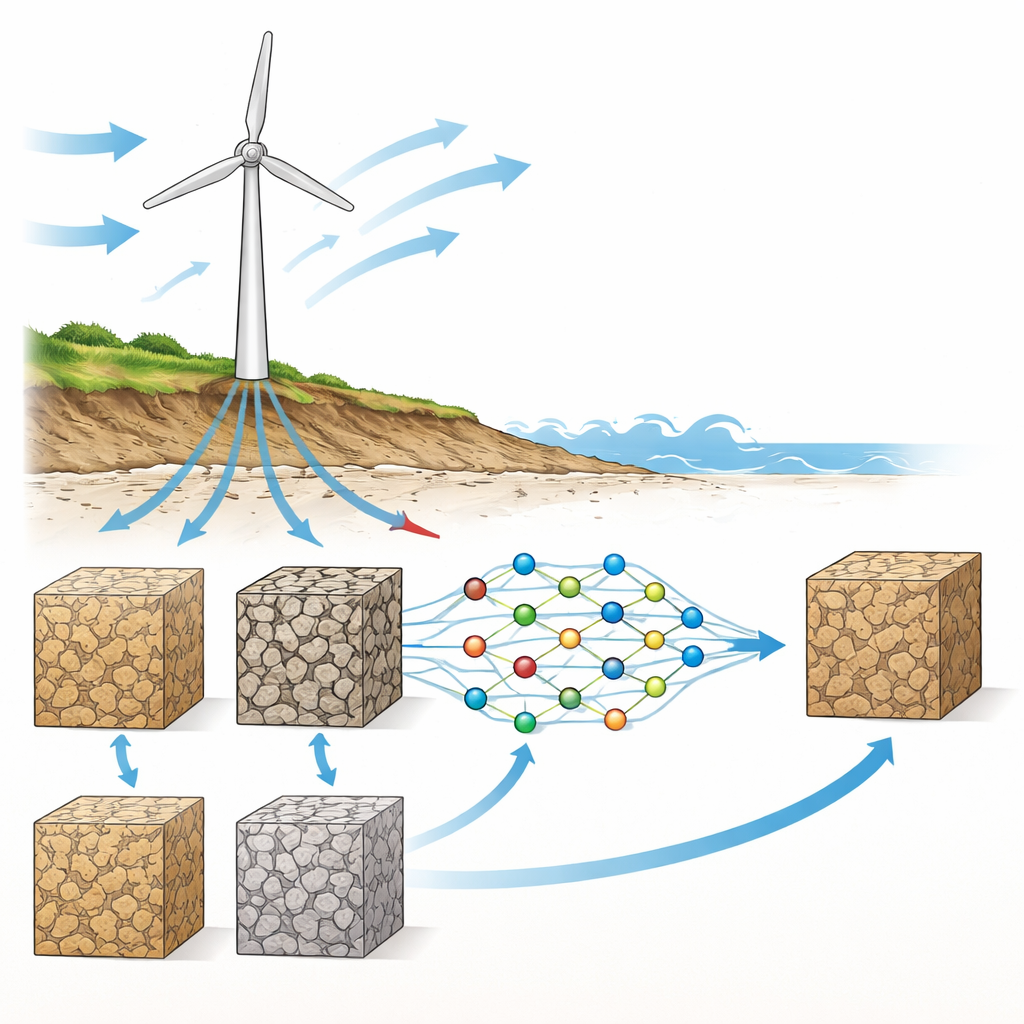
As we build more wind farms, tunnels, and slopes, we rely on the ground to safely carry shifting forces from wind, waves, and earthquakes. Yet the soil beneath our feet is not a uniform block; it is a jumble of sand and grains whose shapes and arrangements constantly change as they are pushed and pulled. This article explains how researchers combine detailed computer simulations of individual grains with modern artificial intelligence to predict how such granular ground will behave under complex, real-world loading conditions.
From loose grains to real structures
Granular materials like sand, mine tailings, and railway ballast behave in surprisingly intricate ways. Unlike crystals or metals, there is no simple equation that tells engineers how a pile of grains will respond when squeezed from several directions at once. In practice, designers rely on laboratory tests and empirical formulas that may only apply to one specific site or soil type. Real soils, however, are deposited by gravity, shaped by past loading, and pushed in multiple directions by wind, waves, and seismic shaking. A wind turbine on a sloping seabed, for example, experiences constantly changing combinations of vertical, horizontal, and twisting forces that traditional tests often fail to capture.
Watching every grain in motion
To tackle this gap, the authors turn to the discrete element method, a numerical technique that treats each grain as an individual rigid particle. In their virtual laboratory, thousands of grains are poured into a small box and then squeezed along three independent directions while the computer tracks every contact force and every tiny rearrangement. The team systematically varies key ingredients that control soil behavior: the initial pressure around the grains, how densely they are packed, the direction of the applied stresses, the alignment of internal layers (called bedding), and the shapes of the grains themselves, from nearly spherical to clearly elongated. Across 260 detailed simulations, they observe how these factors stiffen or weaken the material, make it contract or dilate, and cause its internal structure to become directionally biased.
How grain shape and fabric change strength
The simulations reveal that several often-overlooked features can strongly alter the strength of the ground. When the mean surrounding pressure is higher, the virtual sand becomes stiffer and can carry more shear stress before it starts to rearrange. Denser packings resist shearing better and tend to expand, while loose ones compress as grains find new positions. Changing the orientation of the stress path—encoded by a quantity called the Lode angle—can either increase or decrease the peak strength and shift the balance between contraction and dilation. Likewise, rotating the bedding planes from horizontal to vertical reduces the maximum shear resistance, showing that the history of how soil was deposited matters. Even grain shape plays a significant role: assemblies made of more elongated grains carry higher peak stresses and undergo smaller volume changes than those made of nearly spherical grains prepared at the same relative density.
Teaching a neural network to think like soil
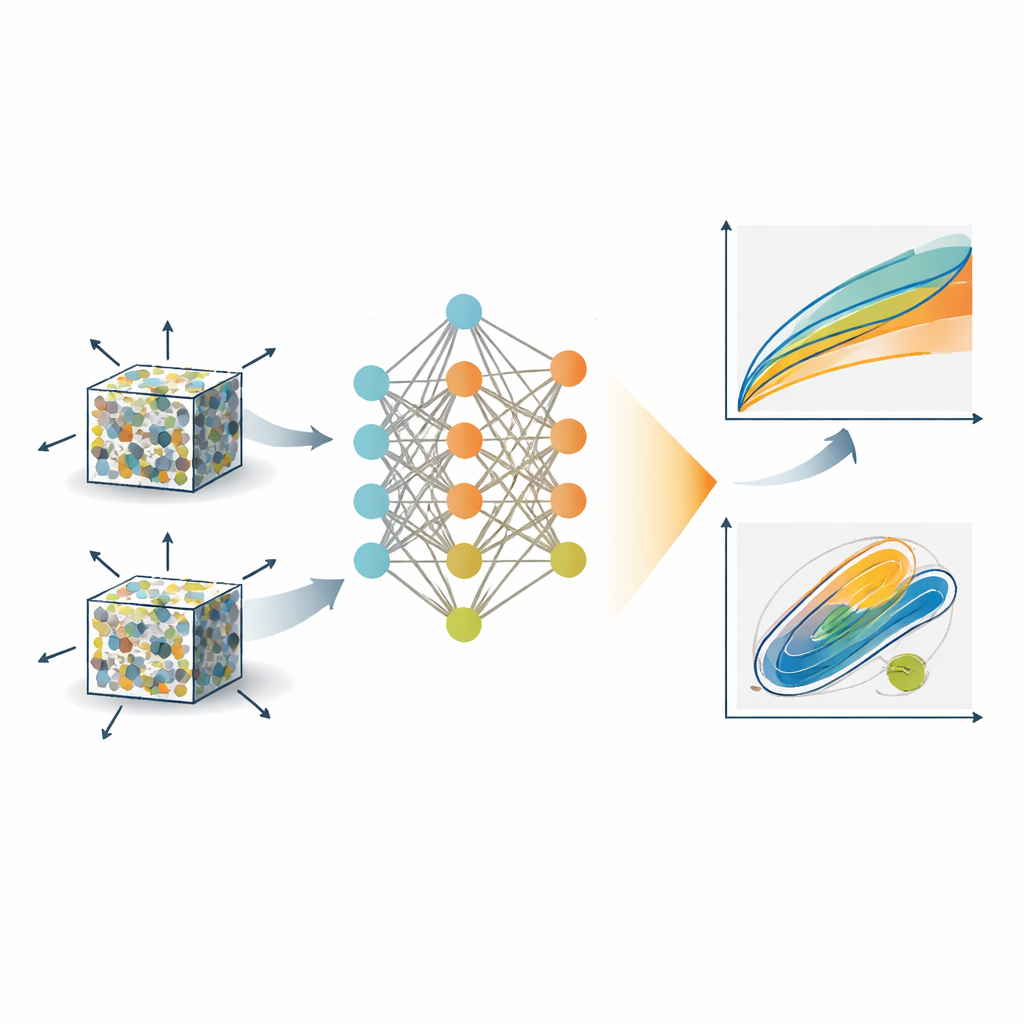
Although these high-resolution simulations offer deep insight, they are too computationally expensive to run inside large-scale engineering models of an entire foundation or slope. To bridge this scale gap, the authors build a deep-learning model—a multilayer neural network—that learns to mimic the simulated soil response. Instead of being fed only simple test results, the network receives rich descriptors of the material state: the shapes of the particles, the starting pressure and density, measures of the internal layering, and the ongoing strains in each direction. Using a carefully designed training strategy and a loss function that emphasizes the initial, most critical phases of deformation, the network learns to output the three components of stress that match the simulations closely, including subtle directional effects and changes in long-term strength.
From virtual grains to safer designs
The end result is a new kind of constitutive model—a rule linking stress and strain—that is informed by grain-scale physics but runs as fast as a conventional engineering formula. It can capture how soil strength depends on grain shape, layering, and complex three-directional loading, without the need for dozens of hand-tuned parameters or site-specific tests. The authors envision embedding this learned model into standard finite element software so that designers of wind turbine foundations, slopes, and underground structures can account for realistic multidirectional loading and evolving soil structure. In simple terms, this work shows how watching every grain in a virtual experiment and distilling that behavior into a trained neural network can lead to more reliable and efficient designs for the infrastructure that supports the energy transition.
Citation: Irani, N., Golestaneh, P., Salimi, M. et al. Microstructure-informed constitutive modeling of granular media under multidirectional loading: From particle-scale to continuum. Commun Eng 5, 80 (2026). https://doi.org/10.1038/s44172-026-00652-1
Keywords: granular soils, deep learning, wind turbine foundations, discrete element simulations, multidirectional loading