Clear Sky Science · en
Electromagnetic Sculptor: a differentiable geometric optimization framework to manipulate electromagnetic fields
Shaping Invisible Waves
Whenever radio, radar, or wireless signals hit an object, they scatter in complex ways that affect everything from stealth technology to mobile reception. Engineers have long tried to "carve" these objects so electromagnetic waves bounce exactly where they want them to go—but doing this reliably for real-world, 3D shapes is extremely hard. This paper introduces Electromagnetic Sculptor, a new computational framework that treats objects like digital clay, automatically reshaping them so they interact with waves in carefully controlled ways, while still remaining buildable in the real world. 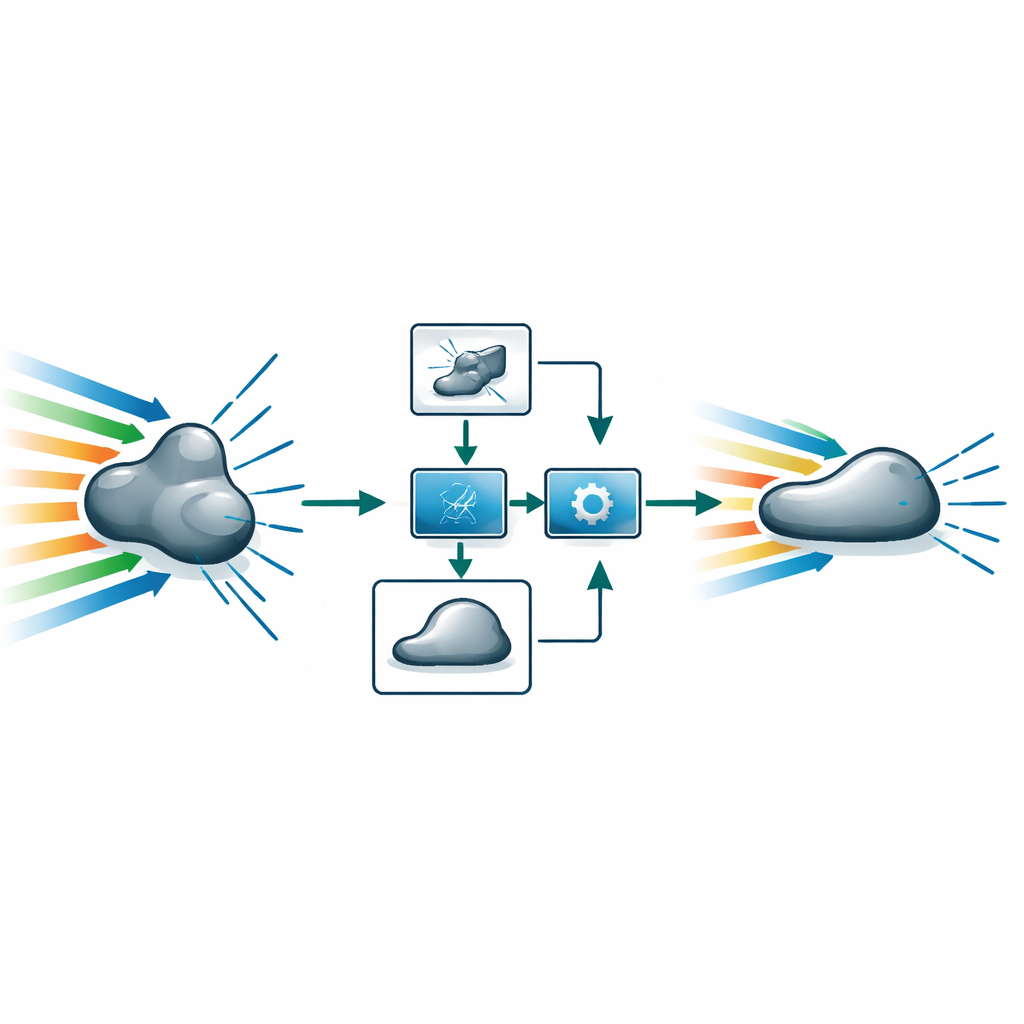
Why Geometry Matters for Wireless and Radar
Electromagnetic devices—from antennas on phones to aircraft surfaces—do not just depend on materials and electronics. Their physical shape plays a decisive role in how they reflect, focus, or absorb energy. Optimizing that shape is like solving a puzzle with thousands of adjustable knobs, because every tiny bump can change how waves scatter. Traditional search methods inspired by nature, such as genetic algorithms or swarm strategies, can explore this vast space but become painfully slow and unstable when the number of design variables grows into the thousands. Newer artificial intelligence approaches can be faster, yet they demand huge training datasets and often struggle to generalize to new shapes, especially fully three-dimensional ones.
A Digital Sculptor for Electromagnetic Shapes
Electromagnetic Sculptor takes a different route: it uses gradient-based optimization, the same mathematical engine that trains modern neural networks, but applies it directly to the geometry of a 3D mesh. The object to be designed is represented as a network of vertices and triangles, and the framework computes how tiny shifts in each vertex will change the scattered field. To keep this efficient, the authors avoid slow full-wave solvers and instead rely on a high-frequency "shooting and bouncing rays" model combined with a physical optics approximation. This model traces many rays as they reflect around the surface, then translates their interactions into a continuous prediction of how much energy will scatter in different directions, and crucially, how that scattering changes if the surface is nudged.
Keeping Shapes Stable and Manufacturable
A naïve approach to moving thousands of mesh vertices with gradient descent tends to twist, fold or tear the geometry into unrealistic forms. Electromagnetic Sculptor introduces two key safeguards. First, it smooths the raw gradients spatially using a carefully designed filter based on Fibonacci lattices on a sphere, which spreads local sensitivity information to neighboring regions. This encourages coordinated, gentle deformations instead of jagged creases. Second, a shape-preserving regularization step, borrowed from computer graphics, enforces an "as-rigid-as-possible" constraint that keeps the optimized object close to its original overall silhouette. Together, these mechanisms allow the algorithm to exploit fine geometric freedom while retaining smooth contours and manufacturability. 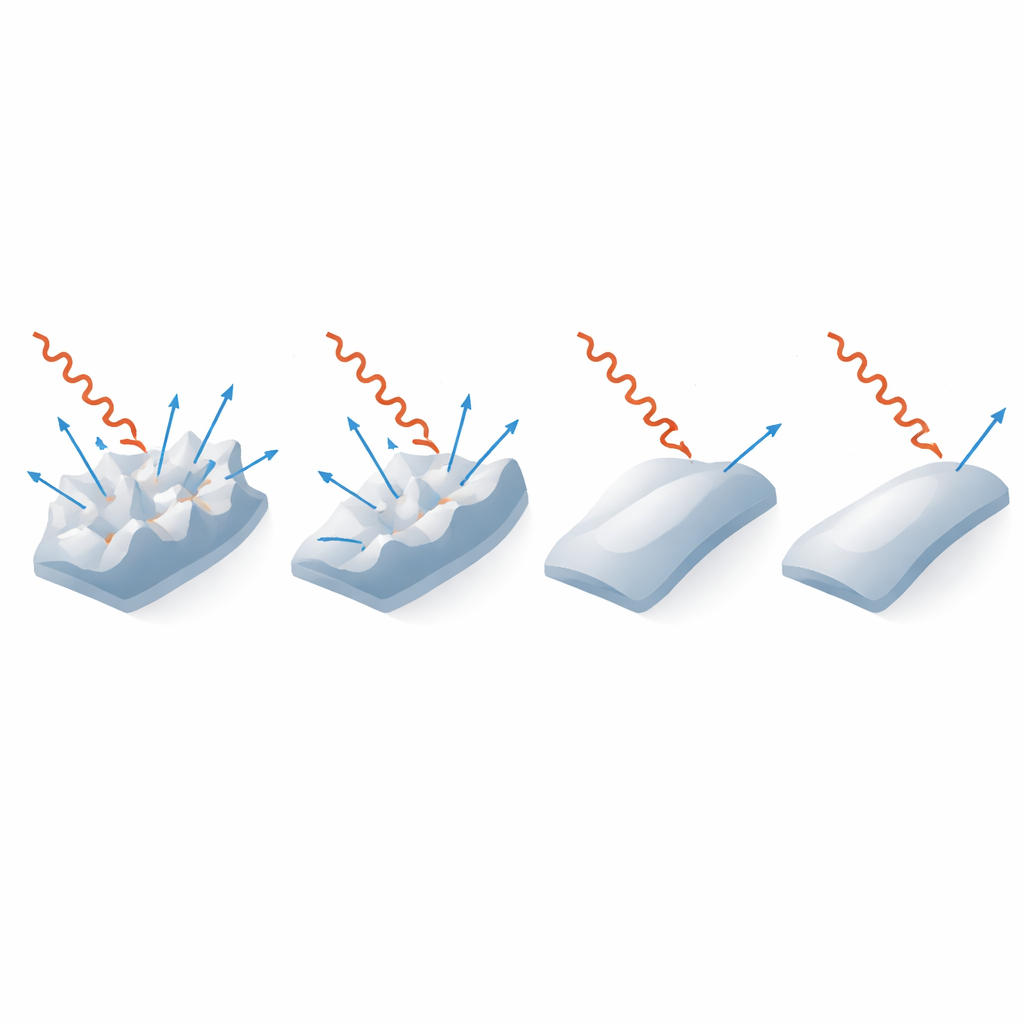
Proving It Works: Hiding from Radar
To demonstrate the framework, the authors focus on reducing radar cross section—the effective size an object presents to radar. They apply Electromagnetic Sculptor to several familiar 3D models, including a sphere, an airplane, a rabbit and a calf, each described by thousands of vertices. Across single-frequency, multi-angle, and broadband (1–5 GHz) scenarios, the method consistently reshapes surfaces so that strong reflections are redirected away from key observation directions. Typical results show around 6 decibels of average radar cross section reduction over wide frequency bands and viewing angles, meaning the object appears roughly four times less reflective to the radar. Importantly, the optimized shapes look like subtly sharpened and smoothed versions of the originals, not exotic or impractical forms.
From Simulation to the Physical World
The team validates their simulations by 3D-printing a scaled calf model, coating it with copper to mimic a metal target, and measuring its radar signature in a compact test range. The measured reductions closely track the predictions, differing by less than 1 decibel on average across 1–4 GHz. The authors also explore when the method remains reliable: they show that the directions and frequencies sampled during optimization must capture most of the pattern’s energy; otherwise, scattering may grow in unsampled regions. They discuss current limitations—such as neglecting diffraction from sharpened edges, the cost of dense sampling for very large or high-frequency structures, and the lack of direct CAD constraints—but argue these are natural next steps. Overall, Electromagnetic Sculptor points toward a future in which engineers can routinely and efficiently sculpt how objects interact with invisible waves, much as industrial designers now sculpt their visible shapes.
Citation: Yang, K., Liu, C., Yu, W. et al. Electromagnetic Sculptor: a differentiable geometric optimization framework to manipulate electromagnetic fields. Commun Eng 5, 84 (2026). https://doi.org/10.1038/s44172-026-00642-3
Keywords: electromagnetic optimization, radar cross section, gradient-based design, differentiable simulation, stealth engineering