Clear Sky Science · en
Optimized T-shaped resonator via local enhancement model integration within a cell for enhanced Rydberg-atom receiver sensing
Listening to Faint Signals
From weather radar to deep-space astronomy, many technologies depend on catching incredibly weak radio and microwave signals. Improving today’s receivers usually means building bigger antennas or more complex electronics, which quickly becomes costly and unwieldy. This paper explores a different path: using excited atoms and a cleverly shaped piece of metal, the authors show how to dramatically boost the tiny electric fields in a very small region of space, pushing the limits of how faint a signal a receiver can hear.
Atoms as Tiny Antennas
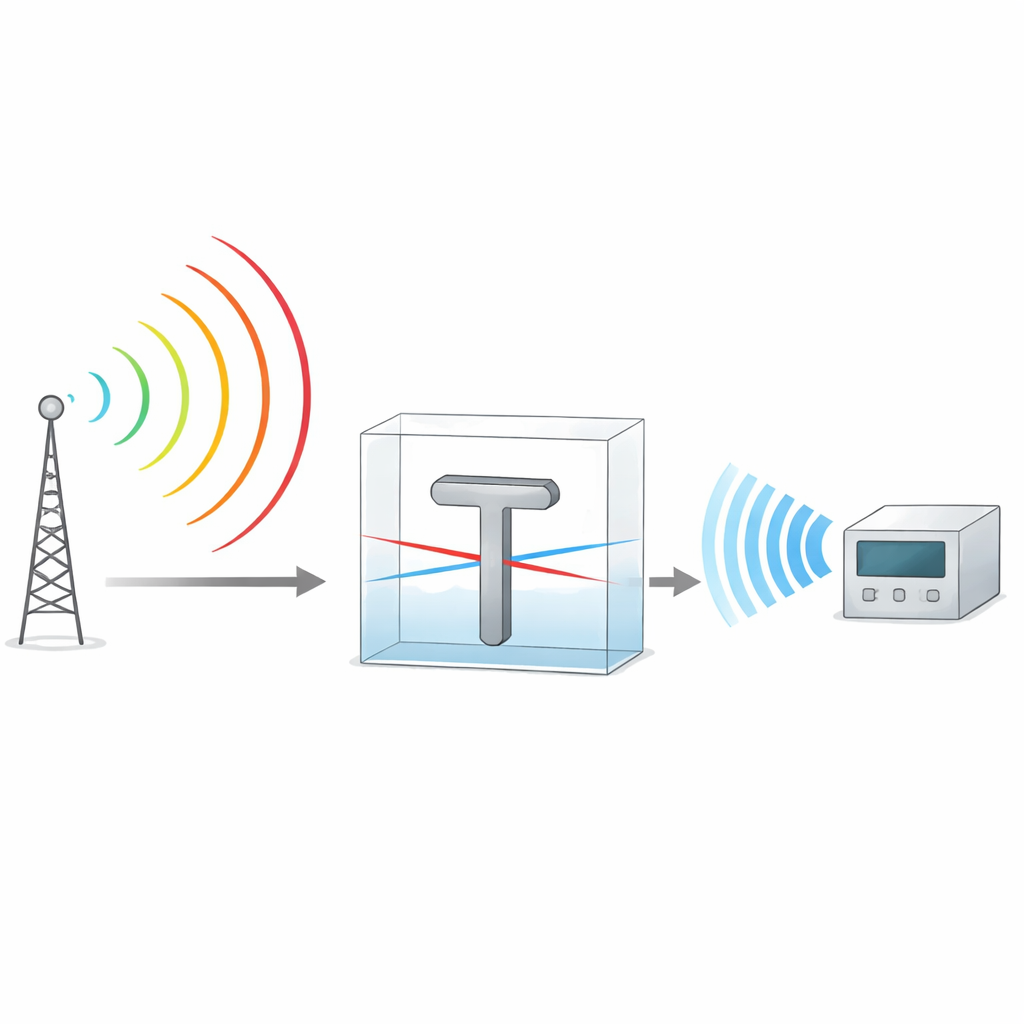
Conventional microwave receivers rely on metal antennas, filters, amplifiers and mixers to turn invisible waves in the air into electrical signals on a wire. Their sensitivity is ultimately limited by the random jostling of electrons—thermal noise—in the electronics. Rydberg-atom receivers work differently. They use atoms in highly excited states that are extremely sensitive to electric fields. In a small glass cell filled with cesium vapor, two lasers prepare and probe these atoms, and a photodetector watches how much light passes through. When a microwave field is present, it shifts or splits the atoms’ energy levels, subtly changing the light signal. Because the atoms themselves act as the sensing element, many noisy electronic stages can be removed, opening the door to better sensitivity and very wide operating bandwidths.
Why Local Concentration Matters
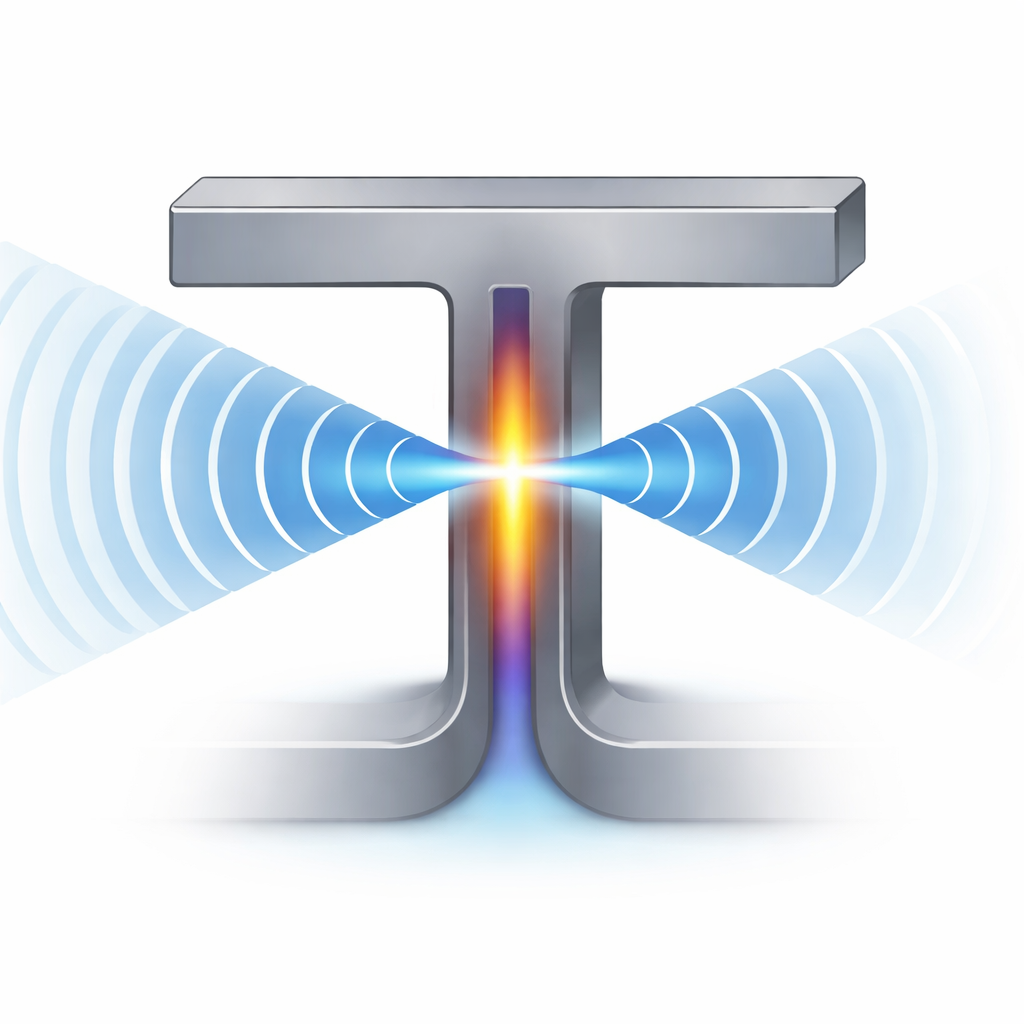
In practice, only the atoms where the two lasers overlap—typically a slender region a few hundred micrometers across—contribute to the measurement. That means what really matters is not the average field over a big antenna, but how strong the field is inside this tiny optical “sweet spot.” Previous work tried to boost this local field using metal resonators placed outside the vapor cell, or by routing signals in through transmission lines. These approaches helped, but they required external antennas, reduced portability, and were mostly designed by trial and error. The authors instead derive a simple physical model that links the resonator’s wavelength, gain, electrical resistance and gap geometry directly to the local field enhancement, giving clear guidance on how to redesign the structure instead of tweaking shapes blindly.
A Compact T-Shaped Resonator Inside the Cell
Guided by their model, the team starts from a basic parallel-plate resonator—a pair of facing metal surfaces that can concentrate electric fields in a narrow gap. To increase enhancement without making the device larger, they focus on raising the electrical impedance at the gap. In practical terms, this means reducing the effective capacitance and increasing the inductance of the structure, which they achieve by carving the metal into a T-shape. The new T-shaped resonator (TSR) is built from oxygen-free copper with a silver coating and is fully enclosed inside the cesium vapor cell, directly interacting with free-space microwave waves in the C band (around 8 GHz). Simulations show that, at the same resonant frequency, the TSR boosts the local electric field by a factor of 57 compared with the field in free space, more than double the 27-fold enhancement of the original parallel-plate design, while shrinking the physical volume to just 13 percent and the surface area to 18 percent of the original.
Putting the Design to the Test
The researchers then integrate the TSR with a standard Rydberg-atom measurement setup. A pair of lasers—at 852 and 509 nanometers—create and probe a specific excited state in cesium atoms, while a distant horn antenna radiates microwaves toward the cell under far-field conditions. By monitoring how the atomic spectrum shifts when microwaves are applied, and by using an atomic superheterodyne technique that mixes a strong local oscillator field with a weak test signal, they can translate the output of a signal generator into an effective electric field at the atoms. Comparing measurements with and without the TSR, they find that the same atomic response is achieved with 32.5 decibels less microwave power when the T-shaped resonator is present—equivalent to about a 47–57 times stronger local field in the laser overlap zone, in close agreement with their simulations.
Noise, Direction and Real-World Use
Adding metal near the atoms introduces its own penalty: thermal noise from the metal’s resistance. Using the Nyquist formula, the authors calculate how this noise depends on material choice and geometry, and they measure it for resonators made from stainless steel and from copper with silver plating. The optimized TSR achieves a low thermal noise level, corresponding to an electric field of only tens of picovolts per centimeter per square-root hertz—small compared with the enhanced fields it produces. At the same time, the TSR acts like a miniature, narrow-band antenna built around the atoms, improving directionality and filtering out off-frequency noise. This spatial and spectral filtering can raise the signal-to-noise ratio of incoming waves, complementing the intrinsic high sensitivity of the Rydberg atoms.
What This Means Going Forward
The study shows that a carefully engineered T-shaped resonator, guided by a simple local enhancement model, can significantly sharpen the “hearing” of Rydberg-atom microwave receivers while keeping the device compact and mobile. By doubling the local field enhancement over earlier designs and fitting entirely inside the vapor cell, the TSR makes it more practical to build portable, high-sensitivity quantum sensors for communication, radar and imaging applications. The authors note that combining this local field boosting with other atomic techniques—such as multi-photon excitation, Doppler-free schemes and repumping—could push sensitivities even further, bringing quantum-enhanced microwave receivers closer to outperforming their traditional electronic counterparts in real-world settings.
Citation: Wu, B., Sun, Z., Sang, D. et al. Optimized T-shaped resonator via local enhancement model integration within a cell for enhanced Rydberg-atom receiver sensing. Commun Eng 5, 63 (2026). https://doi.org/10.1038/s44172-026-00631-6
Keywords: Rydberg atom receiver, microwave sensing, field enhancement resonator, quantum electrometry, T-shaped resonator