Clear Sky Science · en
AI-powered non-destructive testing for smart manufacturing of carbon-negative biopolymer-bound soil composite
Smarter Building Blocks for a Warming World
Buildings are responsible for a huge share of global carbon emissions, largely because of cement-based concrete. This study explores a very different kind of building block: bricks made from soil held together by natural polymers, which can actually store more carbon than they emit. The researchers show how artificial intelligence and simple vibration tests can spot hidden flaws in these "green" bricks while they are still soft and can also track how they dry and harden—paving the way for safer, less wasteful, and more climate-friendly construction.
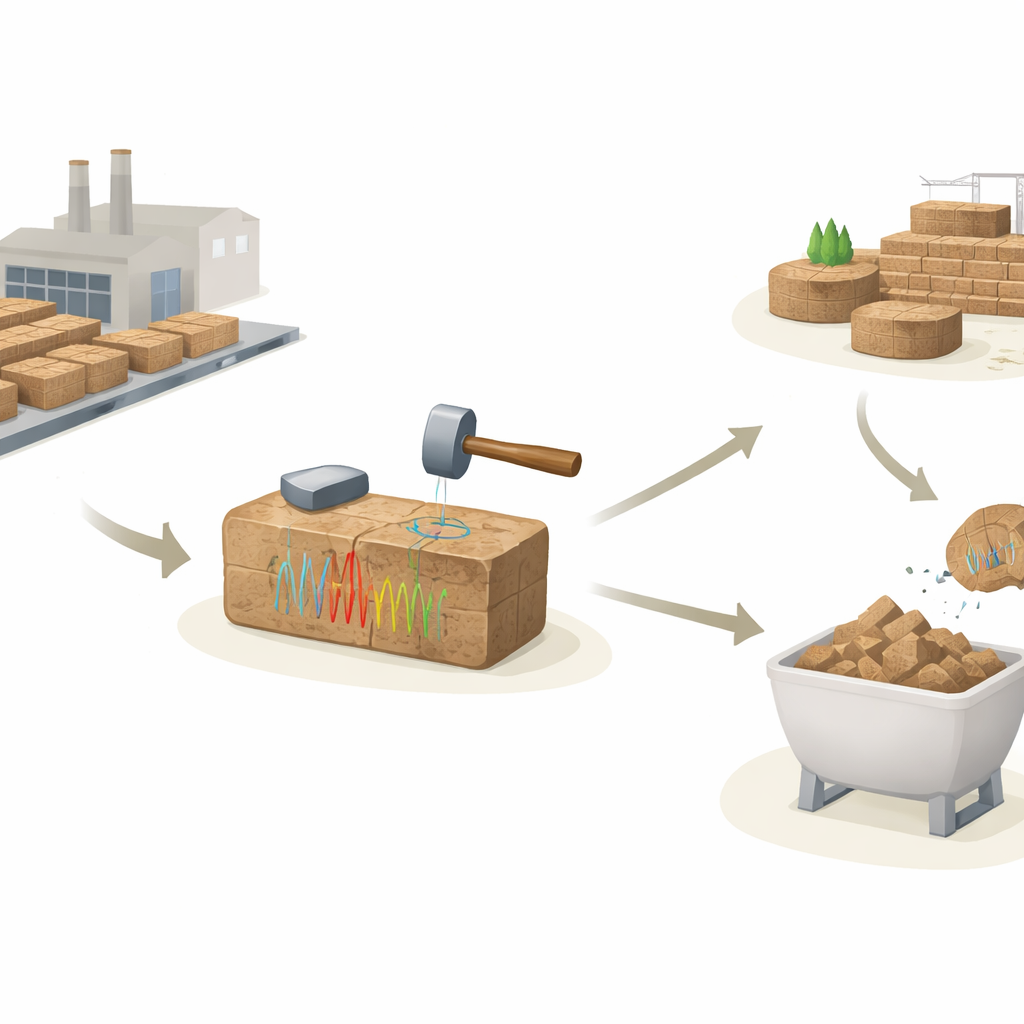
Bricks Made from Nature, Not Cement
The material at the heart of this work is called a biopolymer-bound soil composite. Instead of cement, it uses polymers derived from biological sources, such as proteins, to glue grains of sand together. Once dried, these bricks can be as strong as concrete yet have a negative carbon footprint because they lock away carbon that would otherwise return to the atmosphere. If such materials are to move from the lab into everyday use, manufacturers need reliable ways to ensure that each brick is strong, uniform, and free of dangerous defects. Traditional quality checks for concrete and other building materials tend to be slow, destructive, or only work once the material has fully hardened, which is too late to fix problems without wasting material.
Listening to Vibrations Instead of Breaking Bricks
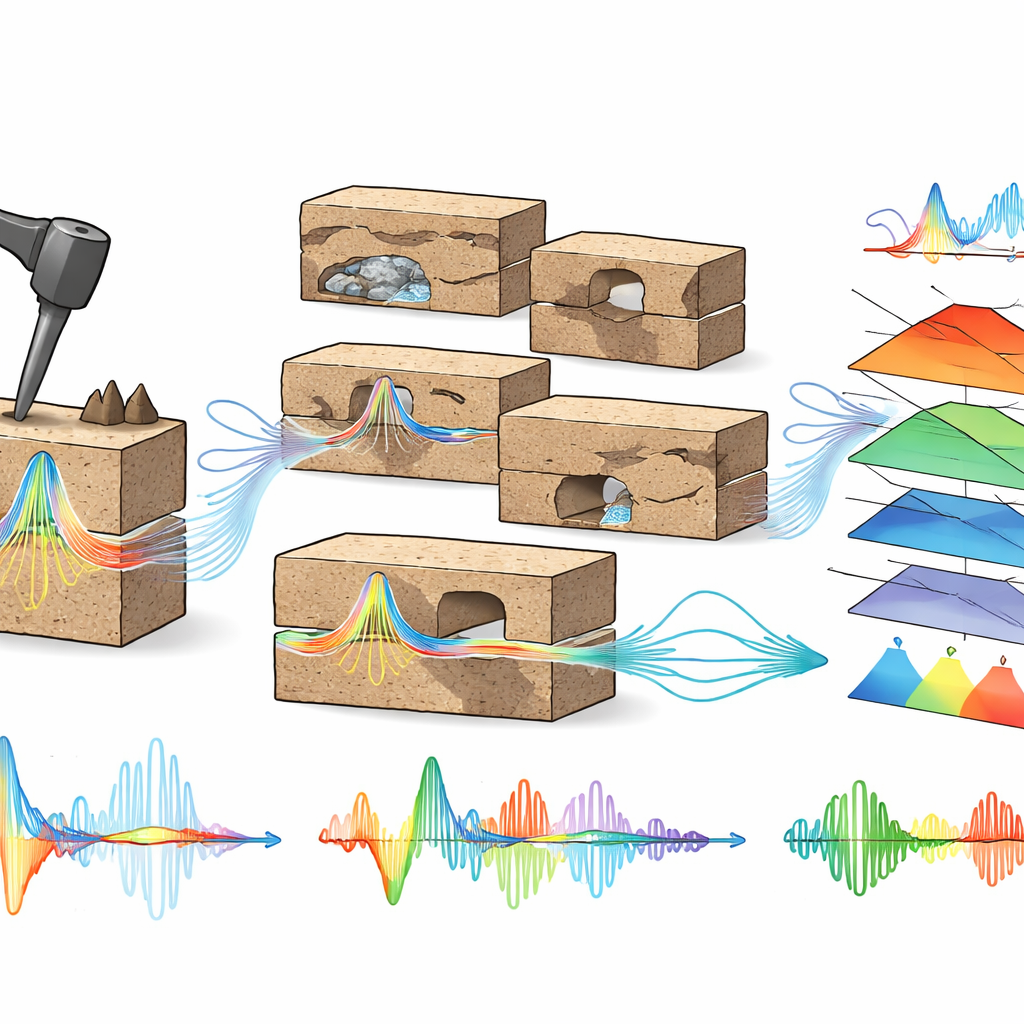
The team developed a non-destructive testing system that "listens" to how a fresh, soft brick vibrates when it is gently tapped. In their experiments, they mixed sand, water, and a blood-protein binder to form a wet composite, packed it into rectangular molds, and immediately tested it. An impulse hammer provided quick taps on the surface while a small accelerometer on the brick recorded the resulting vibration waves. These signals carry information about the internal structure of the material: a smooth, uniform brick vibrates differently from one with voids, dense inclusions, or internal separations that mimic cracks. Because the hardware is simple and off-the-shelf, the sensor can be quickly moved from one brick to another, much like a doctor using a stethoscope.
Teaching AI to Spot Hidden Flaws
To interpret the complex vibration patterns, the researchers built two families of AI models, nicknamed Mini-ft and Mega-ft. Both start by chopping the continuous sensor data into short snippets, each containing the response to a single hammer tap. Mini-ft focuses on 171 key points from each snippet and squeezes this information down to just two features that capture how the signal rises and decays. It then uses a straightforward nearest-neighbor method to decide whether a specimen is normal or defective and a statistical model to estimate how much moisture it has lost as it dries. Mega-ft takes a more powerful approach: it applies thousands of randomly shaped filters to each snippet to create a rich, 20,000-feature description of the vibration. A fast linear classifier then uses this high-detail fingerprint to recognize not only whether a brick is defective but also what kind of defect it is.
How Well Does the System Work?
The team tested their approach on twenty lab-made bricks, including eleven without defects and eight with carefully embedded flaws. Some contained steel pieces to imitate unusually dense regions; others hid hollow plastic shapes to mimic voids; still others had thin plastic sheets standing in for internal cracks of various sizes. Using the simpler Mini-ft model, the system correctly distinguished defective from normal bricks about 96% of the time and could separate nine different classes—one normal plus eight defect types—with an accuracy of about 82%. The more detailed Mega-ft model pushed these numbers even higher, to roughly 99% for basic defect detection and 97% for distinguishing among defect types. The AI could also estimate how far a brick had dried, and therefore how much strength it had gained, with only a few percent error, making it useful for tracking the hardening process over time.
From Pilot Study to Real-World Construction
Although this work was done on brick-sized samples with deliberately exaggerated defects, the findings point toward a practical, factory-floor tool for managing new carbon-negative building materials. Because the method works while the material is still wet, faulty batches could be caught early and the mixture recycled rather than thrown away, cutting both waste and cost. The same vibration and AI system could be adapted to different mix designs, temperatures, and product shapes, from small bricks to larger structural elements or even 3D-printed forms. In simple terms, the study shows that by tapping and "listening" with AI, manufacturers can ensure that nature-based bricks are both green and reliable, helping sustainable construction scale up without sacrificing safety.
Citation: Miao, B.H., Dong, Y., Theissler, A. et al. AI-powered non-destructive testing for smart manufacturing of carbon-negative biopolymer-bound soil composite. Commun Eng 5, 64 (2026). https://doi.org/10.1038/s44172-026-00621-8
Keywords: biopolymer-bound soil composite, non-destructive testing, vibration sensing, AI quality control, sustainable construction