Clear Sky Science · en
Co-packaged electronics with microfluidics for direct-to-package cooling
Keeping powerful gadgets from overheating
From electric cars to data centers, modern electronics are being pushed to run faster and handle more power in ever smaller spaces. All that power turns into heat, which can shorten the life of components or force designers to hold performance back. This study explores a new way to cool electronic parts from the inside of their protective package, offering a path to cooler, more compact, and more efficient devices.
Why current cooling tricks fall short
Today, many high power electronics rely on bulky metal blocks called heat sinks, often cooled by liquid flowing through internal channels. These blocks sit some distance away from the tiny regions on a chip where heat is generated. Heat has to cross several layers of material, including special pastes known as thermal interface materials, before it can reach the coolant. That extra distance adds resistance to heat flow, wastes energy, demands large volumes of coolant, and takes up valuable space. Direct cooling of the chip surface using tiny channels has emerged as an alternative, but building these channels into the chip itself is complex and hard to scale up for mass production.
A cooling system built into the package
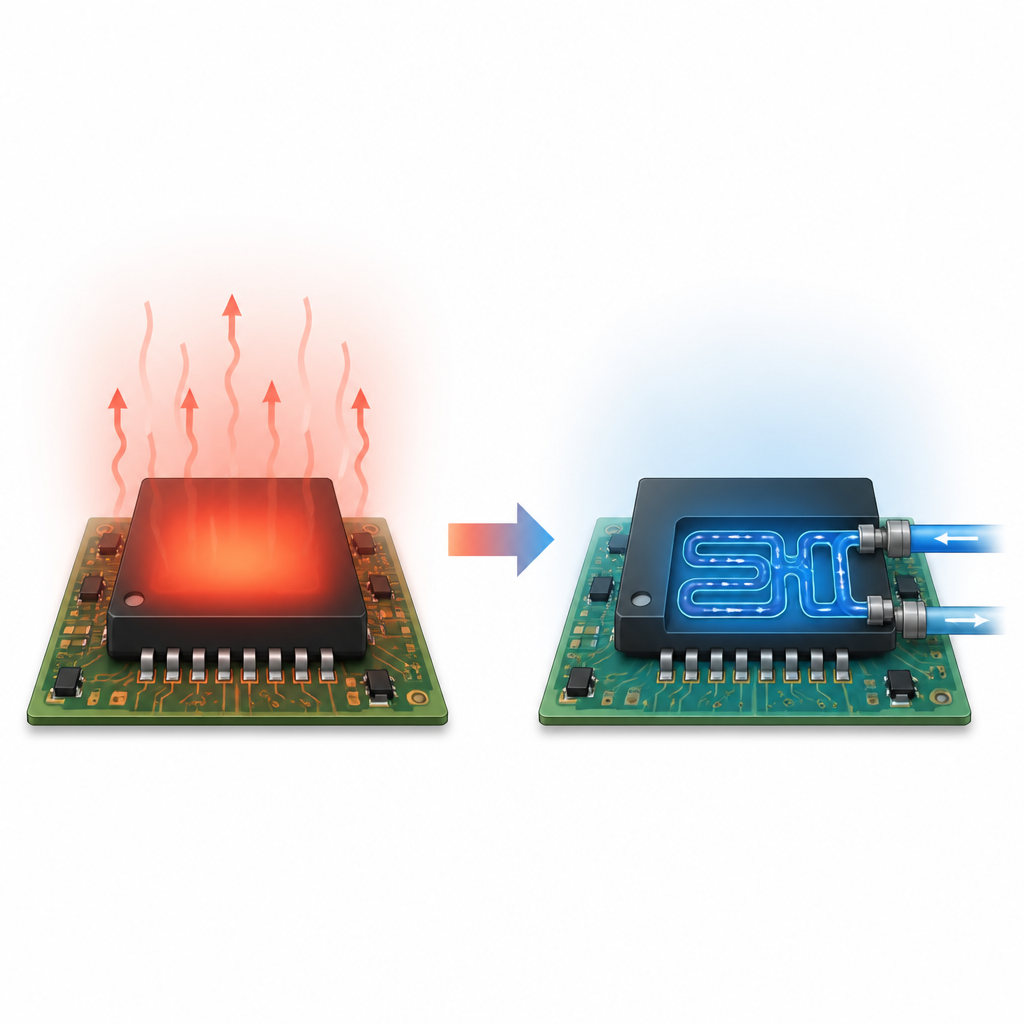
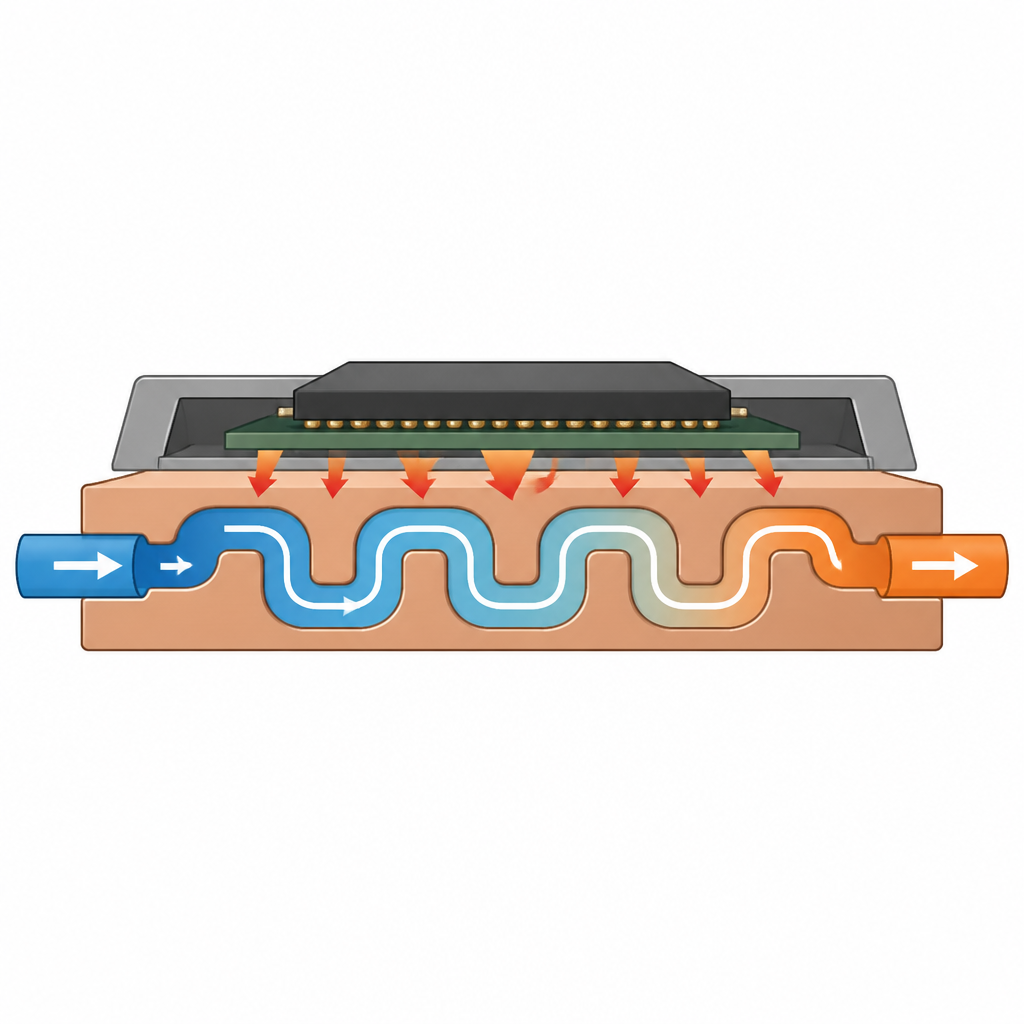
Instead of carving channels into the delicate chip, the researchers placed them into the sturdy metal base of the chip package, a standard flat type widely used in electronics. A silicon test chip that can both heat itself and measure its own temperature was mounted on a thin copper plate. Beneath this plate, the team built a serpentine network of microscopic channels and pumped water through them. In this direct to package design, the coolant flows just underneath the active chip surface, close enough to intercept heat before it spreads into the rest of the system. This approach bypasses messy interface pastes and keeps the overall structure compatible with established assembly steps like soldering and wire bonding.
How much better does it cool
The team compared three setups: a reference package cooled only by still air, the same package mounted on a conventional liquid cooled heat sink, and the new microchannel package with water flowing directly under the chip. In each case, they applied electrical power to heat the chip and watched how its temperature rose over time. With air cooling, the chip climbed to around 220 degrees Celsius at just a few watts. Mounting the package on a water cooled heat sink helped, but required several liters of coolant and still left the chip much hotter than desired. In contrast, the microchannel package reached a comfortable temperature of about 43 degrees Celsius in under 20 seconds using only a few milliliters of water. At high power, it could handle around six to seven times more heat than the air cooled version and about two to three times more than the heat sink cooled version for the same allowed temperature rise.
Measuring efficiency, not just raw cooling
Good cooling is not only about keeping things cold, but also about how much energy and material it costs to do so. The researchers therefore calculated a coefficient of performance, a measure of how much heat is removed compared to the energy spent pumping the liquid. The direct to package system achieved very high values, comparable to the best direct to chip cooling demonstrations, while using much less coolant. They also analyzed how heat moved through the system, separating the roles of the copper, the fluid, and the contact areas. Even though some parts of the chip did not touch the coolant directly, the overall ability to carry heat away was excellent, and the global heat transfer figure of merit matched or exceeded many advanced microchannel designs reported in the literature.
Where this could lead next
Because the cooling channels sit in the package instead of inside the chip, the concept fits more naturally with existing manufacturing lines and can, in principle, be adapted to different types of power devices, including those used in electric vehicles and radio transmitters. The authors note that future work can refine the shape of the channels, change the coolant, or even use fluids that boil to absorb extra heat. They also highlight the need to test long term reliability and to integrate the tiny fluid lines into real circuit boards. If these practical steps are solved, direct to package cooling could allow power electronics to run harder and longer without overheating, enabling more compact, efficient, and durable systems in everyday technologies.
What this means in simple terms
In everyday language, the study shows that drilling tiny water paths into the metal floor beneath a chip can cool it far more effectively than blowing air or attaching a distant metal block. By moving the coolant right under the hot spot, and doing so in a way that works with standard packaging methods, this approach offers a practical route to cooler electronics that waste less energy and last longer, without demanding huge radiators or tanks of liquid.
Citation: Martin, H.A., Zhang, Z., Saeed, M. et al. Co-packaged electronics with microfluidics for direct-to-package cooling. Commun Eng 5, 92 (2026). https://doi.org/10.1038/s44172-026-00620-9
Keywords: microfluidic cooling, power electronics, thermal management, chip packaging, liquid cooling