Clear Sky Science · en
Visualization of text on bowed sheets via High-resolution 3D-Magnetic Resonance Micro-imaging for potential reading of closed books: the proof-of-concept
Seeing Words Without Opening the Book
Imagine being able to read a centuries-old, fragile book without ever cracking its spine. Historians could explore lost works, museums could study priceless documents, and private letters could be preserved without damage. This study presents a proof-of-concept method for doing just that: using ultra–high-resolution magnetic resonance techniques to visualize tiny layers of printing ink on stacked paper sheets, hinting at a future where we might truly "read closed books." 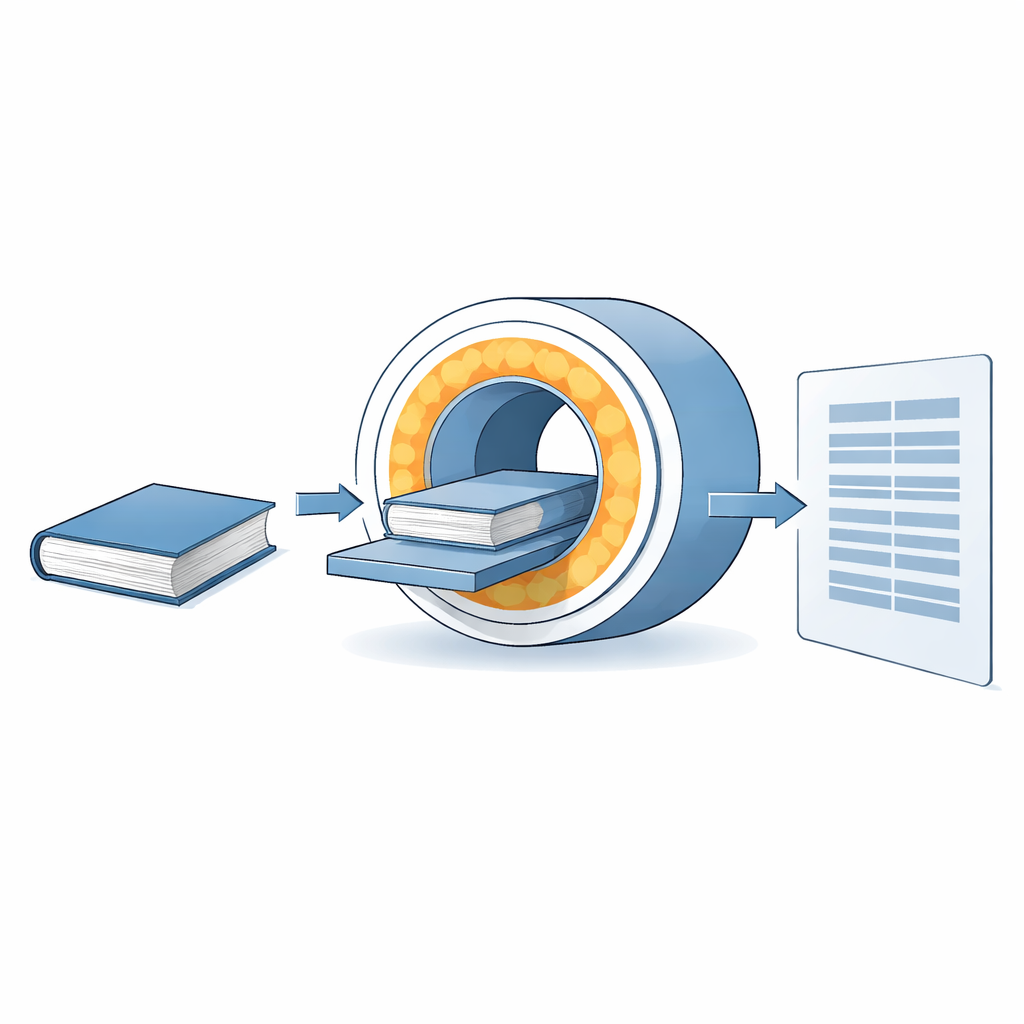
Why Reading Hidden Pages Is So Hard
Conventional scanners and medical imaging devices struggle with the challenge of peering inside books. Ordinary MRI machines are designed for human bodies and can typically resolve details no finer than about a tenth of a millimeter—far too coarse to pick out ink layers only a few tens of micrometers thick. X-ray methods can sometimes see text inside rolled or folded documents, but they depend heavily on the ink containing metals such as iron, and they have trouble with common modern or historical inks made mostly of carbon or organic pigments. Terahertz imaging and neutron techniques offer other options, yet they are limited either in resolution, contrast, field of view, or availability.
Turning Invisible Ink Layers into a Visible Outline
The authors tackle these obstacles by pushing magnetic resonance imaging into the realm of microscopy. Instead of trying to detect the solid ink directly—which produces almost no usable signal—they add a harmless, MRI-visible liquid that seeps into the tiny gaps around the printed regions on and between the paper sheets. The inked areas themselves remain dark while the surrounding liquid appears bright, creating a kind of “negative” image where raised ink layers emerge as subtle elevations in the paper. Using a prototype insert on a powerful 7-tesla human MRI scanner, equipped with unusually strong magnetic field gradients and very sensitive radio detectors, they shrink the three-dimensional pixel size down to about 20 micrometers, small enough to match the thickness of layered printing. 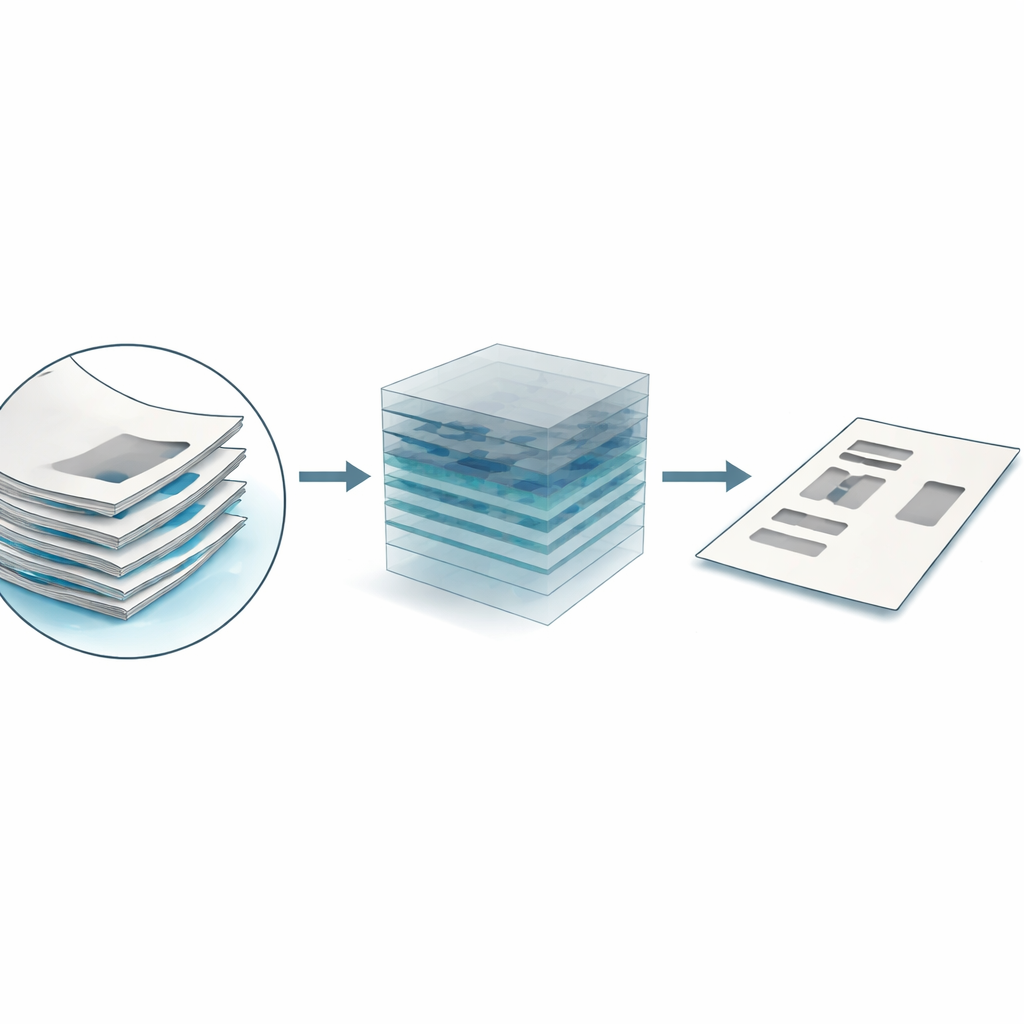
From Stacked Pages to Flattened, Readable Surfaces
To test the approach, the team printed letters and short text passages on multiple sheets, stacking nine pages together and varying how many times ink was overprinted in the same place. This produced controlled ink thicknesses ranging from about 15 to 60 micrometers, similar to or only slightly thicker than common print. After soaking the stack in silicone oil, they acquired high-resolution three-dimensional data over many hours and then “cut” virtual slices through the volume to look for the text. Simple flat slicing worked when pages were nearly straight, but real sheets tend to bow and curve, which blurred or hid portions of the letters.
Teaching the Computer to Follow Curved Pages
To solve this, the researchers developed a semi-automatic software method, nicknamed TRIPATRA, that tracks the three-dimensional surface of each page inside the volume. The algorithm follows the page center lines from slice to slice, estimates smooth mathematical surfaces that match the bent sheets, and then digitally “flattens” those surfaces into two-dimensional images. By reprojecting the original data onto these fitted surfaces and enhancing contrast, the method produces much clearer views of the text, even when pages are noticeably curved. For thicker ink layers, entire sentences can be recognized, and even thinner, barely visible letters become more legible than with manual slicing alone.
How This Stacks Up Against Other Techniques
This magnetic resonance micro-imaging approach complements existing tools rather than replacing them. Compared with micro–computed tomography, it does not rely on heavy metals in the ink and can therefore handle many modern pigment-based inks that X-rays cannot easily distinguish from paper. It also offers higher spatial resolution than current terahertz imaging and uses much lower energy than X-rays or high-frequency radiation, which is advantageous for delicate materials. However, the method presently requires immersing samples in an MRI-visible liquid—something that could harm sensitive or historic documents—and is limited to small fields of view by the size of the specialized detector coils.
Where This Proof of Concept Could Lead
In everyday terms, the study shows that the basic physics and engineering needed to “see” printed letters through closed, slightly bowed pages really do work, at least on small test stacks. The researchers can measure paper thickness, discern raised ink layers only about 30 micrometers thick, and reconstruct readable text from curved, overlapping sheets. To turn this into a practical tool for archives and museums, larger scanning volumes, gentler contrast agents, and more automation will be needed. Still, the principle is now demonstrated: with the right hardware and smart software, magnetic resonance could one day let us explore hidden writing and images deep inside valuable objects—without ever needing to open, unroll, or unseal them.
Citation: Berg, A.G., Seewald, A.K. Visualization of text on bowed sheets via High-resolution 3D-Magnetic Resonance Micro-imaging for potential reading of closed books: the proof-of-concept. Commun Eng 5, 71 (2026). https://doi.org/10.1038/s44172-026-00614-7
Keywords: non-invasive book reading, magnetic resonance microscopy, hidden text imaging, cultural heritage preservation, 3D page reconstruction