Clear Sky Science · en
Sex-specific cardiometabolic responses during microgravity simulation in European Space Agency VIVALDI dry immersion
Why floating in water can teach us about space and health
What happens to the human body when gravity all but disappears, as it does in space? This question matters not only for astronauts but also for people on Earth who spend long periods inactive, such as during illness or aging. In this study, researchers used a clever Earth-based setup called dry immersion, where volunteers lie for five days in a warm water tank while wrapped in a waterproof fabric so they do not get wet. This setup closely mimics some effects of weightlessness, letting scientists track how the heart, blood, metabolism, muscles, bones, and blood vessels adapt in both women and men.
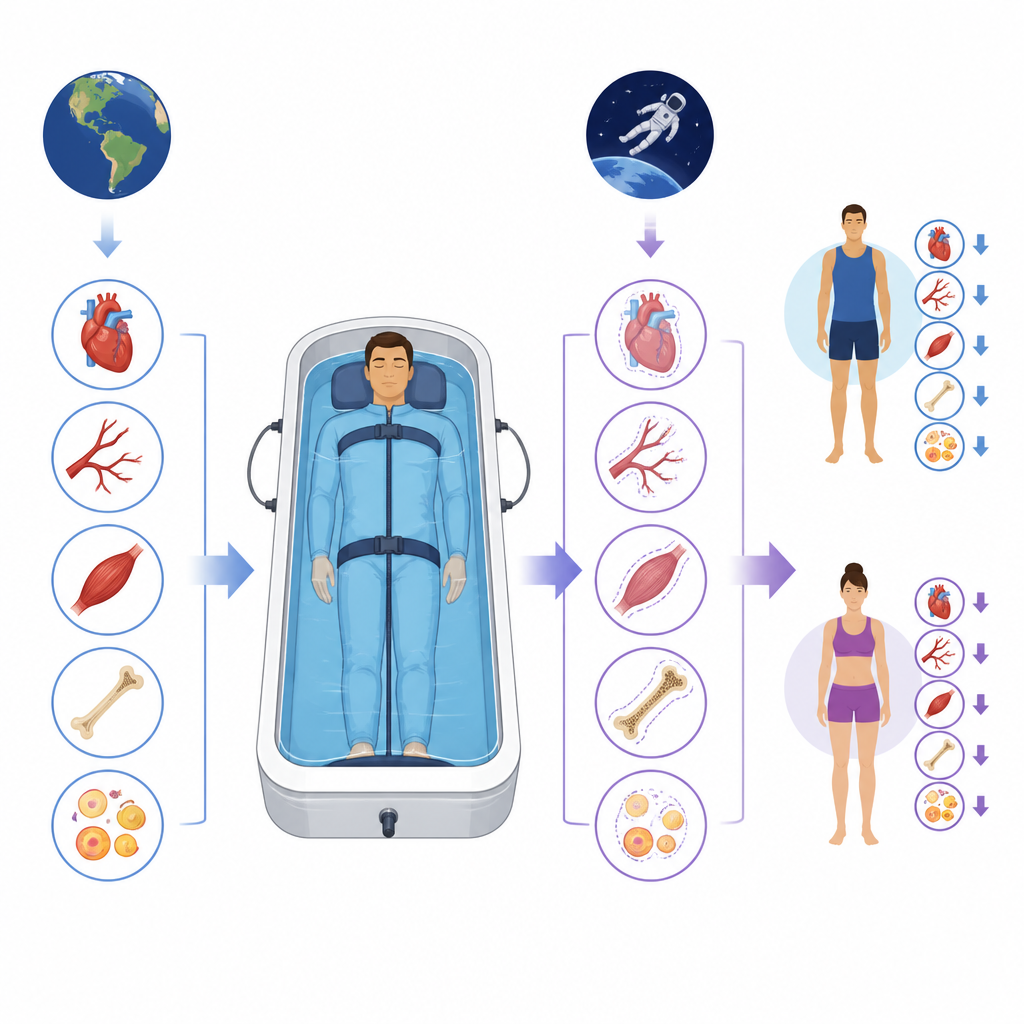
A water tank that simulates weightlessness
Dry immersion removes the usual pressure of body weight and causes body fluids to shift from the legs toward the chest and head, similar to what happens in orbit. The European Space Agency ran two nearly identical five day campaigns: one with 18 healthy women and one with 19 healthy men. Before, during, and after immersion, the team measured heart and blood pressure responses, blood volume and fluid balance, sleep, physical activity, muscle strength, blood fats and sugars, bone markers, and signals from blood vessels. Volunteers stayed strictly off their feet, turning the experiment into a controlled model of extreme, but reversible, inactivity.
How the heart and circulation are strained
Within hours of entering dry immersion, the volume of blood plasma dropped by about one quarter in both sexes, as fluid shifted upward and was then lost in urine. This made the blood thicker and reduced total body water, especially the fluid outside cells. The heart responded by beating faster at rest and during simple exercise, while its ability to pump at peak effort fell. When the team tested tolerance to a strong, headward blood shift using a device that sucks blood toward the lower body, both women and men found it harder to cope after immersion. Women, however, were more likely to reach near fainting at higher levels of this stress, and their blood vessels in the limbs had to tighten more to maintain blood pressure, hinting at slightly lower resilience when gravity is suddenly reapplied.
Muscles, metabolism, and blood fats under stress
The leg muscles, relieved of carrying body weight and barely moving, showed clear signs of rapid deconditioning. Monitors on the ankles recorded a ten to fifteen fold drop in daily movement counts, and strength tests revealed about an eight percent loss in knee extensor force in both sexes after just five days. At the same time, the body’s handling of sugar and fat shifted in an unhealthy direction. In glucose challenge tests, both women and men needed more insulin to control blood sugar, a sign of reduced insulin sensitivity. Women showed a stronger decline in insulin sensitivity and a larger rise in a calculated index linked to future artery disease. Fasting levels of blood fats, including triglycerides and “bad” cholesterol, rose in everyone, and a hormone that usually supports healthier fat and sugar metabolism fell, especially in women.
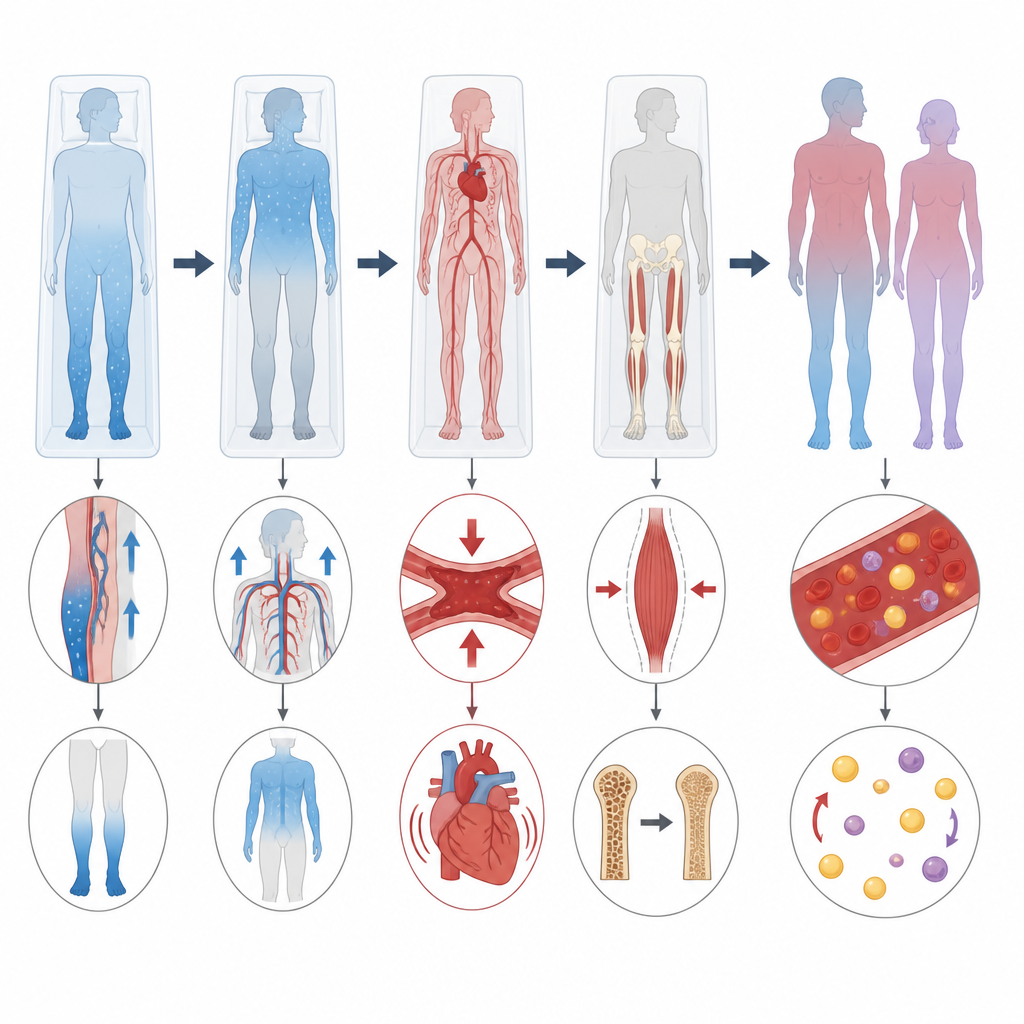
Bones and blood vessels respond to unloading
Because bones no longer had to support body weight, their internal renewal cycle also changed. Markers of bone building in the blood steadily declined during the five days and remained low even two days into recovery, while markers of bone breakdown rose, particularly in women. Blood calcium increased, consistent with bone mineral being released into circulation. At the same time, the inner lining of blood vessels showed signs of being activated or mildly irritated, and factors linked to new vessel growth climbed in both sexes. The veins in the calves, however, seemed mechanically preserved, likely because the surrounding water pressure compresses the lower legs throughout immersion, a key difference from true spaceflight.
What this means for future space missions and life on Earth
Overall, five days of dry immersion produced rapid, multi system strain on the heart, circulation, metabolism, muscles, bones, and vessel lining that looked very similar in women and men, with some important nuances. Women were somewhat more prone to low blood pressure when gravity stress was reapplied, showed greater early loss of insulin sensitivity, a sharper rise in a blood fat risk index, and stronger signals of bone breakdown. These findings confirm that dry immersion is a powerful and practical tool for studying how the body responds to near weightlessness and deep inactivity. They also highlight the need to tailor protective strategies, such as exercise and nutrition plans, to both sexes as space travel expands and as doctors look for ways to combat the harmful effects of prolonged inactivity here on Earth.
Citation: Robin, A., Navasiolava, N., Bergouignan, A. et al. Sex-specific cardiometabolic responses during microgravity simulation in European Space Agency VIVALDI dry immersion. Commun Med 6, 301 (2026). https://doi.org/10.1038/s43856-026-01540-7
Keywords: microgravity, dry immersion, cardiometabolic health, sex differences, space medicine