Clear Sky Science · en
Unbiased characterization of COVID-19 endotypes leads to prognostication of high-risk individuals using routine blood tests
Why some COVID-19 cases turn dangerously severe
When SARS-CoV-2 infects people, the outcomes range from a few days of mild symptoms to life-threatening lung failure requiring intensive care. Doctors still struggle to predict, early on, which newly admitted patients are headed for serious trouble. This study asks a simple but powerful question: can patterns in common blood proteins reveal hidden "types" of COVID-19, and can those types help hospitals spot high‑risk patients using routine blood tests?
Grouping patients by hidden patterns in the blood
The researchers examined detailed protein profiles in blood samples from 731 people in Québec who tested positive for SARS-CoV-2 and were seen in the emergency room or hospitalized. Instead of starting from how sick patients looked, they let a computer algorithm sort people purely by similarities in thousands of blood proteins. This unsupervised clustering revealed six distinct biological subgroups, called endotypes, each with its own molecular fingerprint. 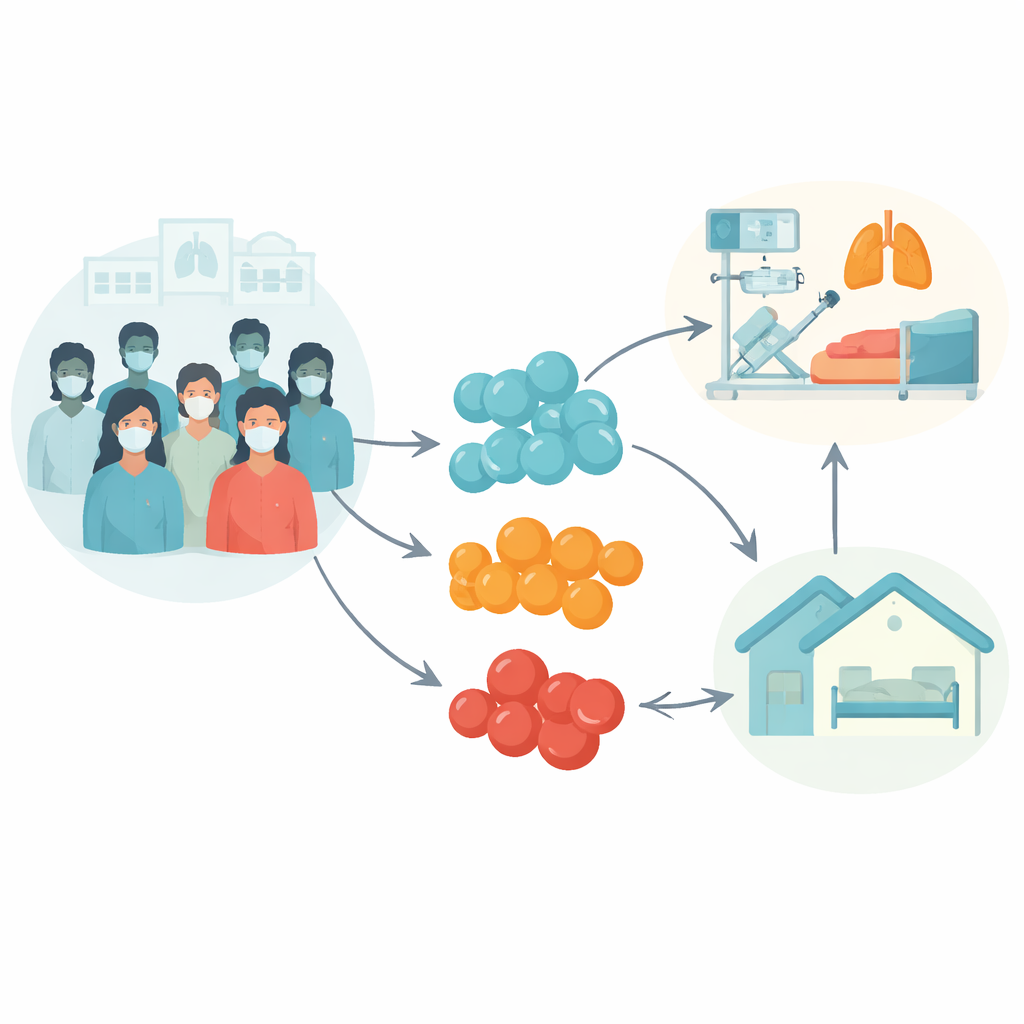
The high‑risk endotype and its warning signals
One group, labeled EP6, stood out as especially dangerous. Nearly three‑quarters of people in EP6 became severely ill or died, and over half developed acute respiratory distress syndrome, a form of catastrophic lung failure. Yet these patients were not necessarily older, heavier, or burdened with more chronic illnesses than others, showing that usual risk factors did not fully explain their fate. Instead, their blood told the story: EP6 patients had very high levels of inflammation and clotting activity, including elevated C‑reactive protein, D‑dimer, interleukin‑6, ferritin, and a marker of blood vessel injury called sFLT1, along with surging neutrophils and depleted lymphocytes. Together, this profile pointed to an out‑of‑control immune response, damaged blood vessels, and disordered coagulation as hallmarks of this endotype.
Turning complex proteomics into practical hospital tools
While full protein profiling is expensive and not available in most hospitals, standard blood tests are common. The researchers therefore built a "nearest‑centroid" model that learns the typical pattern of 43 routine blood markers for each endotype and then assigns new patients to the closest pattern, even when some tests are missing. When tested using cross‑validation and then applied to 903 additional COVID‑19 patients without proteomic data, this model successfully recreated the endotypes. The predicted high‑risk group resembled EP6: these patients were far more likely to require oxygen, intensive care, and to experience severe or fatal outcomes, and they progressed to intensive care more quickly. In effect, deep proteomic data from one cohort was used to train a simple laboratory‑based tool that can stratify risk in many more patients. 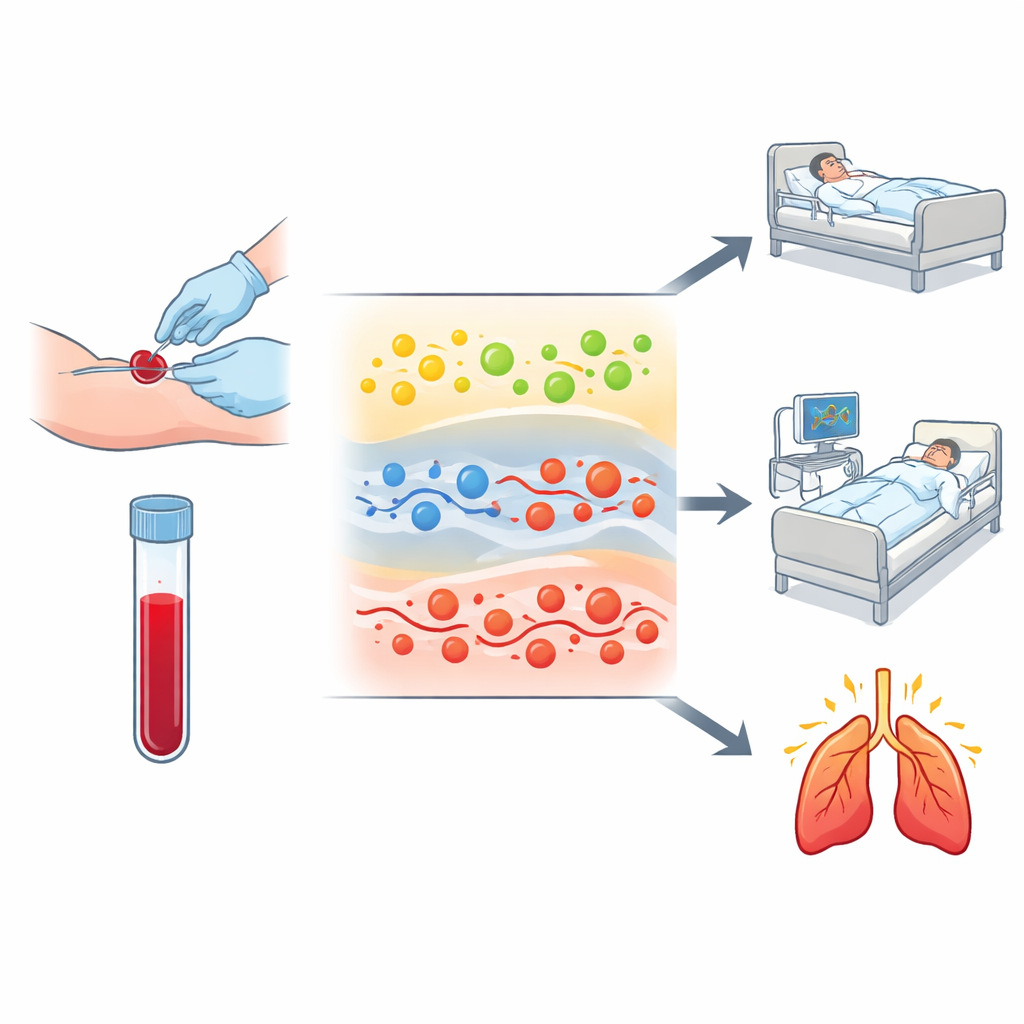
Genetic clues and the biology of lung failure
Digging deeper, the team explored why some patients fall into the EP6 endotype. They searched for genetic variants more common in EP6 and linked them to measured protein levels. One protein, SHC4, emerged as both genetically associated with EP6 and strongly elevated in these patients, hinting at a role in the chain of events that leads from infection to severe lung and organ damage. Among EP6 patients on mechanical ventilators, the researchers also found signs of disturbed fat and lipoprotein metabolism, including changes in a protein called ANGPTL3 and in specific lipid pathways, and an enzyme, alpha‑L‑iduronidase, whose lower levels were tied to longer time on the ventilator. These findings suggest that, even within severe cases, different biological routes can lead to the same clinical picture.
What this means for future care
In plain terms, this work shows that there is no single "severe COVID-19" but several biological versions of it, some driven by extreme inflammation and clotting. By first mapping these hidden disease types using rich protein data and then translating them into signatures based on everyday blood tests, the study outlines a path toward more precise triage: flagging those on a collision course with lung failure while they are still on the ward, and potentially tailoring treatments to the dominant biology in each group. Although further validation is needed before bedside use, the approach could help turn routine blood work into an early‑warning system for severe respiratory illness, in COVID-19 and beyond.
Citation: Ma, W., Soulé, A., Allard, C. et al. Unbiased characterization of COVID-19 endotypes leads to prognostication of high-risk individuals using routine blood tests. Commun Med 6, 261 (2026). https://doi.org/10.1038/s43856-026-01520-x
Keywords: COVID-19 severity, blood biomarkers, proteomics, acute respiratory distress syndrome, risk prediction