Clear Sky Science · en
Minimal correlation but complementary diagnostic utility for plasma cell-free RNA and proteins
Why Tiny Molecules in Blood Matter
When children develop serious inflammatory illnesses, such as Kawasaki disease or the COVID‑related condition MIS‑C, doctors have to make fast decisions with limited tools. This study asks a deceptively simple question: if we look closely at two types of molecules floating in blood—cell‑free RNA and proteins—do they tell us the same story about disease, or different ones? The answer affects how we design future blood tests that could distinguish similar illnesses and guide treatment more precisely.
Two Blood Clues: Messages and Machines
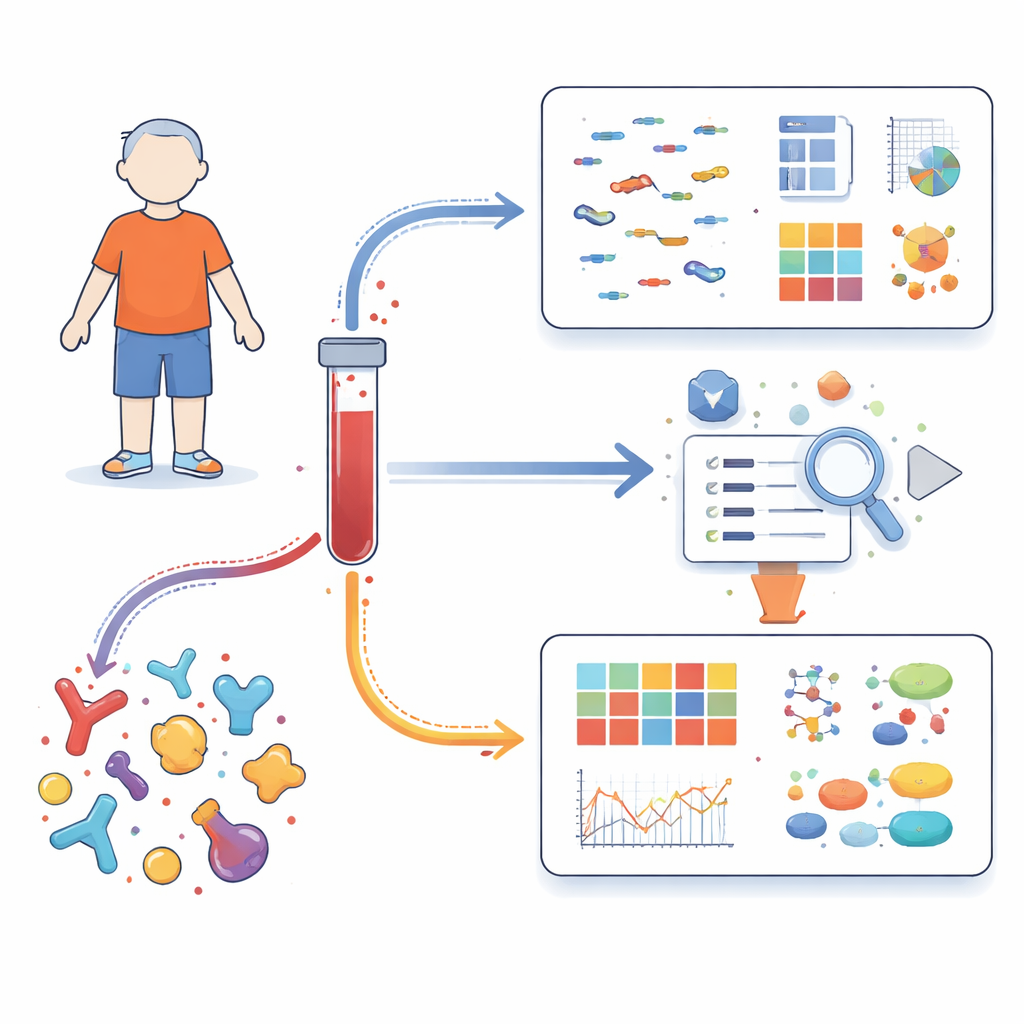
Our blood carries a mix of biological "messages" and "machines." Cell‑free RNA (cfRNA) consists of tiny strands of genetic instructions released when cells are stressed, damaged, or actively sending signals. Proteins, by contrast, are the working parts built from those instructions. Both can be measured from a small tube of plasma. In this study, researchers analyzed blood from 263 children with Kawasaki disease or MIS‑C using two powerful technologies: RNA sequencing to read tens of thousands of cfRNA signals, and a proteomics platform called SomaScan to measure more than 6,000 distinct proteins. A subset of 63 children had both cfRNA and protein measured from the same sample, allowing direct comparison.
Same Patients, Surprisingly Different Signals
One might expect that higher levels of a given RNA would generally match higher levels of its corresponding protein. Instead, when the team compared cfRNA and protein molecule by molecule across matched samples, they found almost no correlation. On average, RNA and protein measurements for the same feature behaved nearly independently. This was true even when they focused only on molecules detectable in both assays. The lack of alignment suggests that what is released into plasma as cfRNA versus protein is governed by different biological processes, such as how cells die, how long molecules survive in circulation, and how they are cleared from the body.
Different Paths, Complementary Insights
Although individual cfRNA and protein levels rarely rose and fell together, both types of measurements captured important aspects of the children’s illnesses. When the researchers compared Kawasaki disease to MIS‑C, they found hundreds of cfRNA transcripts and dozens of proteins that differed between the two conditions. The patterns pointed to related but distinct biology. cfRNA tended to highlight upstream control processes—such as genes involved in immune signaling and tissue damage—while proteins reflected downstream effects, including inflammatory mediators, tissue remodeling, and metabolic changes. In MIS‑C especially, many more cfRNA features than proteins were altered, hinting that cfRNA may be particularly sensitive to widespread tissue injury and immune activation.
Teaching Computers to Read Blood
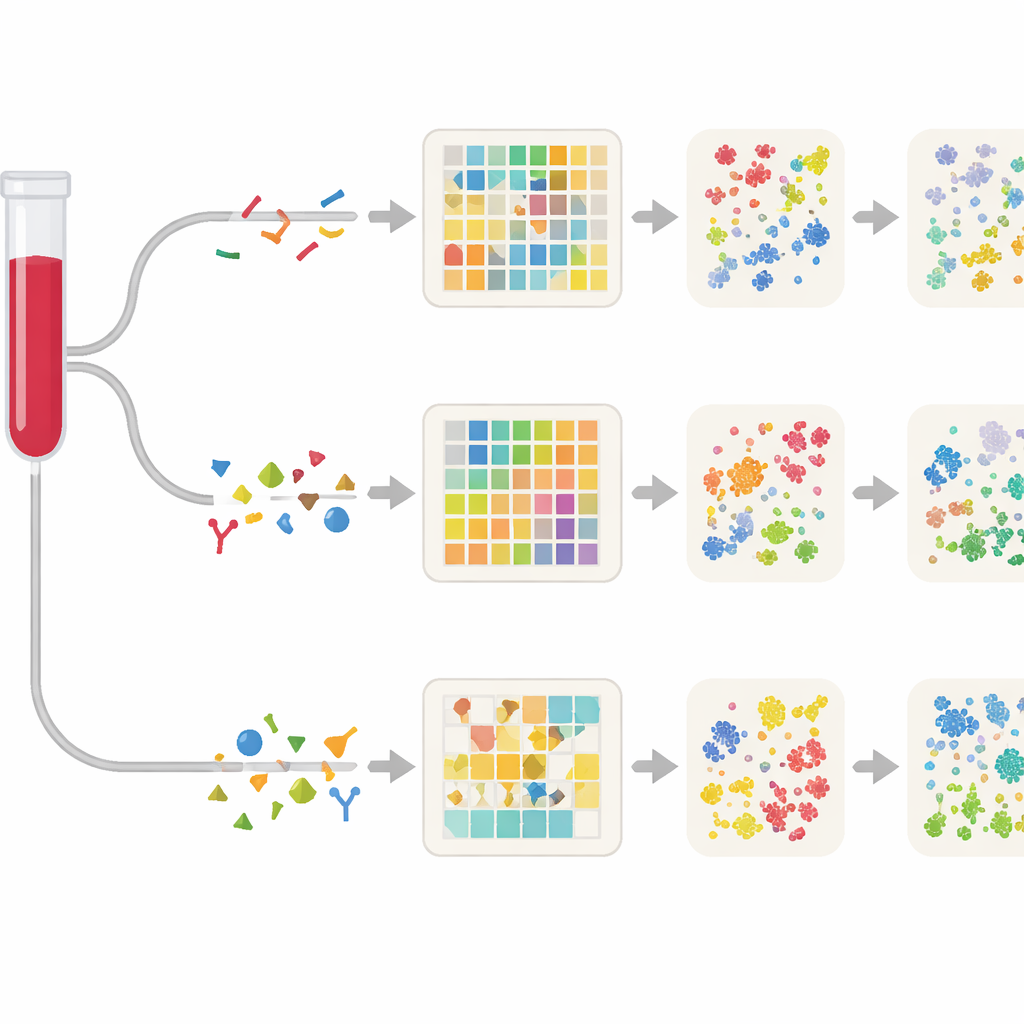
To test how useful each type of measurement could be for diagnosis, the team trained machine‑learning models to distinguish Kawasaki disease from MIS‑C using either cfRNA or protein data alone. Both approaches performed impressively well: in repeated tests, each reached a median accuracy corresponding to an area under the curve above 0.93, meaning the models reliably separated the two illnesses from blood alone. cfRNA models achieved this using fewer features, likely because RNA sequencing captures a wider range of potential biomarkers. Protein‑based models, however, still reached similar accuracy despite measuring fewer unique molecules. When the researchers drilled down into known Kawasaki subtypes, both cfRNA and protein could detect differences between most subgroups and MIS‑C, but one Kawasaki subtype looked strikingly similar to MIS‑C at the protein level, hinting at shared underlying biology.
What This Means for Future Blood Tests
For families and clinicians, the key takeaway is that no single blood readout tells the whole story. Cell‑free RNA and proteins are only weakly linked in plasma, yet each independently carries strong diagnostic signals and emphasizes different layers of disease biology. cfRNA provides a dynamic snapshot of which genes are being turned on or off in response to inflammation and tissue damage, while proteins capture the functional molecules acting in the bloodstream and organs. By combining these complementary views, future tests could more accurately distinguish between look‑alike conditions such as Kawasaki disease and MIS‑C, reveal meaningful subtypes within a diagnosis, and ultimately support more tailored and timely treatments for sick children.
Citation: Bliss, A., Loy, C.J., Kim, J. et al. Minimal correlation but complementary diagnostic utility for plasma cell-free RNA and proteins. Commun Med 6, 252 (2026). https://doi.org/10.1038/s43856-026-01489-7
Keywords: cell-free RNA, plasma proteomics, Kawasaki disease, MIS-C, blood biomarkers