Clear Sky Science · en
Proteomic signatures of the APOE ε4 and APOE ε2 genetic variants and Alzheimer’s disease
Why some genes change brain aging
Alzheimer’s disease does not strike everyone with the same force. One of the biggest known influences is a gene called APOE, which comes in several versions that can either raise or lower a person’s risk. This study asks a simple but crucial question for families and doctors alike: what actually happens in the body that makes one version of the gene harmful and another protective? By tracking thousands of proteins in blood and brain fluid, the researchers map how APOE shapes the chemistry of aging brains long before memory problems appear.
The gene with two very different faces
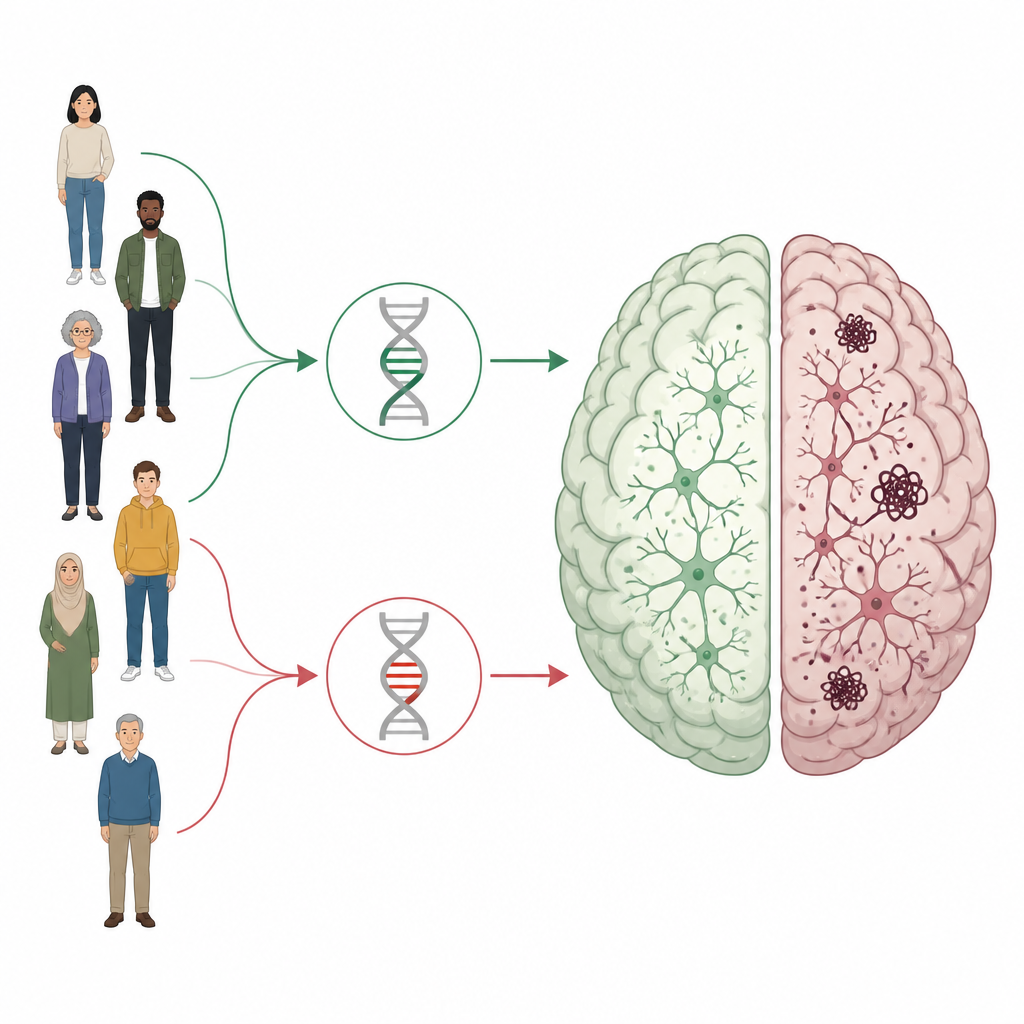
The APOE gene helps move fats and other substances around the body. Most people carry the common form, called ε3, but some carry ε4, which increases the chance of Alzheimer’s, while others carry ε2, which lowers it. The team pulled together data from more than 10,000 volunteers across several major studies. They measured thousands of proteins in blood plasma and in the fluid that bathes the brain and spinal cord, then compared these patterns between people with different APOE versions and with or without Alzheimer’s or early amyloid buildup, the sticky protein that forms plaques in the disease.
Protective patterns that appear early and stay steady
For people carrying the ε2 version, the researchers found wide ranging protein differences compared with those carrying ε3. Many of these shifts were already present in people without any signs of amyloid buildup and across younger and older age groups. The altered proteins pointed to better cellular upkeep, healthier energy use, and quieter inflammatory activity. Importantly, these ε2-linked signatures changed little as people aged or developed Alzheimer’s, suggesting that ε2 sets up a long lasting, body wide buffering system against cellular stress that continues even when disease processes begin.
Risky patterns that get pulled into disease
The ε4 version told a different story. It was also linked to many protein changes, some visible before symptoms, but these signals were much more entangled with disease. When the researchers adjusted for whether a person already had Alzheimer’s, a large share of ε4 related protein shifts faded, showing that many changes reflect the fallout of ongoing damage rather than the gene’s direct effect. Proteins tied to ε4 often pointed to problems in cell division control, support cells in the brain, blood vessels, immune activity, and the disposal of misfolded proteins. Once amyloid and other disease features appeared, these ε4 linked pathways seemed to be easily pushed into a harmful cascade.
How the two versions shape different futures
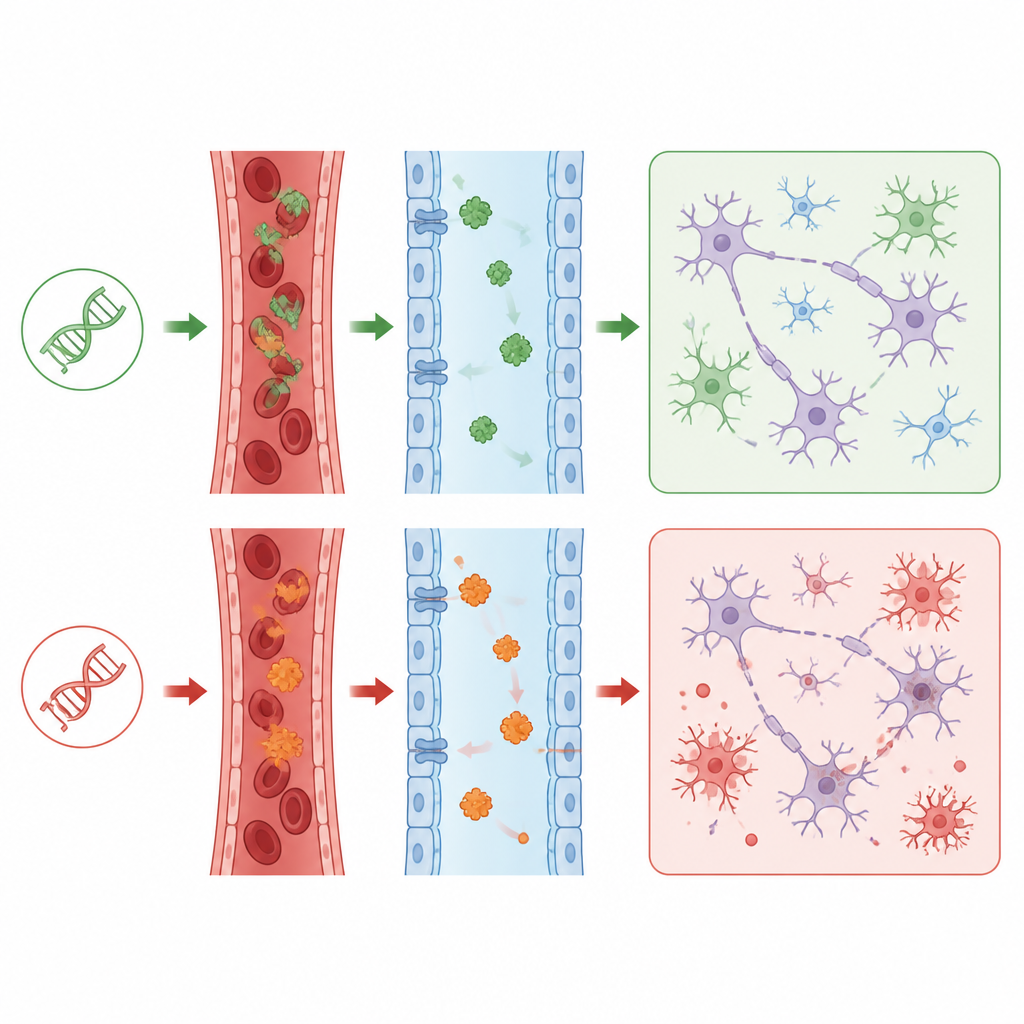
To sort cause from consequence, the team used statistical tools that test whether a protein is more likely to sit upstream or downstream of disease. For ε2, many proteins looked like genuine intermediates: changes in their levels could explain part of the reduced risk of Alzheimer’s, and they were less clearly driven by existing damage. In contrast, only a modest set of ε4 linked proteins seemed to act in this upstream way; far more appeared to be remodeled by Alzheimer’s itself. The two gene versions rarely controlled the very same proteins in opposite directions. Instead, they influenced mostly distinct sets of proteins, with a few shared “switch” proteins behaving differently depending on which version was present.
What this means for future tests and treatments
In plain terms, this work suggests that the protective ε2 version helps the body maintain balance and dampen stress from an early age, making brain cells more resilient. The risky ε4 version, by contrast, seems to prime the system in ways that leave it vulnerable to being pushed off course once amyloid and other disease changes start. Because many of the key proteins linked to each gene version can be detected in blood or brain fluid before symptoms, they offer a roadmap for new biomarkers and, potentially, treatments that are tailored to a person’s APOE type. Rather than a single good or bad gene, APOE shapes Alzheimer’s risk through different molecular routes, some of which might be targeted to delay or prevent the disease.
Citation: Lu, L., Pichet Binette, A., Hristovska, I. et al. Proteomic signatures of the APOE ε4 and APOE ε2 genetic variants and Alzheimer’s disease. Nat Aging 6, 1138–1157 (2026). https://doi.org/10.1038/s43587-026-01123-0
Keywords: APOE gene, Alzheimer’s risk, blood proteins, brain aging, biomarkers