Clear Sky Science · en
The potential role of Arctic seaway expansion in driving the Mid-Pleistocene Transition
Why a distant Arctic gateway matters today
Hundreds of thousands of years ago, a subtle change in the Arctic seafloor may have helped shift Earth’s ice ages into a new rhythm. This study investigates how the gradual flooding of the Barents Sea shelf, which opened a new seaway between the Arctic Ocean and the North Atlantic, could have reshaped ocean circulation, trapped more carbon in the deep sea, and allowed larger ice sheets to survive. Understanding this ancient reorganization helps explain why the planet moved from shorter, smaller ice ages to the longer, deeper freezes that still echo in our climate system.
A mystery in the rhythm of ice ages
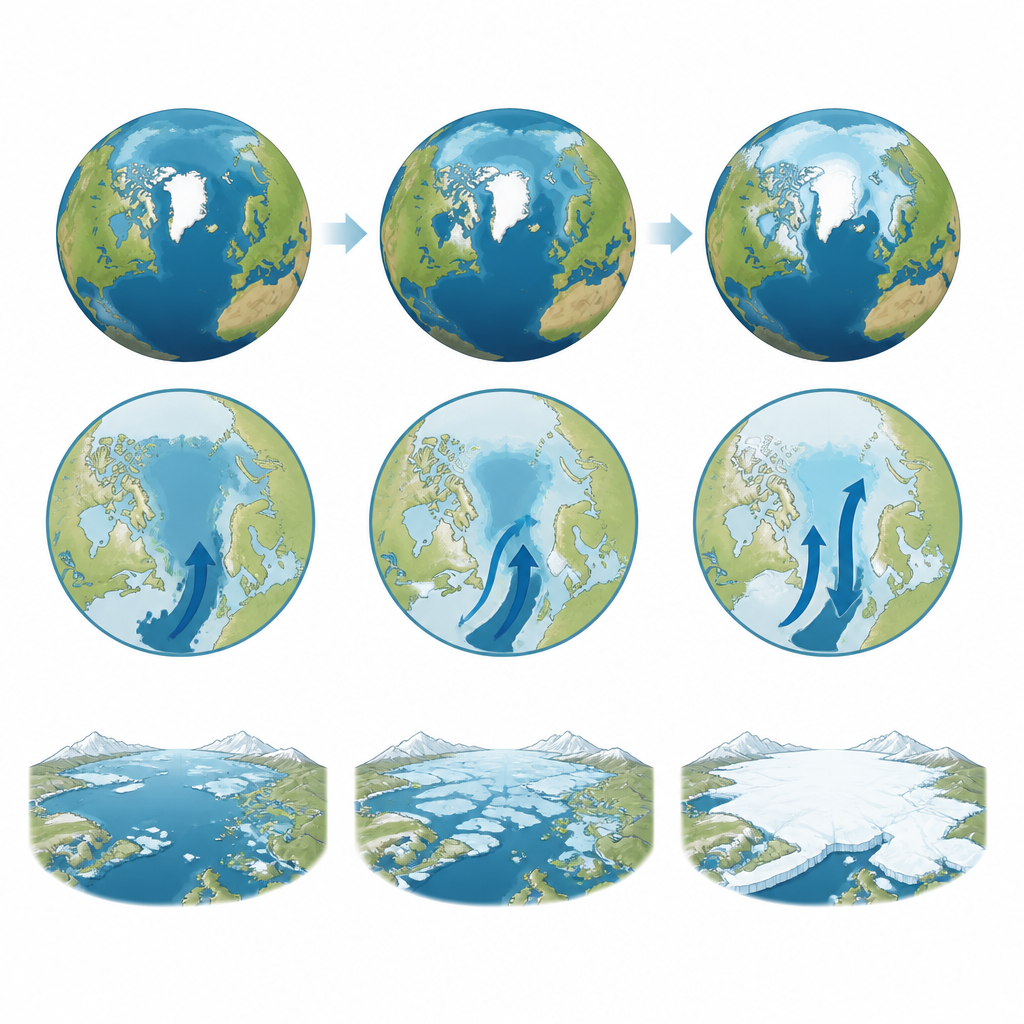
Climate records show that between about 1.25 and 0.7 million years ago, during the Mid Pleistocene Transition, Earth’s ice ages changed character. Before this interval, glaciers waxed and waned roughly every 41,000 years, tracking gentle tilts in Earth’s axis. Afterward, the pattern shifted to roughly 100,000 year cycles, with colder, longer glaciations and shorter warm periods. Because the incoming energy from the Sun changed very little across this time, scientists suspect that slow changes inside the Earth system, such as ice sheet behavior and ocean circulation, altered how the climate responded to orbital nudges.
Listening to ancient oceans with chemical fingerprints
To probe what happened in the Arctic, the researchers analyzed a long sediment core from the Mendeleev Ridge in the western Arctic Ocean. They measured ratios of neodymium isotopes preserved in a thin coating of iron and manganese minerals that formed on the seafloor as sediments settled. Different water masses carry distinct neodymium “signatures,” so shifts in these ratios reveal changes in which waters filled the deep Arctic. By combining this record with earlier data, and comparing it with other Arctic and North Atlantic sites, they built a nearly two million year history of how strongly the Atlantic and Arctic Oceans were connected.
Signs of growing meltwater and changing inflow
The neodymium record shows two key patterns. First, after the Mid Pleistocene Transition, short, sharp excursions appear that the authors link to pulses of meltwater from expanding ice sheets in North America and Eurasia. These pulses likely delivered large amounts of fresh water and eroded rock to the Arctic, momentarily altering deep water chemistry. Second, beneath this noise, there is a long term trend: before the transition, the deep Arctic appears less strongly influenced by Atlantic water and was persistently fresher at the surface, while after the transition, the baseline signal shifts toward values that match modern Atlantic inflow. Together with microfossil and isotope evidence for changing surface salinity and species distributions, this suggests that the connection between the Atlantic and Arctic gradually strengthened.
Opening a new door in the Arctic
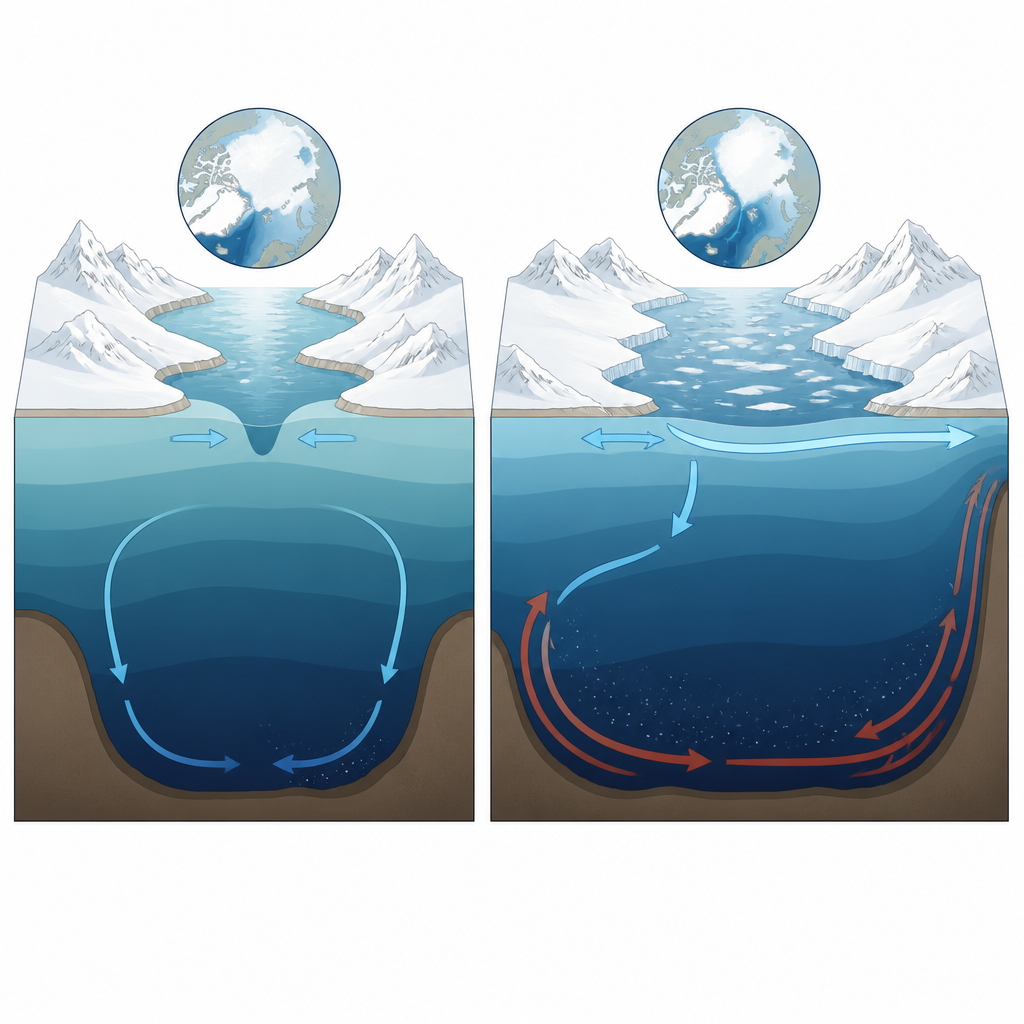
Geological studies of the surrounding shelves provide a possible driver for this change. As Northern Hemisphere ice sheets grew and eroded the Barents Shelf over many glacial cycles, they stripped away vast amounts of rock and lowered the land, slowly turning a mostly dry platform into a flooded seaway. Models and seafloor maps indicate that this Barents Seaway became a stable ocean gateway around the same time as the Mid Pleistocene Transition. Once open, it provided a second major route, alongside Fram Strait, for salty Atlantic water to enter the Arctic and for fresher Arctic water to flow back south. This new pathway could enhance the export of cold, fresh surface water to the North Atlantic without requiring a stronger global overturning circulation.
From seaway reshaping to longer ice ages
The authors propose that this rearranged gateway system helped freshen the North Atlantic, weakening deep mixing there and allowing dense, carbon rich southern waters to spread farther north in the deep ocean. This deeper pool of “old” water would store more carbon away from the atmosphere, driving down carbon dioxide levels and cooling the planet. At the same time, additional heat and moisture carried northward by Atlantic waters would fuel snowfall over growing ice sheets, while the fresher surface ocean would further limit deep overturning. These linked feedbacks made ice sheets larger and more stable so that they could survive brief warm peaks in sunlight and instead respond on slower, 100,000 year timescales. In this way, a slowly opening Arctic seaway may have played a quiet but powerful role in reshaping Earth’s ice age cycles.
Citation: Jang, K., Bayon, G., Han, Y. et al. The potential role of Arctic seaway expansion in driving the Mid-Pleistocene Transition. Commun Earth Environ 7, 449 (2026). https://doi.org/10.1038/s43247-026-03570-4
Keywords: Mid Pleistocene Transition, Arctic Ocean circulation, Barents Seaway, glacial cycles, ocean carbon storage