Clear Sky Science · en
Cost‑effective offshore carbon capture, utilization and storage deployment and transport network optimization in southern China
Why this matters for our climate future
Coastal megacities like those in southern China are economic powerhouses, but they also release huge amounts of carbon dioxide into the air. Cutting these emissions quickly without stalling growth is a major global challenge. This study explores whether using rocks under the nearby sea to permanently store captured carbon can offer a realistic, cost-conscious path to net zero for one of the world’s busiest coastal regions.
Busy coast, heavy emissions
The researchers focus on Guangdong Province and the wider Guangdong–Hong Kong–Macao Greater Bay Area, one of China’s richest and most densely populated hubs. Despite progress in cleaning up its energy mix, the region still relies heavily on coal and other fossil fuels. In 2023 it emitted nearly 900 million tons of carbon dioxide, with pollution concentrated in industrial cities such as Zhanjiang, Huizhou, Maoming and Guangzhou. While the Pearl River Delta combines high emissions with relatively low emissions per unit of economic output, western Guangdong has both high total emissions and high intensity, signaling strong pressure to cut pollution without undermining local industry.
Turning the offshore seafloor into a storage ally
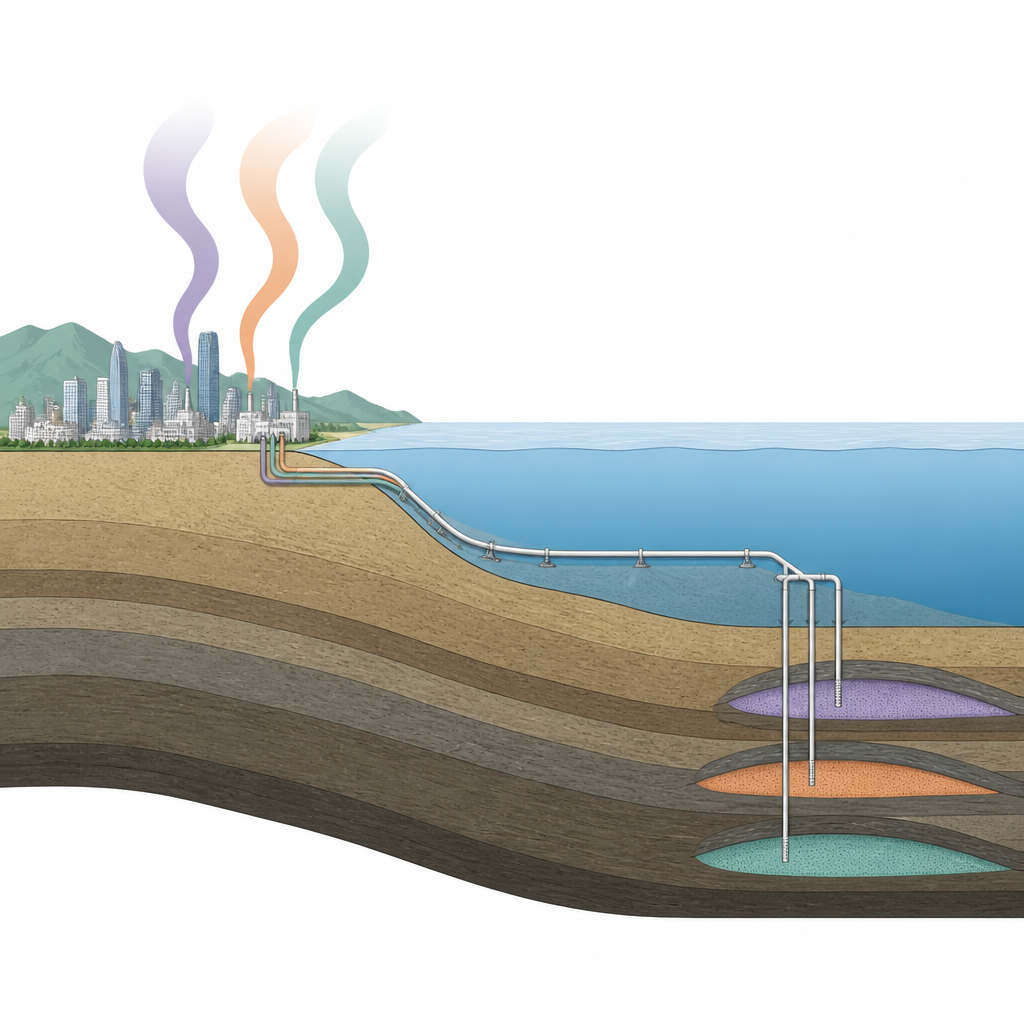
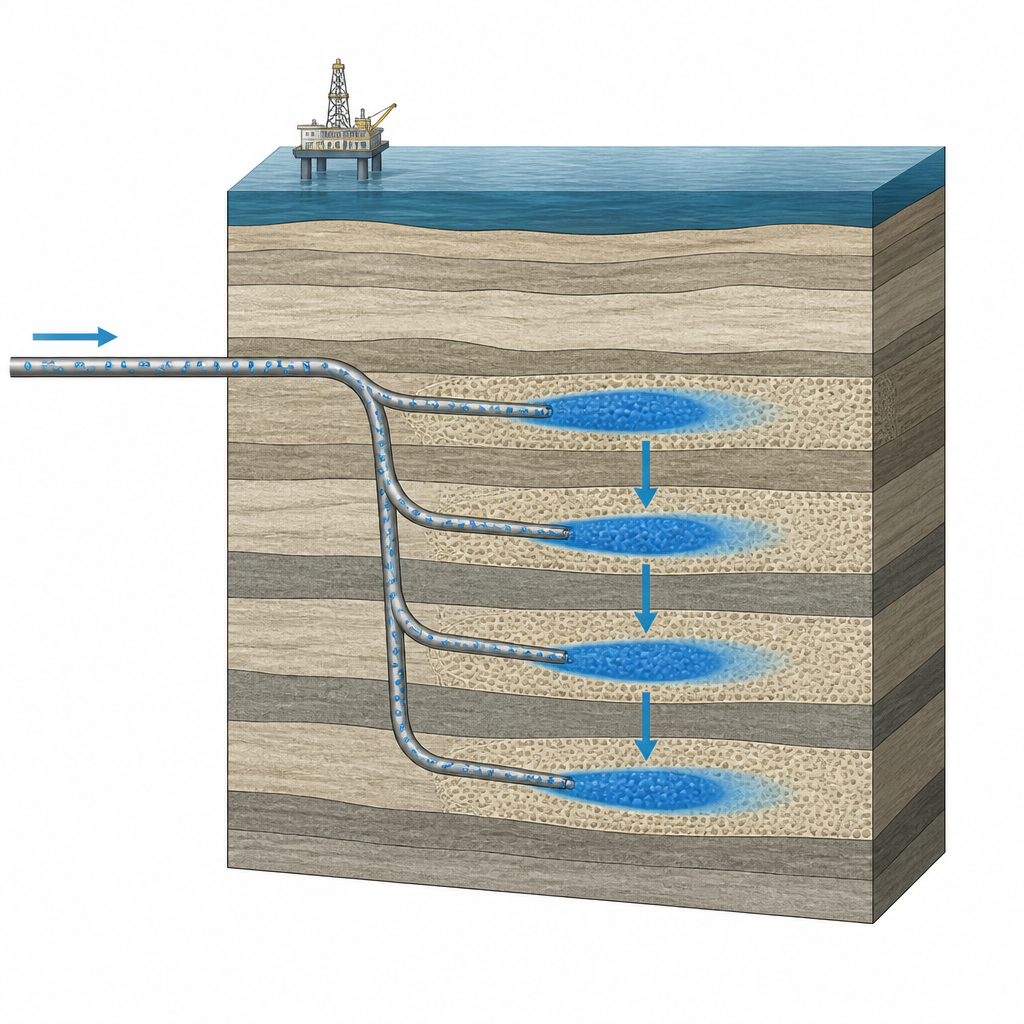
On land, Guangdong’s fractured geology offers limited places to safely lock away carbon. Offshore, however, the story changes. Under the seabed of the Pearl River Mouth Basin and Beibu Gulf Basin lie thick layers of sedimentary rock that can trap carbon dioxide for centuries or longer. The team compiles existing geological studies and identifies several promising “sags” and oil fields, where porous rock layers are capped by tight seals. Some oil fields already have platforms and pipelines, and in a few cases, injecting carbon dioxide can help push more oil out of the rock, creating extra income that helps offset project costs. Overall, the offshore formations are estimated to hold tens of billions of tons of carbon dioxide, far more than the study’s projected storage needs this century.
Designing an efficient carbon highway
Capturing carbon at smokestacks is only part of the puzzle. Moving that gas to offshore storage sites can be very expensive if not carefully planned. The authors build a two-step computer model that first pairs each emitting city with suitable offshore storage zones, then optimizes the layout of onshore and offshore pipelines using tools from graph theory and digital mapping. They group nearby industrial sources into four coastal clusters, each feeding into a hub city and then out to a particular offshore storage area. This optimized network cuts the total pipeline length by more than half compared with a simple direct-connection layout, highlighting how thoughtful infrastructure design can sharply reduce costs.
When does it start to pay off?
The study then asks whether such a system can make financial sense under a medium future carbon price. It simulates three capture levels, in which 20, 40 or 60 percent of emissions are trapped and stored between 2030 and 2060. Even after paying for capture plants, pipelines and storage wells, the model finds that total discounted revenue from selling avoided emissions eventually exceeds costs in all three cases. The cluster closest to shore, serving Zhanjiang and Maoming, is projected to break even first, around 2037, thanks to short pipelines and strong industrial demand. Clusters with longer routes, especially the one serving Guangzhou and Shenzhen via the Huizhou offshore sag, turn profitable later and are more sensitive to transport distance.
A stepwise plan for a fairer net-zero pathway
Based on these results, the authors propose a three-phase rollout. The western Guangdong cluster would start around 2030, taking advantage of existing offshore platforms and oil recovery income to reduce early losses. Once that project is working and earning money, the large Pearl River Delta cluster would follow after 2037, with smaller clusters added around 2040 as experience grows. By 2050, even the lowest capture case nearly meets the share of national carbon cuts that Guangdong would be expected to shoulder if reductions were divided according to economic strength, while higher capture cases go well beyond that share. Because the offshore rocks still have ample unused capacity by 2060, the system could continue supporting net-zero emissions for decades. Overall, the work suggests that carefully planned offshore carbon storage could allow wealthy coastal regions to take on a bigger slice of emission cuts, easing pressure on poorer areas while keeping climate goals within reach.
Citation: Xiong, P., Jiang, S., Zhang, K. et al. Cost‑effective offshore carbon capture, utilization and storage deployment and transport network optimization in southern China. Commun Earth Environ 7, 462 (2026). https://doi.org/10.1038/s43247-026-03455-6
Keywords: offshore carbon storage, CCUS, Guangdong emissions, carbon transport network, net zero planning