Clear Sky Science · en
Forest management plan validation gradually reduces forest loss in Congo Basin concessions
Why this forest story matters
The Congo Basin rainforest is often called Earth’s second green lung, storing huge amounts of carbon and supporting millions of people. Yet trees there are disappearing as roads and logging expand. This study asks a practical question with global consequences: when governments require logging companies to follow detailed forest management plans, does the forest actually fare better over the long run?
Rules for cutting trees
Across Central Africa, governments grant large areas of natural forest to companies for industrial logging. In exchange, firms are supposed to prepare Forest Management Plans, or FMPs. These plans map where timber can be harvested, where wildlife and water sources must be protected, and where local people can farm or gather products. They also set cutting cycles so that trees have time to grow back and encourage less damaging logging methods, such as carefully planned roads and controlled tree felling. However, drawing up and approving these plans is costly and slow, and many concessions have been allowed to operate for years before their plans were officially validated.
Tracking two decades of forest change
The authors combined satellite records of forest cover from 2000 to 2020 with detailed maps of logging concessions in Cameroon, the Central African Republic, the Democratic Republic of the Congo, the Republic of the Congo, and Gabon. They knew when each concession received its logging permit and, crucially, when its management plan was formally approved. Because different concessions obtained plan validation at different times, the team could compare how forest loss evolved before and after validation, and contrast these trends with concessions that never obtained a validated plan during the study period.

What happened where plans were validated
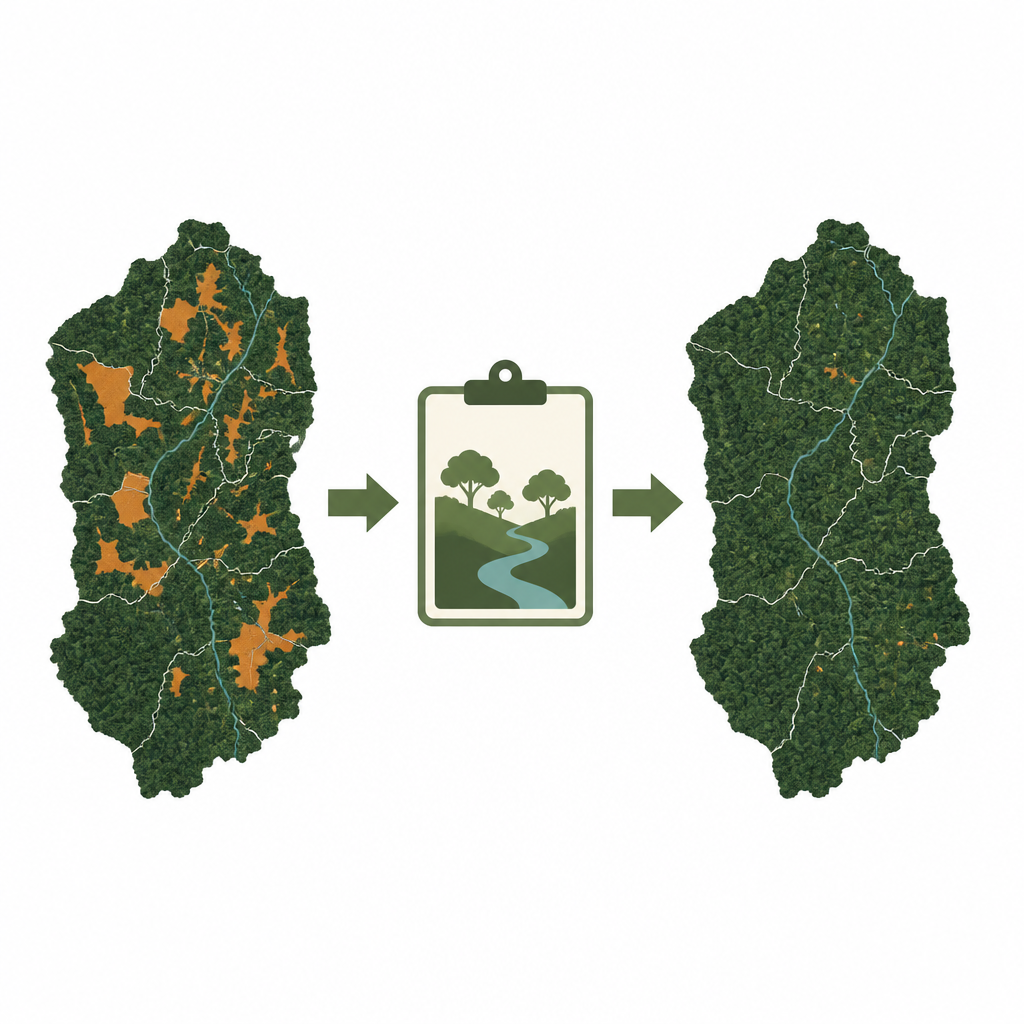
Concessions that eventually obtained a validated plan did not look different from other concessions in the years before approval: their forest loss followed similar paths. After validation, however, a clear pattern emerged. Tree loss inside these concessions declined gradually, not overnight, averaging about 100 fewer hectares lost per year than in comparable concessions without validated plans. This corresponds to roughly a 47 percent reduction in annual loss. Over 19 years, concessions with validated plans kept about 4,000 extra hectares of undisturbed tropical moist forest, and the total area of intact forest inside them grew steadily larger than would be expected without validation.
Less disturbance, not just more regrowth
The team also looked at forest regrowth, which signals how much land has been cleared or degraded and then allowed to recover. Surprisingly, concessions with validated plans showed less regrowth than those without. Rather than indicating a problem, this fits with the main finding: when there is less disturbance to begin with, there are fewer bare or degraded patches that need to grow back. The results hold under many checks, including alternative ways of measuring forest change, considering a concession heavily affected by wildfire, and separating concessions that also hold independent certification. The study found no sign that reduced damage inside treated concessions was offset by extra forest loss in nearby areas, and no strong differences in the overall road network linked to plan validation.
What this means for forests and people
Overall, the study shows that when forest management plans are fully validated and put into practice, logging concessions in the Congo Basin become noticeably less damaging to the forest over time. These plans do not halt logging, and they cannot solve all ecological or social concerns, such as the future of forests after permits expire or the well-being of nearby communities. Still, by steadily reducing tree loss and maintaining more intact forest, validated plans act as a public good that benefits the climate, biodiversity, and local livelihoods. The authors conclude that speeding up the preparation, approval, and long-term enforcement of such plans, with international support where needed, is a practical way to limit preventable forest loss in one of the world’s most important rainforests.
Citation: Houngbedji, K., Bouvier, M., Leblois, A. et al. Forest management plan validation gradually reduces forest loss in Congo Basin concessions. Commun Earth Environ 7, 414 (2026). https://doi.org/10.1038/s43247-026-03429-8
Keywords: Congo Basin forests, forest management plans, industrial logging, tropical deforestation, satellite monitoring