Clear Sky Science · en
Temperature-driven decline in recalcitrant dissolved organic carbon weakens coastal macrophyte’s blue carbon storage potential
Why coastal plant meadows matter for climate
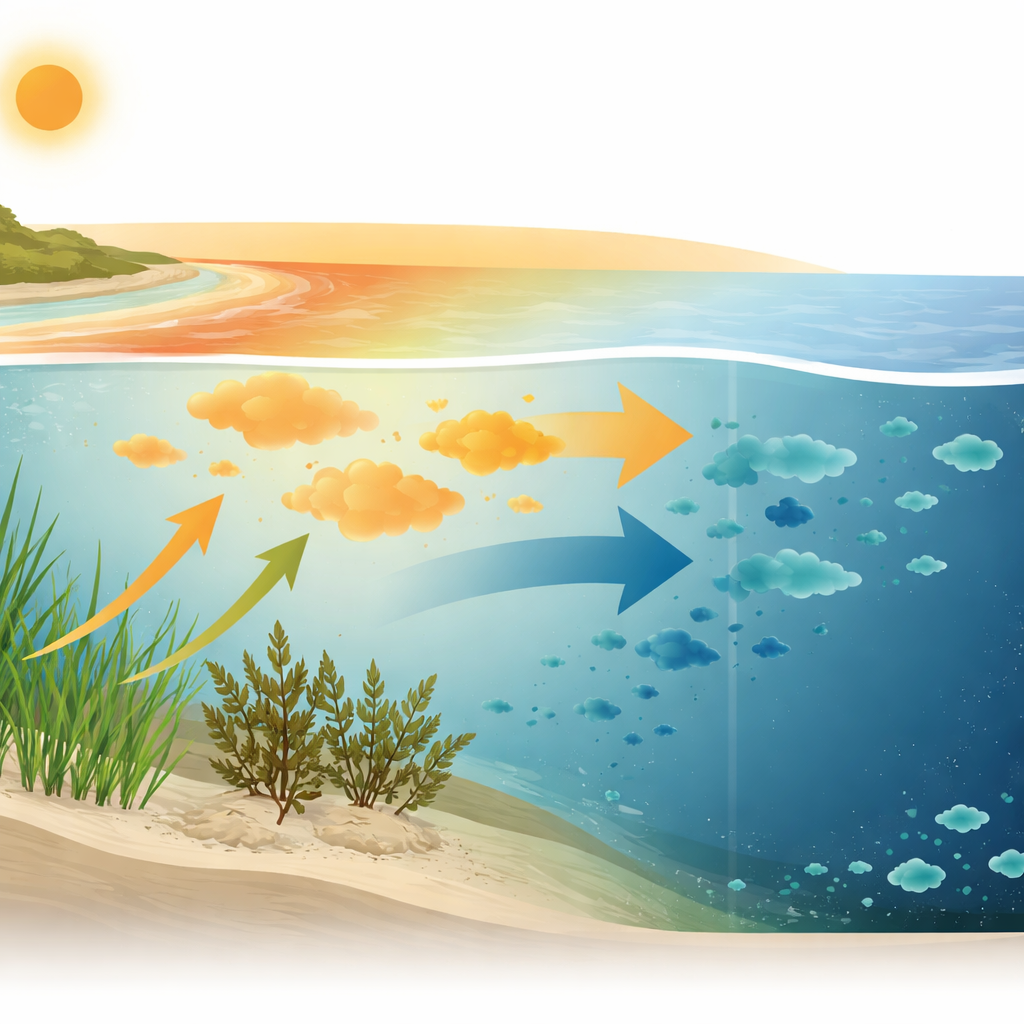
Along many shorelines, underwater meadows of seagrasses and seaweeds quietly pull carbon dioxide out of the atmosphere and ocean, helping to slow climate change. Much attention has focused on the carbon these plants bury in their sediments, known as blue carbon. This study shows that an often-overlooked pathway—carbon that dissolves into seawater and lingers there for months or longer—may be just as important, and that warming seas are starting to weaken this hidden climate service.
A closer look at invisible carbon in the sea
When marine plants grow, they do not keep all the carbon they capture. Part of it leaks out as dissolved organic carbon, an invisible mix of carbon-rich molecules in seawater. Some of this dissolved carbon is “labile,” meaning microbes quickly consume it and return it to the atmosphere as carbon dioxide. Another share is “recalcitrant”: it resists rapid breakdown and can stay in the ocean for months, years, or even longer, effectively storing carbon out of the air. Until recently, scientists knew little about how much of this tougher carbon came from coastal plant meadows, or how rising temperatures might change the balance between short-lived and longer-lived forms.
Testing warming and an ocean invader
The researchers built large tank systems that mimic shallow coastal habitats from southern Spain, where three native species—two seagrasses and one green seaweed—form mixed plant beds. They also included an invasive tropical seagrass that is spreading through warming Mediterranean and Atlantic waters. The team grew communities with only native species, only the invader, or a mix of both, and then gradually warmed the tanks to three temperatures representing present-day summers and projected warmer conditions. Over several weeks they measured plant growth, oxygen production and use, and the amount and type of dissolved carbon released around the plants, then followed how that carbon was broken down by marine microbes over a 60‑day period.
Warming reshapes the mix of dissolved carbon
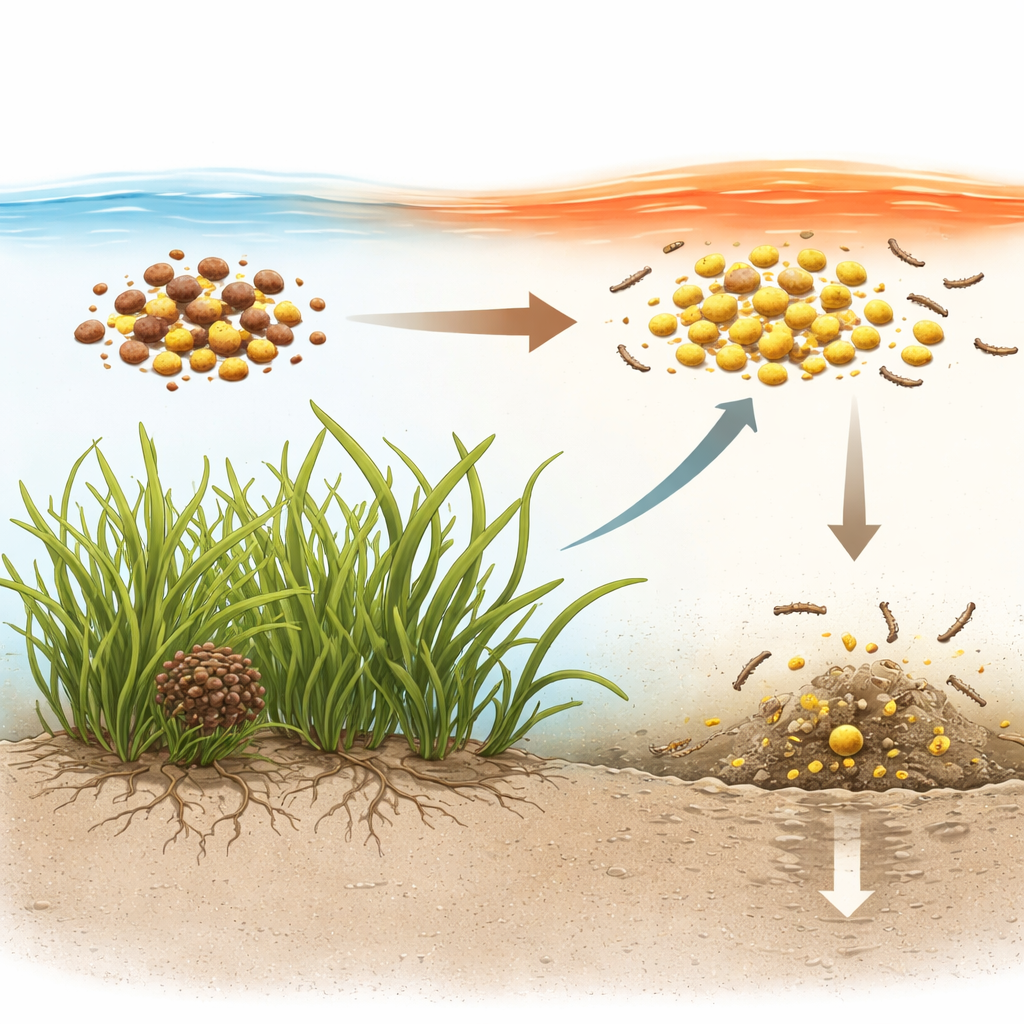
Plant health and overall carbon metabolism changed little across the tested temperatures, and the invasive seagrass did not strongly alter how much dissolved carbon the communities released. What did change sharply with warming was the nature of that dissolved carbon. At higher temperatures, the total amount of dissolved carbon tended to increase, but a greater share of it was in the easily degradable, labile form. The sturdier, recalcitrant fraction shrank by about 28% between the coolest and warmest treatments, even though the plants themselves showed no major stress. This means that under warmer conditions, more of the carbon leaving coastal meadows is routed back into the fast carbon cycle through microbial activity, instead of joining the slower, long-term storage pool.
Putting hidden carbon flows into context
To understand how important this overlooked pathway might be, the authors developed a common yardstick for comparing different carbon routes. They expressed dissolved carbon release relative to plant biomass, the carbon content of plant tissues, and pigment content, and then compared these numbers with known rates of carbon burial in sediments from the same coastal sites and from other studies worldwide. Their analysis suggests that, when scaled up to the global area covered by seagrasses and similar plants, the amount of recalcitrant dissolved carbon they export into the ocean each year is on the same order of magnitude as the carbon they lock into sediments—and may even be somewhat larger. Yet this dissolved pathway is rarely counted in blue carbon budgets or climate policies.
What this means for future oceans
This work reveals that coastal plant meadows are powerful but climate-sensitive engines of long-term carbon storage, not only through buried roots and sediments but also through slowly decaying dissolved carbon that spreads into the wider ocean. As oceans warm, the chemical “recipe” of that dissolved carbon shifts toward more short-lived forms, chipping away at the durability of this hidden carbon sink even when the plants themselves appear healthy. The study’s standardized method offers a way to track these changes across different habitats and species, improving estimates of how much carbon the ocean can safely hide from the atmosphere as the planet heats up.
Citation: Yamuza-Magdaleno, A., Azcárate-García, T., Egea, L.G. et al. Temperature-driven decline in recalcitrant dissolved organic carbon weakens coastal macrophyte’s blue carbon storage potential. Commun Earth Environ 7, 362 (2026). https://doi.org/10.1038/s43247-026-03417-y
Keywords: blue carbon, seagrass meadows, dissolved organic carbon, ocean warming, coastal ecosystems