Clear Sky Science · en
Decoding bacterial and fungal richness with autoencoders yields a unified ratio indicating soil health and ecological susceptibility
Why tiny soil life matters for our future
Every handful of soil is home to billions of bacteria and fungi that quietly keep ecosystems running. They recycle nutrients, build and break down organic matter, and help plants cope with drought and poor soils. This study explores how these unseen communities are distributed across Australia and introduces a simple number—the ratio of bacterial to fungal richness—that could help track soil health and flag ecosystems that are more vulnerable to environmental change.
Taking the pulse of life in the soil
The researchers drew on a national soil survey that spans deserts, grasslands, farms, and forests across Australia. From these samples they measured how many different kinds of bacteria and fungi live in the top ten centimeters of soil. Instead of looking only at where particular species occur, they focused on richness, the count of distinct types in each major group. Richness is not the whole story of how soil works, but it is linked to resilience and the ability of soils to support many functions at once. By combining this biological information with detailed maps of climate, vegetation, terrain, minerals, soil chemistry, and land use, the team set out to understand what controls this diversity at continental scale.
Using artificial intelligence to read complex patterns
To make sense of the huge, tangled dataset, the scientists used a supervised autoencoder, a type of neural network that compresses many environmental variables into a smaller set of key gradients and learns how these relate to microbial richness. This method can handle non‑linear and interacting effects better than traditional statistics while still allowing the patterns to be interpreted. The models reproduced observed richness reasonably well and revealed that climate sets broad boundaries, while vegetation, soil properties, and topography fine‑tune where different microbes thrive. Bacterial richness was linked to a wide mix of conditions, including terrain complexity, soil texture, and nutrient levels, while fungal richness showed a tighter dependence on moisture, organic carbon, and plant productivity.
Bacteria and fungi follow different environmental rules
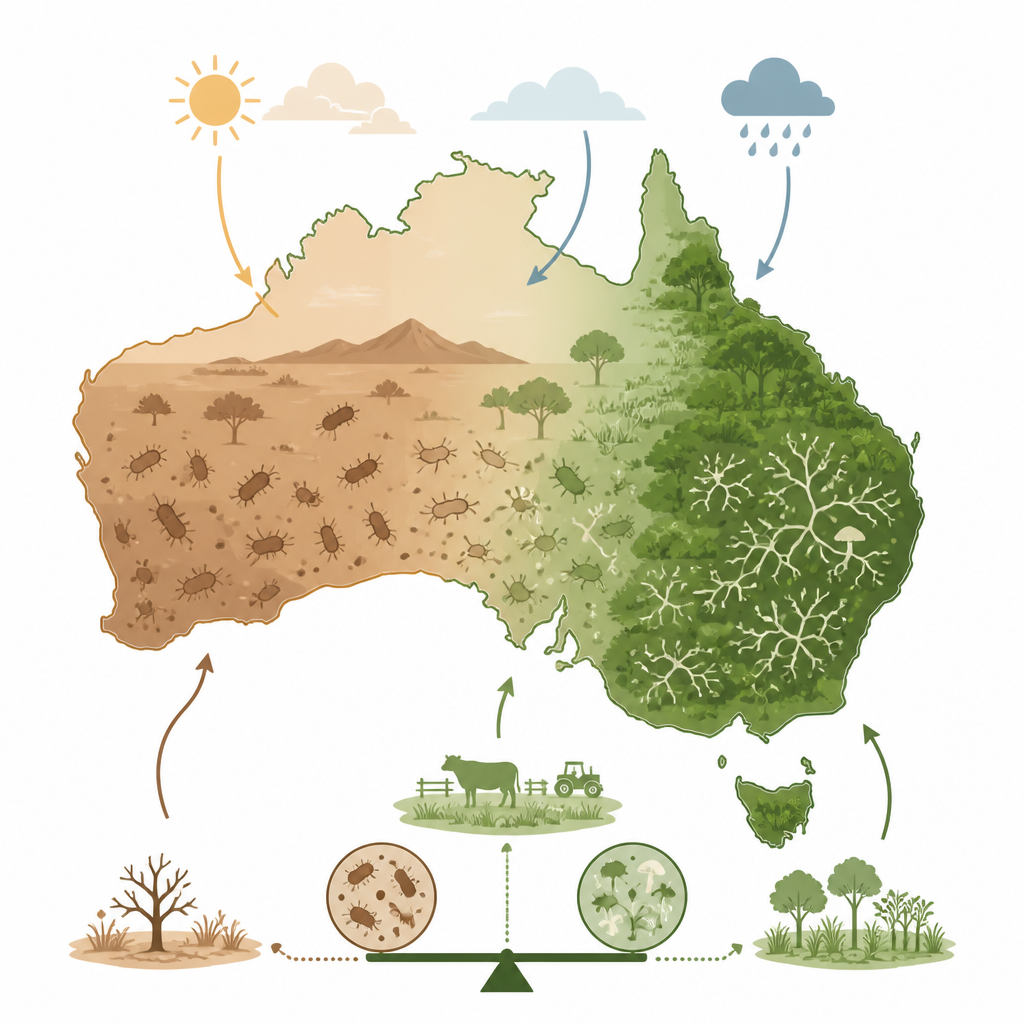
Across Australia, bacteria and fungi did not peak in the same places. Bacterial richness was highest in nitrogen‑rich, topographically varied regions, often in drier landscapes where conditions change sharply over short distances. Fungi were most diverse in wetter coastal areas, tropical and temperate forests, and organic‑rich soils, where plant inputs are steady and moisture is more reliable. Structural equation models confirmed that soil carbon, nitrogen, phosphorus, pH, mineral types, water‑holding capacity, and land use all shape these patterns in different ways for the two groups. For example, higher soil organic carbon boosted fungal richness and shifted the balance away from bacteria, while more arid conditions and higher pH favored bacteria over fungi.
A single ratio that captures shifting soil balance
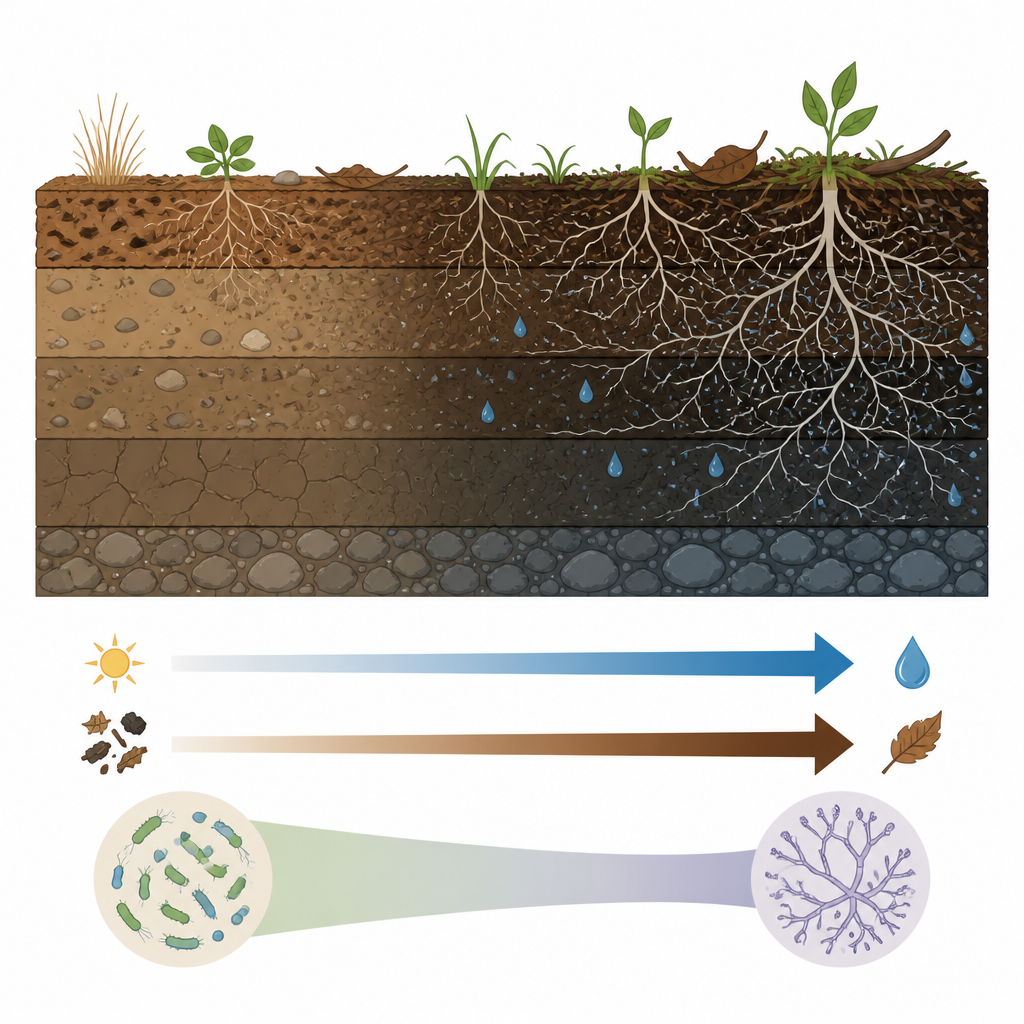
Because bacteria and fungi respond so differently to the environment, the authors proposed a simple indicator: the bacterial‑to‑fungal richness ratio. High ratios, where bacteria dominate in terms of richness, were common in arid and semi‑arid interiors and in some dry, low‑input soils. Low ratios, where fungi dominate, appeared in wetter, cooler, and organic‑rich regions, including many forests and certain fertile or waterlogged soils. When this ratio was viewed across climate zones, vegetation types, land uses, and soil classes, it reflected gradients of aridity, nutrient imbalance, and land‑use pressure. The ratio increased with dryness and rising pH, and decreased with greater water availability and organic carbon, echoing known shifts from faster nutrient turnover in harsh conditions to greater carbon storage in moist, fungal‑rich systems.
What this means for soil health and ecosystem risk
By combining advanced modelling with large‑scale field data, the study shows that bacterial and fungal richness, and especially their ratio, can serve as practical indicators of soil community balance and ecological condition. The ratio does not directly measure how fast nutrients cycle or how much carbon is stored, but it aligns with broad shifts in the dominant ways soils process energy and matter. This makes it a useful early‑warning signal for areas facing rising aridity, nutrient stress, or intensifying land use. The authors suggest that this framework, developed in Australian landscapes, could be tested in other regions to build simple, scalable tools for monitoring soil biodiversity and anticipating how ecosystems may respond as climates and land uses continue to change.
Citation: Viscarra Rossel, R.A., Behrens, T., Bissett, A. et al. Decoding bacterial and fungal richness with autoencoders yields a unified ratio indicating soil health and ecological susceptibility. Commun Earth Environ 7, 407 (2026). https://doi.org/10.1038/s43247-026-03398-y
Keywords: soil microbiome, bacterial richness, fungal richness, soil health, ecosystem vulnerability