Clear Sky Science · en
An integrated strategy maximises cobenefits of conservation and restoration for ecosystem services in coastal wetlands
Why saving coastal wetlands matters
Along the coast of China’s Yellow River Delta, mudflats and marshes quietly store carbon, filter polluted water, and shelter millions of migratory birds. Yet decades of land reclamation, aquaculture ponds, and expanding cities have sliced these wetlands into fragments. This study asks a simple but powerful question: if we plan protection and repair of these habitats together, rather than piecemeal, can we get far more benefit from every dollar spent?
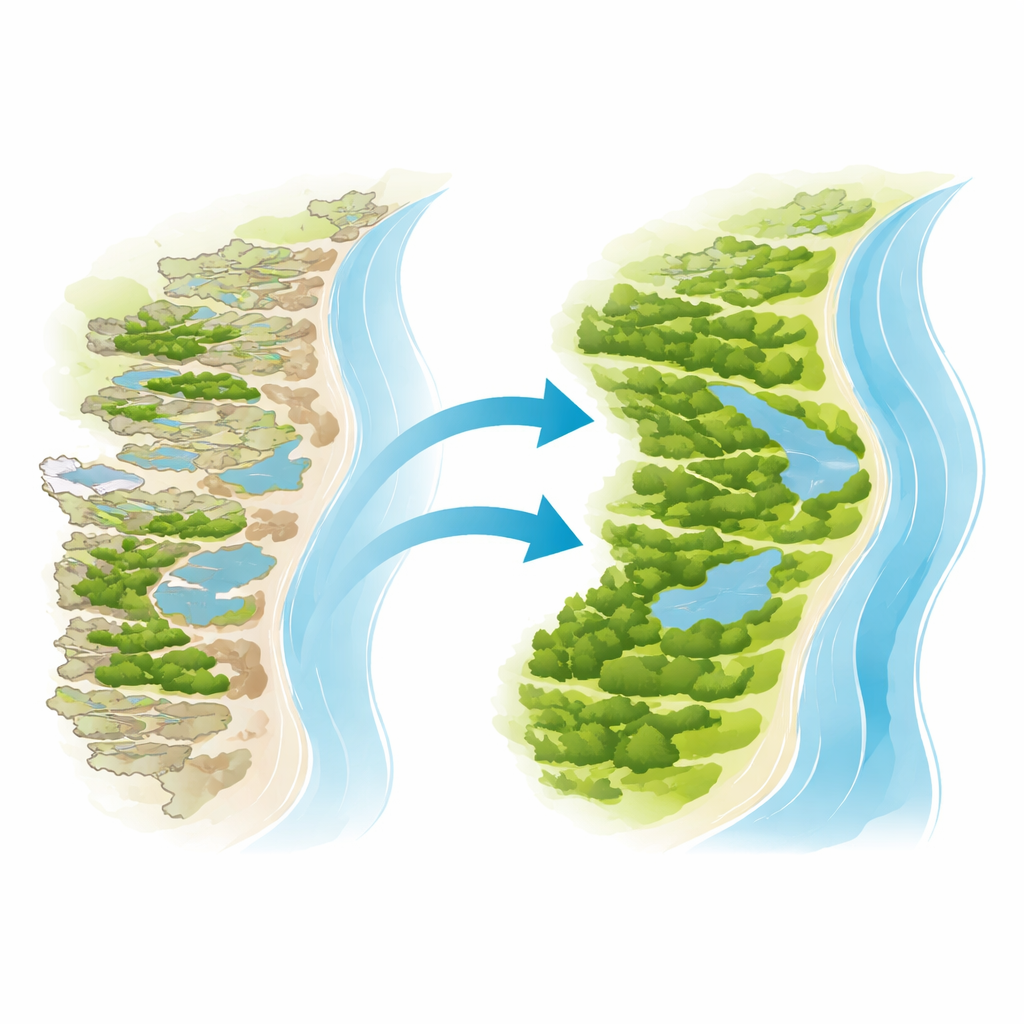
From scattered fixes to a bigger plan
Many coastal restoration projects around the world focus on single sites: filling one pond here, planting reeds there. While these efforts can succeed locally, they often ignore how water, wildlife, and pollution move across an entire coastline. The authors argue that treating conservation (protecting what is left) and restoration (bringing damaged areas back) as separate tasks wastes opportunities. In the Yellow River Delta, a globally important stopover for waterbirds and a storehouse of “blue carbon,” they show that a region-wide plan can better protect nature while remaining realistic about limited budgets.
Mapping damage and room for recovery
The team first retraced forty years of change in the delta, pinpointing “key damaged zones” where natural wetlands had been converted to aquaculture ponds, salt pans, and farmland and where the ability to store carbon, host wildlife, and clean water had declined. They then used elevation data and models of tidal flooding to find places where salt and freshwater marsh plants could realistically grow again, screening out sites that would be too dry, too salty, or too hard to re-flood. This produced a map of where restoration could work in practice, alongside remaining natural wetlands that are candidates for stronger protection.
Letting the computer choose smart combinations
With these maps in hand, the researchers turned to a planning tool widely used in conservation. They divided the delta into a grid of planning units and asked the model to pick sets of cells that would jointly deliver rising “target levels” of three key services—habitat quality, carbon storage, and water purification—while minimizing overall cost. Costs included not only lost income from aquaculture or farming but also the engineering work needed to reconnect sites to water, adjusted for how easy each place would be to re-flood. By gradually tightening the targets from 10% up to 90% of the maximum possible improvement, they watched how the balance between conserving intact sites and restoring damaged ones changed.
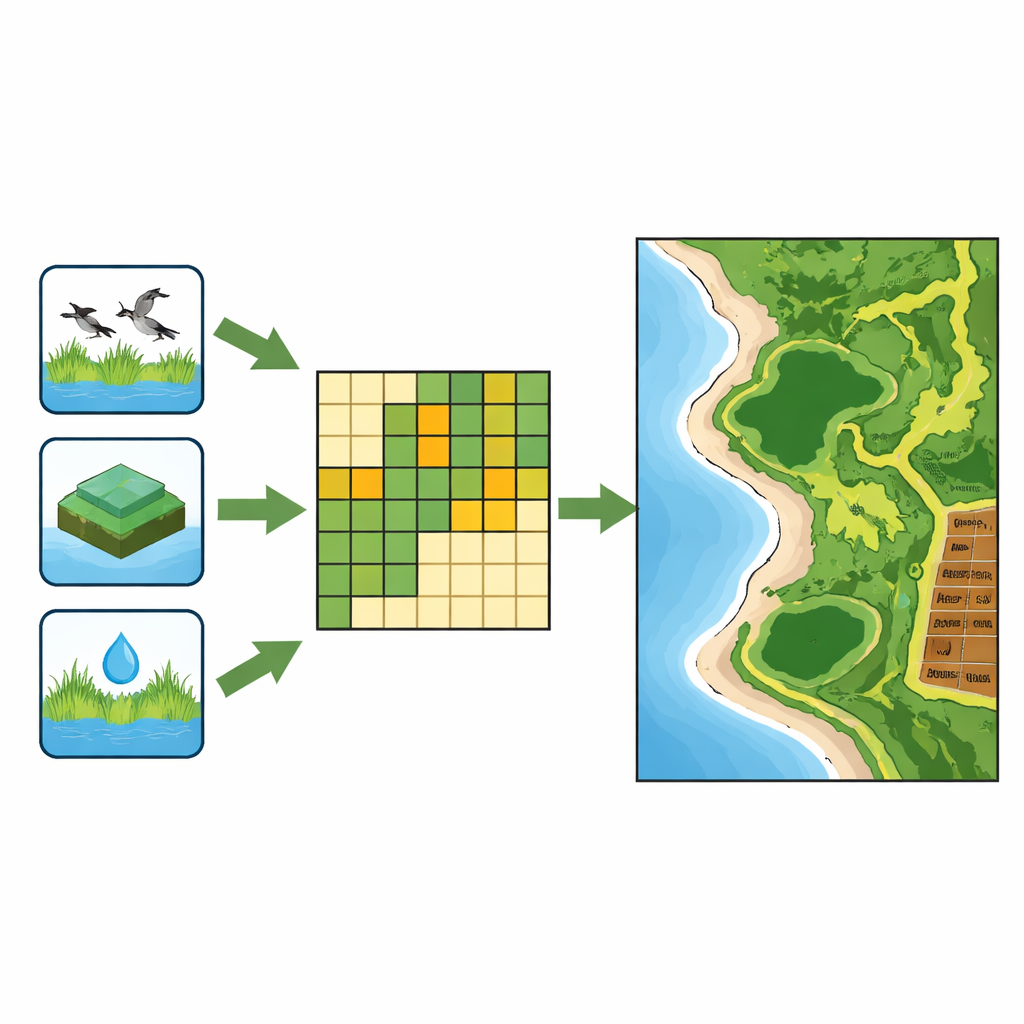
Finding the sweet spot for more value
The model revealed that at low target levels, it is cheapest to lean on conservation: protecting existing high-quality marshes, especially inside the Yellow River Delta National Nature Reserve and along parts of Laizhou Bay. As expectations rise, simply guarding what remains is no longer enough, and restoration of aquaculture and salt fields becomes increasingly important despite higher costs. The standout result was a middle-ground scenario: at about a 50% target for reducing ecosystem service losses, an integrated pattern of protection and restoration raised the total economic value of services by roughly 19% compared with the current situation. Beyond this level, costs climbed faster while gains in benefits started to taper off.
Turning science into on-the-ground action
Building on the optimal 50% scenario, the study sketches concrete guidance for managers. It identifies hundreds of square kilometers of natural wetlands that should be added as strict conservation zones, as well as about 600 square kilometers where restoration would pay off most, chiefly by converting aquaculture ponds and some farmland back to salt marsh and freshwater marsh. Well-connected habitat “cores” would safeguard sensitive migratory birds, while restored patches between them would act as stepping stones. Extra marsh area would lock away millions of tons of additional carbon and could fully treat nutrient pollution from nearby aquaculture, supporting hybrid fishery–wetland systems that pair food production with natural water treatment.
What this means for coasts everywhere
To a lay observer, the study’s message is that smart planning can make every yuan, dollar, or euro invested in coastal wetlands work harder. Rather than choosing between protecting what is left or fixing what is broken, the authors show that blending both approaches under a single, spatially explicit plan can unlock hidden gains in biodiversity, carbon storage, and clean water. Their framework—identifying realistic restoration sites, weighing costs carefully, and optimizing for multiple benefits at once—is designed to be adapted beyond the Yellow River Delta. If adopted widely, such integrated strategies could help embattled coasts around the world stay richer in wildlife, better shielded from climate change, and more livable for people.
Citation: Zhi, L., Li, X., Li, X. et al. An integrated strategy maximises cobenefits of conservation and restoration for ecosystem services in coastal wetlands. Commun Earth Environ 7, 363 (2026). https://doi.org/10.1038/s43247-026-03376-4
Keywords: coastal wetlands, ecosystem services, restoration planning, conservation strategy, Yellow River Delta